Pinta's Teddy Bear
Man on FirePinta's Teddy Bear is a much-patched brown stuffed animal that Pinta keeps beside her in bed. Its worn body and the secret name Pinta withholds make it more than a detail of her bedroom: the bear is a constant in her private world, present as she listens to Creasy's music and again when an injury gives them a reason to speak alone. Through it, the story gives a modest, concrete shape to Pinta's guardedness and to the closeness beginning between the child and her bodyguard.
Appearance and Place in Pinta's Room
The bear is described as very old, brown, and visibly repaired: button eyes look out from a body with so many patches that they hold in the stuffing. It lies beside Pinta on her pillow, close enough to be part of the arrangement of her bed rather than an object set aside in the room. The text does not explain how she acquired it or how long she has owned it. What it establishes instead is habitual nearness: at night the bear is there with her, and when she is hurt it is still at her side.
That nearness makes its worn condition significant without turning it into a stated biography. The patches and exposed stuffing register repeated use; the bear has been handled and kept, not replaced by something pristine. Pinta's attachment is conveyed through these material particulars and through what she does with it. After Creasy has left her bedroom, she switches off the light, hugs the bear, and falls asleep. The gesture offers a private reassurance that contrasts with the formal, careful exchange she has just had with him.
The Bear and the Nightly Music
The bear first appears during a night when Pinta is awake in bed, listening to faint music from Creasy's room. Creasy has played music upstairs, but Pinta cannot make out the words. When one tape ends, another song begins; after it finishes, the same song plays again, and she gradually drifts off. The narrative identifies the plaintive song as Blue Bayou. Beside her, the bear's quiet presence frames this listening as part of her bedtime world, even as the sound from Creasy's room crosses the floor between them.
Later, Pinta works out which song she hears night after night. Directly trying to revive Creasy's old memories has not succeeded, so she notices the repeated music and discovers its source by slipping into his room while he is working on the fence. She reads the tape in the cassette player: Linda Ronstadt's Blue Bayou, the last tape he plays at night. The bear is not shown causing this discovery, but the earlier scene places it beside Pinta as she listens. Together, the recurring song and the familiar object establish a domestic pattern through which she attends to Creasy without pressing him with questions.
The Injury and the Name She Withholds
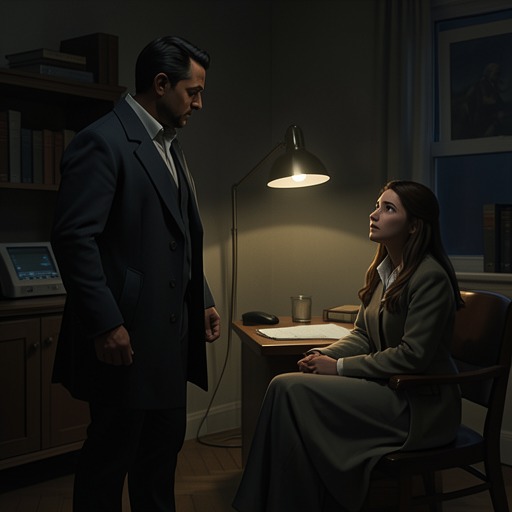
The bear returns after Pinta falls on the steep slope behind the house. She has gone to see the two nightingale chicks Bruno has found in a nest and injures her ankle and side while scrambling uphill. After the doctor finds nothing broken and binds her ankle, Creasy carries her back and later goes upstairs to check that she is comfortable. Pinta is propped against two pillows, with the battered brown bear beside her.
Creasy asks whether she always sleeps with it and what she calls it. Pinta answers that it has no name. The exchange is brief, but it gives the bear a distinct place in their conversation: Creasy has noticed it, and Pinta has to decide what to disclose. Her answer appears straightforward while he is in the room. After he leaves, however, the narration reveals that she lied; the bear does have a name. Pinta hugs it as the painkillers make her drowsy and soon falls asleep.
The name itself is withheld, so the scene does not turn the bear into a fully explained symbol or provide a story about its past. Instead, that small omission preserves a boundary around Pinta's intimate life. She can accept Creasy's practical care and speak with him, yet keep something about the object—and herself—private. The bear's importance lies partly in this double role: it is openly visible at her bedside, but its personal meaning remains hers alone.
Narrative Significance
Across these scenes, the bear connects repeated nighttime listening to a moment of direct contact between Pinta and Creasy. It sits with her while she hears his music, remains beside her when he comes to check on her, and is in her arms when she finally sleeps. The movement is not a transformation of the object; it is a change in what the reader knows about Pinta's relation to it. First the bear is described through its age and repairs, then through her habitual closeness to it, and finally through the small secret of its name.
That sequence also keeps the developing bond between Pinta and Creasy measured rather than sentimentalized. Their exchange over the bear does not erase the distance between them, and Pinta's lie shows that she has not surrendered every private confidence. Yet she allows him to see the object that accompanies her at night, while he approaches it through an ordinary, gentle question. The bear thus marks both connection and reserve: a battered, familiar presence that makes Pinta's solitary listening visible while keeping part of her inner life out of reach.