Pinta's kidnapping and Creasy's shooting
Man on FirePinta's kidnapping and Creasy's shooting turns a carefully assessed protection assignment into a violent failure: Creasy kills two attackers, but the abductors escape with Pinta and leave him gravely wounded. The episode brings together the danger her parents feared, the routes and vulnerabilities Creasy had studied, and the emotional bond made unmistakable when Pinta cries out his name as he falls.
Causes and Preparation
Before the abduction, Rika had pressed Ettore to find a way to keep Pinta safe, invoking the kidnapping of the Macchetti child outside a Milan school in broad daylight. Ettore argued that Pinta was not a likely target because the family was not wealthy; his answer also carried the bitterness of a man whose financial difficulties were becoming known in the city. The disagreement frames the attack as a danger anticipated but discounted, not as a threat the family had never considered.
Creasy approached his new work in military terms. He thought of Pinta as an "asset" an enemy might try to capture, and assessed the house, other regular destinations, and the roads between them as possible points of attack. He judged the road especially vulnerable and planned to vary the daily route at random. That calculation shaped his attention without giving him control over every moment in Pinta's movements.
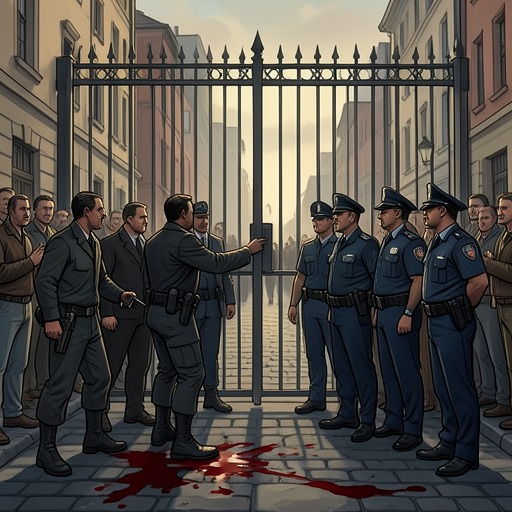
His inspection of the school supplied a concrete contrast between fortified space and exposed approaches. At the entrance, Pinta pulled a metal handle set into the wall; an old watchman opened the gates after speaking with her through a shutter at eye level. Creasy noted the spike-topped walls and the lack of cover outside the heavy gates. Inside, the ivy-clad school stood in spacious grounds, with a playing field and running track on one side and a copse well back from the encircling wall. He judged the school itself reasonably secure. The later attack, however, came as Pinta returned to the car outside an apartment, beyond the school perimeter he had examined.
The Abduction and Exchange of Fire
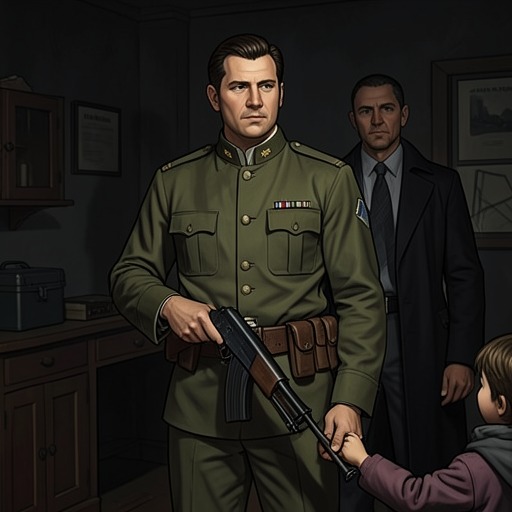
Creasy was seated in his car when the apartment door slammed shut and Pinta began walking toward him. Before she had crossed the distance, a black car came around the corner behind him and drove onto the grass. He saw four men and recognized the attack. Pinta stopped in surprise; Creasy got out quickly, reaching for his gun, and shouted, "Run, Pinta, run!"
The attackers' car stopped in front of Pinta, cutting off her path to Creasy. Two men jumped from the back. Pinta ducked beneath a reaching arm and ran around the car toward her bodyguard, while both men pursued her with revolvers. Creasy tried to line up a shot but hesitated because Pinta stood between him and the attackers. That split-second constraint is central to the scene: his duty was to stop the abductors, but firing through the space she occupied could endanger the person he was trying to protect.
One man caught Pinta, lifted her, and turned toward the car. The other faced Creasy and fired high. Creasy shot him twice in the chest. As the captor struggled to force Pinta into the back seat, she screamed, kicked, and fought him. Creasy closed the distance, but the man finally threw her inside and turned with his gun coming up. Creasy aimed high, toward the man's head, because he feared a bullet might ricochet into the car. The shot struck below the nose and angled upward into the brain; the man's body slammed against the door and closed it.
Three shots then came from the front seat. Creasy went down as the abductors' wheels spun and the car accelerated away. Pinta screamed his name as the vehicle bounced back onto the road. The sequence reverses the apparent advantage of Creasy's training: he identifies the danger, responds with lethal force, and reaches the car, yet the attackers still escape with their intended captive.
Wounds and Pinta's Fate
Creasy could barely move. Stunned by the bullets, he lay in quiet, pain and shock, waiting for help; his immediate hope was simply not to die. What remained with him was not only that Pinta had been taken but the sound of her calling his name. He understood it as anguish because she had seen him fall, not as a cry asking him to save her. The moment makes the protective assignment personal through the child's response at the point of separation.
When Creasy was later in hospital, Guido told him what had happened to Pinta. The ransom had been paid two days before, and she was supposed to have been released that night. When she failed to appear, police found her the next morning in the trunk of a stolen car. A major sweep for a Red Brigade gang had, it was thought, made the kidnappers nervous and driven them into hiding for several hours. Pinta's hands and mouth had been taped; she had vomited, probably from petrol fumes, and the autopsy determined that she had choked to death. Guido described her death as unintentional, but the explanation does not undo the result: a ransom payment and a planned release could not save her after the abduction.
Consequences and Narrative Significance
The shooting leaves Creasy alive but unable to prevent the outcome that his security work was meant to forestall. In the immediate scene, his hesitation is prompted by Pinta's position in the line of fire; moments later, his careful upward aim is intended to keep a ricochet from reaching her inside the car. Those decisions distinguish his violence from indiscriminate firing, but they cannot overcome the attackers' advantage or the abduction already in motion.
The later report sharpens the event's tragic irony. Creasy's preparations focused on likely capture points and the practical vulnerabilities of house, school, and road, while the actual threat became a sudden assault outside the apartment. Even the successful shots do not produce a rescue: one attacker is killed before Pinta is forced into the car, another is killed as the door closes, and the men in the front seat shoot Creasy before escaping. The abduction thus changes the meaning of his assignment from prevention to loss, and Pinta's cry links that physical defeat to the bond between protector and child.