Premium bodyguard
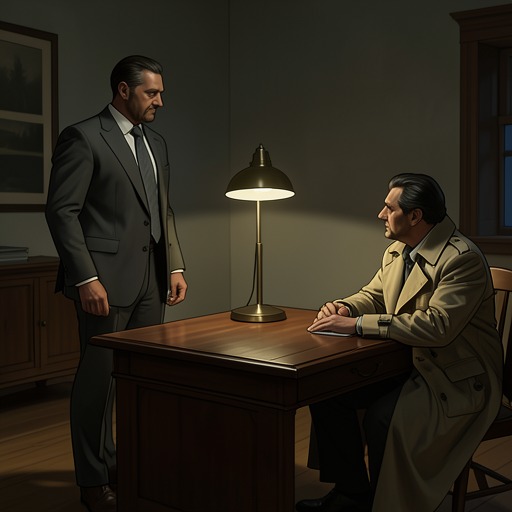
Man on FireA Premium bodyguard is a low-cost guard whose value lies less in stopping a kidnapping than in making an insured client appear to have taken precautions. Vico Mansutti presents the idea as a solution to Ettore Balletto’s immediate domestic and financial problem: Rika Balletto fears for Pinta’s safety, while Ettore says he cannot afford the changes she wants. The proposal initially looks like a modest piece of insurance arithmetic. Its later connection to Pinta’s kidnapping exposes a darker possibility: a safeguard that exists on paper can help make a crime profitable rather than prevent it.
Insurance and the nominal safeguard
Vico introduces the proposal while explaining that kidnapping insurance operates differently from ordinary Italian insurance. Italian insurers are not permitted to write ransom policies, on the reasoning that coverage might encourage kidnapping; foreign insurers can offer it, and Lloyd’s of London is described as a major provider. The policy conditions include paying premiums outside Italy and never disclosing that coverage exists. The secrecy requirement is central to the arrangement: the insurance is meant to protect a family financially without letting kidnappers know that a ransom may be insured.
Vico connects the cost of such coverage to security measures. Ettore has already heard the comparable principle in relation to his factory: providing watchmen or guard dogs can reduce an insurance premium. In Vico’s account, the same logic applies to kidnapping policies, whose high premiums and large insured sums make even a partial reduction worthwhile. His numerical example is hypothetical, not a stated record of Ettore’s eventual premium: on a policy for one billion lire, a five-percent rate would cost fifty million lire; a full-time bodyguard might reduce the rate to three percent, or thirty million, saving twenty million lire.
The apparent saving still fails if the guard costs thirty million lire a year. Vico’s answer is the Premium bodyguard: someone cheap enough to preserve the insurance discount, though not someone expected to foil a kidnapping. In the example, this kind of guard costs about seven million lire annually. The calculation separates protective appearance from protective capacity. The guard’s practical inadequacy is not an accidental flaw in Vico’s proposal; it is compatible with the proposal’s immediate purpose, which is to lower the premium at low cost.
A solution to a family dispute
The idea emerges from Rika Balletto’s insistence that Pinta’s safety cannot be dismissed. She points to the kidnapping of Pepino Macchetti, taken outside his school in Milan in broad daylight, and demands that Ettore find a way to keep their daughter safe. Ettore counters that the family is not rich and is therefore unlikely to attract kidnappers, while his financial problems are already becoming known in the city’s business circles. His response does not resolve Rika’s fear; it sharpens the contrast between her urgent concern and his limited means.
Ettore turns to Vico, his friend and lawyer, expecting him to explain the financial realities to Rika. Vico instead argues that a lawyer’s explanation will not save her face, and recommends hiring a bodyguard. The recommendation initially irritates Ettore, who has just discussed his inability to afford things. Vico’s distinction between an ordinary guard and a Premium bodyguard makes the expense seem manageable: a cheap hire can reassure Rika and, under the insurance logic he has outlined, may reduce the cost of coverage.
Vico’s practical plan is explicitly temporary. Ettore could hire the inexpensive guard for a few months, let Pinta return to school, and then dismiss him for incompetence or some similar reason. The proposed dismissal confirms that the arrangement is not presented as a durable security system. It is designed to satisfy appearances and calm the immediate household crisis while fitting Ettore’s limited budget. When Ettore asks where to find such a man, Vico says he has the name of an agency in Milan.
Creasy as the hired guard
The agency connection brings Creasy into the arrangement. Elio, who works for an auditing firm in Milan, tells Guido Arrellio that one of his clients is a security agency supplying bodyguards to industrialists. Trained guards are in short supply and well paid, but Creasy is, at this point, in no condition to take an ordinary protective job: he is described as unfit and virtually an alcoholic. Guido doubts that he would accept work under false pretenses. Elio’s explanation that the position is for a Premium bodyguard changes the calculation; the pay is poor, but Guido knows Creasy has money of his own and suggests the job to him.
Creasy nevertheless approaches the assignment as real protection. He thinks of Pinta as an asset that an enemy might try to capture, and applies military experience to the problem. He considers an attack at the house, at another regularly used location, or on the route between them. On a map of the area between Milan and Como, he studies roads, identifies likely ambush points, and plans to vary the route to Pinta’s school. At the school, he notes the spike-topped walls, the heavy gates, the old watchman, and the open ground before the entrance; after inspecting the grounds, he judges the school itself reasonably secure. His method gives the nominal post genuine operational substance, even though the original proposal had depended on hiring someone expected to do little to prevent a kidnapping.
That difference becomes consequential when the kidnapping attempt takes place. As Pinta approaches the car, a black car mounts the curb and four men appear. Creasy recognizes the attack, orders her to run, and draws his gun. When one kidnapper catches Pinta, another fires at Creasy; he shoots that man twice in the chest. The scene shows the gap between the cheap hire as Vico had described it and Creasy’s actual conduct: Creasy does not function merely as a figure on an insurance application, but acts under immediate threat. The attackers nevertheless take Pinta.
Exposure and reversal
After the kidnapping and Pinta’s death, the arrangement is first exposed to Rika in personal terms. When Guido visits the Balletto household in Como, Rika learns that Creasy had been hired for a pittance merely to appease her. Furious, she condemns the choice of a drunk to protect her daughter. Her anger registers the original arrangement as a failure of care, not simply a disappointing purchase: the gesture intended to save face has not delivered the protection she believed it promised.
Later, Creasy tells Rika what he has learned from Fossella, transforming the meaning of the policy and the guard. The kidnapping was a setup for insurance money. Ettore had taken out a two-billion-lire policy with Lloyd’s of London; Fossella was to return half the ransom to Ettore, and Vico had acted as intermediary, taking a commission through his organized-crime connections. Rika listens without taking her eyes from Creasy, then turns toward Ettore with hatred. The disclosure makes the earlier financial explanation look radically different: insurance, secrecy, the nominal bodyguard, and the family’s concern for Pinta belong not merely to a plan for managing risk but to a scheme that exploited those arrangements.
The concept therefore turns on a distinction between the appearance of protection and protection itself. Vico’s example treats the guard as a lever in an insurance calculation; the temporary hire is meant to reassure Rika and reduce expense, not to provide strong defense. Creasy’s vigilance and gunfire briefly contradict that limited role, while the later revelation places the insurance arrangement inside a criminal conspiracy. The Premium bodyguard is thus more than a cheap employment category in the plot: it marks the point where a financial instrument can be made to look like family protection, and where that appearance conceals the betrayal of the person it was supposed to safeguard.