The body as a weapon
Man on FireThe body as a weapon is Creasy’s practical model of physical life: the body is an instrument to be trained, repaired, and kept responsive to the mind. His work protecting Pinta gives that principle a new purpose. The same attention that once belonged to military readiness becomes care for a child and, eventually, an effort to recover his own neglected strength. Yet the kidnapping exposes the model’s limits: a body can be prepared and quick to act, but it cannot make danger simple or guarantee that protection will succeed.
A military model of the body
When Creasy takes the protection job, he has never worked as a bodyguard, but translates it into familiar military terms. Pinta is the asset to be protected; the possible attack is a capture attempt, and the relevant terrain includes the house, other places she regularly visits, and the route between them. He studies where a kidnapper might strike and judges the road especially vulnerable, since a vehicle could exploit predictable travel. His planning turns bodily protection into a problem of anticipation: the protector must read space from an adversary’s perspective before an attack begins.
That outlook shapes his inspection of Pinta’s school. On the drive there, he looks for bends where a car would have to slow and for stretches away from buildings. At the gates he notes the high, spike-topped walls and the lack of cover outside; inside, he surveys the grounds, including the playing field, running track, and copse. The school seems reasonably secure, but security is not an abstraction to him. It is a set of physical arrangements through which a vulnerable person moves—and through which a protector must remain alert.
Care as physical discipline
Pinta’s ankle injury and the approaching sports meeting redirect Creasy’s attention from threat assessment to training. He makes starting blocks and sets them on the front lawn, then practices starts with her in a blue-and-white tracksuit. He explains reaction time as a chain running from the ears, through the brain, to the nerves in the limbs. The lesson is not simply to anticipate the starting gun; she must concentrate on its sound without consciously waiting for it, so that the response becomes automatic. He claps his hands to imitate the gun, and after an afternoon of practice she is rising quickly from the blocks.
The exercise gives bodily training a different emotional direction. Creasy insists that they practice every day for an hour and tells Pinta she will win on the big day. His close attention to her movements is still disciplined and technical, but it now serves her development rather than a combat objective. Watching the child’s energy and fitness also makes him consider his own condition. He plans that, once his job is confirmed after three months, he will find a gym in Como or Milan and exercise a couple of evenings a week. The prospect of physical recovery emerges through his involvement in Pinta’s future.
Decline and rebuilding
Creasy’s own body has not remained the reliable instrument he expects. After recognizing that his reactions have become dull, he understands the danger starkly: if he had been slower, Rika would have been dead. He has long cared for his body as he cared for his other weapons, nursing it after injury and exercising its parts so that they remain responsive to his brain. But the comparison also reveals what has gone wrong. A body cannot be cleaned, burnished, or lubricated like a gun; neglect has accumulated as slackness and lost muscle tone, visible to Guido, who knew him in earlier days.
Recovery therefore means rebuilding rather than simply polishing an existing machine. Creasy expects a long, painful process: ten minutes of circuit training in his room each morning at first, followed gradually by more demanding work in a gym with weights and bars. He believes it will take months, but also that he has caught the decline in time. This measured plan contrasts with the fantasy of instantly restoring a weapon to perfect condition. The body is material, slow to recover, and subject to the effects of neglect even when its owner understands its importance.
The limits of the weapon
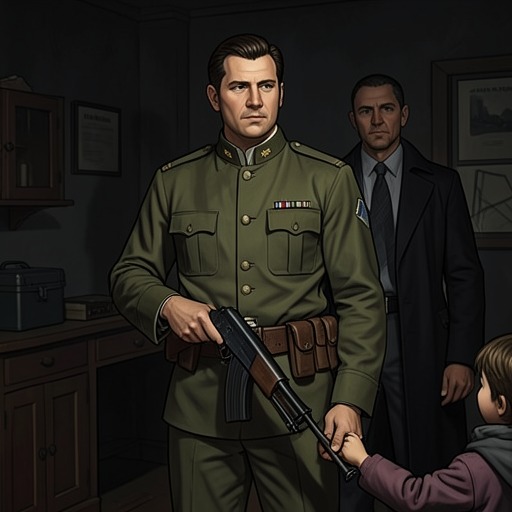
The kidnapping makes those limits immediate. As Pinta approaches the car, a black car comes around the corner, mounts the curb, and reveals four men. Creasy recognizes the attack and rushes from his own car, reaching for his gun. He calls for Pinta to run. When she darts around the kidnappers’ car toward him, her position obstructs his aim; he hesitates rather than risk shooting her. One man grabs and carries her away, while another fires high at Creasy. Creasy shoots that man twice in the chest.
The sequence distinguishes physical readiness from control over the outcome. Creasy reacts quickly enough to fight, but the protective purpose of his body and weapon imposes a constraint: he cannot take an unimpeded shot while Pinta is between them. Later, Guido tells him that the ransom had been paid and that Pinta was supposed to be released, but the kidnappers hid during a police sweep connected to a Red Brigade gang. She was found in the trunk of a stolen car; taped at the hands and mouth, she had vomited, probably from petrol fumes, and choked to death. The disclosure makes bodily vulnerability the terrible counterpoint to Creasy’s ideal of bodily readiness. His disciplined body can confront an attacker, but it cannot undo the conditions that killed the child he was hired to protect.