
The Weight of Toil
Martin EdenThis thread examines how labor can sustain survival while also consuming the time, health, and imagination needed for a meaningful life.
increasing Bearing strength in each event
 decreasing
Bearing strength in each eventdecreasingWork as Familiar Life

Labor Before Reflection
An inherited routine
Martin’s childhood and youth are shaped by work, from jobs and voyages to his family’s struggle to survive. Labor is an ordinary condition, not yet an object of analysis.
A later question
Meeting Ruth and entering the world of books makes Martin compare different forms of living. Work becomes a question of what it enables and what it takes away.
The Laundry’s Mechanical Day
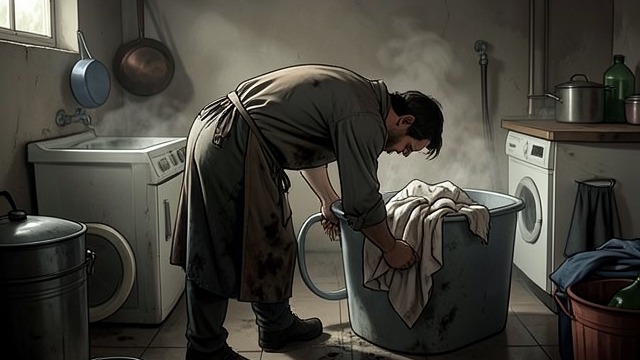
The Worker as Machine
Motion replaces thought
Laundry tasks demand speed and accuracy in a hot, exhausting room. Martin’s attention contracts to the next garment, leaving no space for reading or reflection.
A human cost
The work produces clean linen for comfortable hotel guests while exhausting the people who process it. The contrast makes the labor’s social arrangement visible.
The Habit of Drinking

Relief Follows Exhaustion
A shared pattern
Joe drinks after laboring beyond his limits, and Martin eventually does the same. Both seek a temporary return of feeling after weeks in which fatigue has suppressed thought and pleasure.
Cause and consequence
Martin comes to understand drinking as a response to the work regime, not its origin. The insight shifts his criticism from individual weakness toward the conditions that produce it.
The Choice to Leave

Survival Beyond the Job
Martin’s departure
Martin leaves to pursue writing, convinced that another kind of work can preserve his intellectual life. Joe turns instead toward the freedom of the road.
Different answers
Neither man believes the laundry’s wages justify its demands. Their choices question the assumption that earning a living is sufficient proof that a life is being well lived.
Work and the Final Emptiness

Achievement Without Appetite
A completed career
Martin’s writings eventually earn wealth and wide recognition. The work has achieved what he once demanded of it as a means of survival and social mobility.
No restored vitality
The completed achievement does not return the desire that sustained him. The novel leaves the relation between productive work and meaningful life unresolved, showing that success cannot repair every form of exhaustion.
In Martin’s early memories of working-class life
During Martin’s weeks of laundry employment
After repeated weeks of overwork
When Martin and Joe decide to quit the laundry
After Martin’s literary work has been completed and sold
