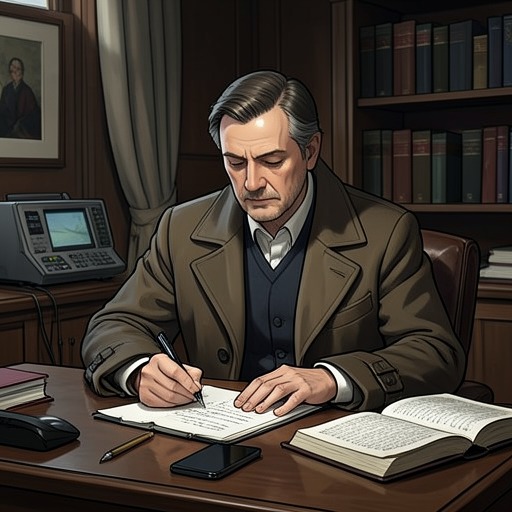
A dog asleep in the sun
Martin EdenA dog asleep in the sun is Martin Eden’s metaphor for possessing rich inward visions but lacking the words to communicate them. The image marks a turning point: what first feels like a painful limit becomes a recognition of the work he must undertake to become a writer and make his imagination available to Ruth Morse.
The Image and Its Occasion
The image arises while Martin is explaining that he intends to educate himself independently, at a pace he believes a classroom could not match. Ruth Morse answers with a proverb about traveling fastest alone. Martin wants to tell her that he would travel faster with her, but the thought opens into a vision he cannot yet express: the two of them moving through sunlit spaces and starry reaches, her hair blowing across his face.
The scene makes the gap between experience and speech bodily and immediate. Martin feels a sharp yearning to paint the vision in words, while recognizing that his language cannot make Ruth see what he sees. He imagines dogs asleep in the sun, whining and barking without being able to tell what has stirred them; then he identifies himself with one of them, able to see beauty but able only to bark at Ruth.
From Wordlessness to Expression
The comparison does not present Martin’s inability as an absence of imagination. His mind is crowded with noble and beautiful visions; what he lacks is command of expression. He understands that great writers have learned to make words obedient and to combine them so that their meaning exceeds the sum of their separate parts. The dog’s noisy but inadequate response thus distinguishes having an experience from giving it communicable form.
Martin’s realization changes the image from self-accusation into a declaration of effort. He resolves to stop sleeping in the sun, stand with open eyes, and struggle, toil, and learn until he can share the wealth of his vision. His first words after the reverie, “I have had a great visioning,” surprise him because they seem to give an adequate name to the pause that has overtaken him. The small success makes the larger craft appear attainable, without suggesting that he has already mastered it.
The Image as a Writing Vocation
The recognition immediately redirects Martin’s thoughts toward his writing. He recalls his article, “Pearl-diving,” and sees that it would need to become something different if he dared to put into it the beauty burning within him. He asks himself why he cannot render that beauty in verse as the poets do, then turns to the mysterious delight and spiritual wonder of his love for Ruth Morse as another subject he longs to sing.
The image therefore connects self-education to artistic vocation: Martin’s aim is not merely to acquire learning, but to acquire the means of expression. Its emotional force comes from the contrast between an intimate vision he longs to share and the speech that currently fails him. The dog asleep in the sun names that impasse, while Martin’s resolve to rise and learn points toward the labor he believes can overcome it.