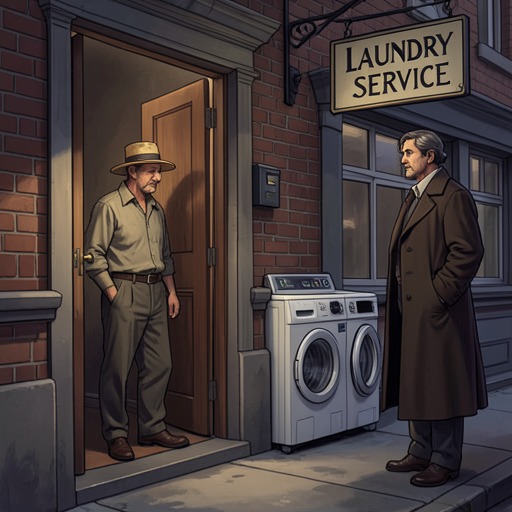
Brissenden writes and entrusts Ephemera to Martin
Martin EdenBrissenden’s presentation of Ephemera turns a private act of artistic sharing into a test of what art is for: Martin Eden sees a poem that must reach the world, while Brissenden insists that his greatest work belongs to him and need not submit to the marketplace. The scene joins admiration, refusal, literary counsel, and an unexpected gift, while making the poem’s immense scale echo the fragile life from which it has emerged.
The manuscript and its making
After a long absence that he does not explain, Brissenden meets Martin with his cadaverous face visible across the steam rising from a tumbler of toddy. Martin tells him about the work he has accomplished; Brissenden replies that he, too, has been working, and draws a manuscript from inside his coat. He passes it to Martin, who first reads the title and looks up in surprise.
Brissenden says Martin is responsible for the title and connects it to Martin’s conception of man as a temporary creature, strutting briefly within the limits of existence. The idea had lodged in Brissenden’s mind until he had to write it out. He presents the poem for Martin’s judgment, making the encounter both a sharing of the finished work and an invitation to respond to it.
The poem is six or seven hundred lines long. As Martin reads, his flushed face pales; he is overwhelmed by its construction and beauty, and tears and chills accompany his response. Its subject ranges across humanity and the soul’s attempts to understand itself, looking outward to distant suns, space, and cosmic conflict. Against that scale, the human voice remains frail: a small, persistent cry set amid the immense violence and motion of the universe. The poem’s vision thus holds two measures together—the vastness of the cosmos and the almost vanishing human being who continues to question it.
Martin’s response and Brissenden’s refusal
Martin praises the poem as an achievement without parallel in literature. Its account of the human voice amid cosmic immensities obsesses him; he reaches for images of a gnat’s thin cry against the noise of larger creatures to convey how minute yet insistent the poem’s human longing seems. He calls Brissenden a true artificer and says that the work joins truth to rhythm and beauty. The force of his admiration briefly makes him doubt his own writing, which he dismisses in comparison, before he offers to market the poem himself.
Brissenden expects no magazine to risk publishing it. Martin rejects that judgment and wagers that a magazine will accept it within one or two submissions, insisting that editors would recognize an extraordinary poem. Brissenden declines the bet, not because he doubts the work’s scale, but because he refuses to expose it to the editors he despises. He calls it his swan song, the greatest thing he has done, and the realization of an ideal he had held as a young man. He is proud of it and will not have it pawed over or soiled; he has made it and shared it with Martin, but will keep it as his own.
Martin argues that beauty should bring joy to the rest of the world. Brissenden answers that it is his beauty. His refusal puts the poem’s public value and private possession into direct conflict: Martin treats publication as the natural extension of an achievement, whereas Brissenden sees the act of withholding it as protection from a literary marketplace he hates. Martin denounces his stance as fanatical and selfish, but Brissenden accepts the charge with sardonic composure and continues to condemn magazine editors. Their disagreement does not undo the intimacy of the exchange; it shows that sharing a work does not mean surrendering authority over its fate.
Advice for Martin’s work
Brissenden asks Martin to type the manuscript for him, then draws out Martin’s own bulky manuscript, The Shame of the Sun. He has read it three times, a repeated reading he presents as the highest compliment he can give. Although he holds back after Martin’s praise of Ephemera, he predicts that Martin’s book will make a hit and provoke a controversy valuable for the publicity it generates.
His advice is pointedly different from Martin’s proposal to submit the work to magazines. Brissenden recommends approaching first-class publishers, where a reader might judge it favorably, and urges Martin to seek a publisher soon. He argues that Martin has absorbed the substance of the books he has read and transformed it through his own mind into The Shame of the Sun. The forecast of future fame is Brissenden’s judgment, not a reported outcome of this exchange; in the moment, his practical counsel contrasts with his refusal to make his own poem available.
The parting gift and immediate consequences
Brissenden leaves late that night. As he boards the car, he suddenly turns back and presses a small, tightly crumpled wad of paper into Martin’s hand, saying he had been at the races and had the right information. Only after returning to his room does Martin unroll the greasy paper and discover a hundred-dollar bill. The gift arrives without a formal explanation of its purpose, but Martin accepts it, confident that his future success will allow him to repay his friend.
The money immediately changes Martin’s circumstances. In the morning he pays every bill, advances Maria three months’ rent, and redeems all his pledges from the pawnshop. He buys Marian a wedding present and chooses Christmas presents for Ruth and Gertrude. With what remains, he takes the Silva family into Oakland, fulfilling a promise he had delayed: every member, including the youngest, receives shoes, while the family also gets toys, candy, and nuts. The money Brissenden gives as he departs therefore becomes not merely assistance to Martin but the means for Martin to discharge debts and extend generosity to others. The exchange leaves both men’s work in view—one poem deliberately kept from public judgment, one manuscript urged toward publication—alongside a gift whose consequences are enacted in Martin’s care for the people around him.