Delirium
Martin EdenDelirium is the state in which Martin Eden’s illness transforms the pressures of debt, laundry work, and uncertain writing income into a looping series of confused visions. Ordinary objects and amounts become an ordeal to interpret: bills appear beneath his eyelids, cuffs carry debts, and checks circulate through an imagined laundry. The visions do not resolve his material troubles; instead, their repetitions expose how completely those troubles have occupied his mind. The state ends not through a solution to the debts, but when Maria Silva hears him groaning and comes to his aid.
Entry into the illness
Martin has received a letter at two in the afternoon. While trying to make sense of the sums recurring in his thoughts, he loses track of time; when a knock at the door and Maria Silva’s question bring him back to himself, the room has grown dark. He answers that he has merely been napping, in a muffled voice he does not recognize. The discrepancy between his impression of a brief rest and the passage from afternoon into night is an early sign that his sense of time and self has become unreliable. He then recognizes that he is sick, but this recognition does not free him from the mental circuit that follows.
The opening visions are anchored in exact amounts. One figure recalls the grocer’s bill; another eventually resolves into the two dollars and a half owed to Maria Silva. Martin treats identifying each sum as an urgent task, as though finding the right creditor could settle the larger disorder. Even the relief of remembering Maria Silva’s debt is temporary: another amount appears and sends him searching through memory again. His thinking is organized around obligations, but illness makes the act of accounting laborious and bewildering rather than clarifying.
The laundry becomes a world of debt
The visions next place Martin at a mangle, feeding starched cuffs. He initially mistakes the printed figures on them for a new way of marking linen, then recognizes a familiar debt in the amount on one cuff. The bills become part of the machinery, revolving around the drum. Imagining that he can escape payment by throwing them away, he scatters them onto the floor. He intends to pay only Maria Silva, whose debt he believes she will not press, and searches through the growing heap for her bill. The sequence turns a particular financial worry into a task that expands beyond his control: the bills multiply, yet the one he means to honor remains difficult to find.
A hotel manager appears in the vision and threatens to deduct the cost of the cuffs from Martin’s wages. The cuffs rise into a mountain, and Martin imagines being bound to work for a thousand years to pay for them. This episode joins the fear of debt to the labor that produces wages: even his attempt to escape payment generates another imagined liability. The scene’s exaggerated scale belongs to the delirium, not to an actual confrontation. Its movement from discarded bills to an immense pile of work makes the laundry feel like a closed system in which every effort to get free creates a further obligation.
Checks, manuscripts, and repetition
The mangle returns, but its material changes. An editor feeds cuffs toward Martin, and each cuff is now a check. He examines them in anxious expectation; for what feels like an immense stretch of time, they are all blank. When one finally bears five dollars, he reacts with anger and imagines attacking the editor. Before that action can proceed, the scene shifts: he finds Joe starching manuscripts and tries to stop him. The writing career and the laundry have become inseparable images, with manuscripts treated as work moving through the same machinery as linen and payments.
The vision then reverses the scale of the checks. Instead of a single small payment among blanks, checks of at least a thousand dollars fall like snow. Martin sorts them into bundles of a hundred and ties the bundles with twine. This imagined abundance does not settle into a stable escape from want. Joe juggles irons, shirts, and manuscripts, adds bundles to a flying circuit, and eventually draws Martin into it. Martin repeatedly circles with manuscripts in his arms, while a child’s song accompanies the rotation. The contrast between the five-dollar check and the immense checks is stark, but both belong to an uncontrolled cycle: money, writing, and labor keep moving without bringing Martin to rest.
Interruption and recovery
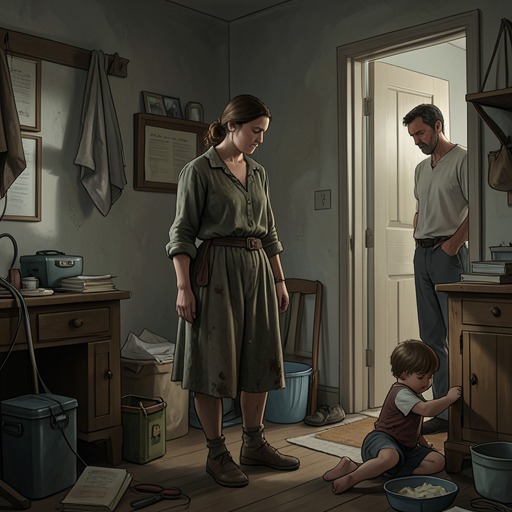
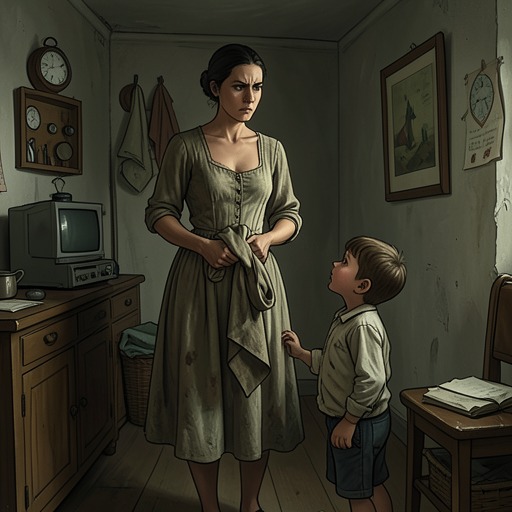
The cycle ends when Martin hears Maria Silva enter his room at two in the morning. She has heard his groans through the thin partition and comes to care for him, placing hot flat-irons against his body and damp cloths on his aching eyes. This is not part of the imagined laundry machinery: her intervention marks a return to the actual room and to another person’s attention. The transition also contrasts the impersonal pressures recurring in his visions with the immediate help offered by Maria Silva.
Martin does not go out to look for work the next morning. He remains delirious until late afternoon, when he regains consciousness and looks around the room with aching eyes. Mary, an eight-year-old member of the Silva family, has been keeping watch; Maria Silva hurries in from the kitchen and checks Martin’s forehead and pulse. The episode thus extends beyond the night’s visions into a period of illness during which others attend to him. Its narrative force lies in the return of the same concerns—debts, wages, writing, and work—in distorted forms, followed by a recovery made visible through the practical care of the household.