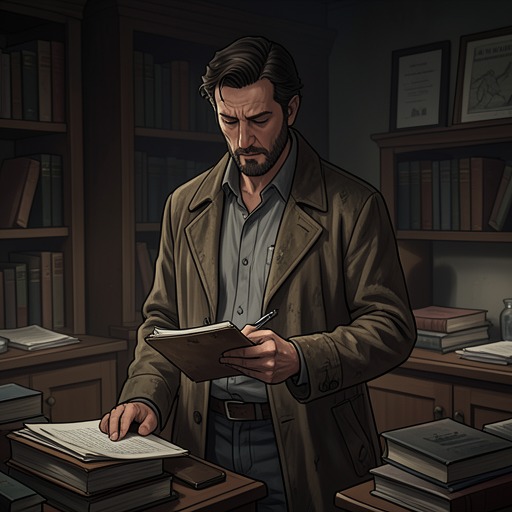
God and Clod Schools of Fiction
Martin EdenThe God and Clod Schools of Fiction name the two opposing, equally incomplete accounts of human nature that Martin Eden sets against his ideal of fiction. One treats people as godlike and forgets their earthly origins; the other treats them as mere clods and ignores their dreams and higher possibilities. Martin’s alternative is an impassioned realism that keeps both dimensions in view, refusing to separate human aspiration from the life that gives it substance.
The Two One-Sided Schools
As Martin understands them, the schools differ not simply in subject matter but in what each leaves out. The god school attends to humanity’s elevated possibilities while overlooking its material beginnings. The clod school fixes on the brute and earthly, denying the dreams and possibilities that reach beyond it. Each errs through excessive singleness of vision and purpose: neither account can represent a person fully on its own.
Martin does not resolve the opposition by simply choosing the more flattering portrait. The compromise he considers closer to truth refuses to flatter the god school, while still challenging the clod school’s brute savagery. Its balance is not a bland midpoint: it preserves the force of earthly reality without allowing that reality to cancel human aspiration.
Martin’s Alternative: Impassioned Realism
Martin’s broader artistic aim is to depict life as it is while retaining its spirit-groping and soul-reaching. He wants realism joined to the fancies and beauties of imagination, with human aspiration and faith running through the representation. The God and Clod distinction therefore supplies a standard for judging fiction: truth requires more than physical or social facts, but elevated ideals become false when detached from the conditions of human life.
This standard also explains Martin’s distrust of artistry when it is separated from humanness. He regards his horror stories as imaginative and fantastic, their grotesque or impossible material given the glamour of reality. He recognizes their skill, but considers that realism an effective trick rather than the foundation of great literature: artistry alone cannot make such work fully human. For him, the test is not whether a story can make the fantastic seem real, but whether its form holds reality and human possibility together.
Works, Practice, and Reception
Martin expresses the general argument in an essay titled God and Clod, and sees his story Adventure as having achieved his ideal of truth in fiction. The novel also names Joy, The Pot, and The Wine of Life among the works he considers part of his later, higher achievement. These works represent his effort to move beyond the early writing he valued chiefly for the money it brought, toward fiction shaped by artistic discipline without surrendering strength or realism.
That ambition meets a practical contradiction: Adventure and the other work he regards as best continue to go begging among editors. His theory thus distinguishes literary worth from market acceptance. The work that most closely embodies his ideal does not secure publication, while the horror stories he considers lesser work have sold. The God and Clod Schools of Fiction are consequently more than a classification of literary styles: they articulate the artistic measure Martin applies to his own career, even as the editorial market fails to reward the fiction that best meets it.