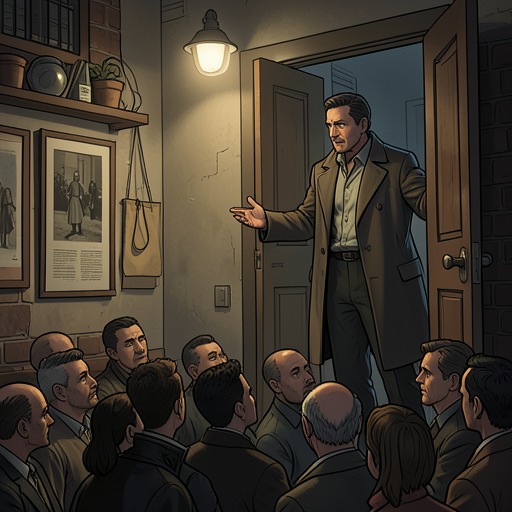
Hamilton
Martin EdenHamilton is a labor organizer and participant in a working-class philosophical discussion whose brief appearances reveal an unusual combination of political initiative, intellectual confidence, and reluctance to sustain an undertaking. He helped plan and precipitate a cooks’ and waiters’ strike, yet did not remain with the union; later, in Kreis’s rooms, he joins Kreis in challenging Norton’s idealism and metaphysics. Through these contrasting episodes, Hamilton appears capable of organizing collective action and forceful debate, but not inclined to devote himself to either for long.
Identity and Background
Hamilton is introduced by Brissenden among a circle of working-class people with interests and abilities extending well beyond their jobs. The others include a restaurant dishwasher with theosophical interests, an exceptionally knowledgeable statistician, a stone-mason who has opinions on many subjects, and a baker committed to socialism and unionism. Hamilton is identified as the man who organized the cooks’ and waiters’ union and set the strike in motion. Brissenden’s account places him within a social world where intellectual discussion and practical organizing coexist with ordinary wage labor.
His identity is therefore conveyed less through personal history than through two kinds of competence: he can plan a labor action, and he can enter a sustained argument about philosophy. The novel supplies no fuller biography in these scenes. Instead, Hamilton is drawn through what he has done and through his place in the informal community that Martin encounters with Brissenden.
Organizing and Labor Politics
Hamilton planned the union’s strike in advance, using Kreis’s rooms as the place where the action was laid out. The account makes him a significant organizer: the strike did not simply arise spontaneously, but was prepared through deliberate planning. Yet Brissenden also says Hamilton undertook it for the fun of it and was too lazy to stay with the union afterward. The gap between initiating collective action and remaining to support the organization is central to this brief portrait.
Brissenden frames that inconsistency as a waste of ability. In his view, Hamilton could have risen high if he had chosen to apply himself, and there was no limit to his possibilities apart from his formidable laziness. This is Brissenden’s judgment, not a record of Hamilton’s own explanation. The contrast nevertheless gives Hamilton a distinct place among the people introduced: he has demonstrated that he can plan and mobilize, but his initiative does not become sustained commitment. The strike episode thus presents both his effectiveness and the limit Brissenden sees in it.
Philosophy in Kreis’s Rooms
Hamilton appears again during the discussion Martin attends at Kreis’s rooms. Kreis begins questioning Martin, but Norton joins in, and the exchange develops into a contest between Norton and the men associated with a more materialist, fact-oriented position. Hamilton is one of Kreis’s partners in that argument. The gathering is presented as intellectually animated rather than as a formal lecture: the participants follow the dispute closely, and philosophical concepts are contested among people whose working lives include trades and service occupations.
The disagreement turns partly on what counts as a sound way to reason. Kreis and Hamilton treat Norton as a metaphysician; Norton, in turn, accuses them of reasoning from words and theories rather than adequately confronting philosophical questions. Their approach is characterized as beginning with facts and assigning names to them. The dispute is not reduced to a simple opposition between people who think and people who do not: Martin is struck by the seriousness and animation of the discussion, and recognizes philosophy as something these participants actively argue over rather than merely encounter in books.
Hamilton’s own contribution is identifiable in a specific exchange about the Law of Parsimony. Norton invokes the principle, and Hamilton’s side immediately claims it for its own reasoning. That response shows him participating in the conceptual contest, though the episode does not provide a separate, extended account of his personal system. Much of the detailed case against positive science is made by Norton; it should not be mistaken for Hamilton’s speech. Hamilton is present as one of the opponents Norton addresses, not as the speaker responsible for every claim in the debate.
Narrative Role and Characterization
Hamilton’s two appearances establish a pointed parallel: he has helped organize a union and he takes part in an ambitious philosophical argument, yet Brissenden’s portrait emphasizes how readily he leaves an enterprise unfinished. The novel does not show the strike itself or explain the subsequent course of the union, and Hamilton’s part in the evening’s debate is narrower than Norton’s. What it does show is a man whose capabilities are recognized by others, while sustained application remains in question.
His presence also broadens Martin’s encounter with working-class life. The people in Kreis’s rooms are not presented only by occupation: they bring specialist knowledge, political commitments, and competing accounts of how the world can be known. Hamilton belongs to that mix as both an organizer and a discussant. When the last ferry to Oakland is due, Martin and Brissenden leave while Norton continues arguing and Kreis and Hamilton remain poised to answer him. The conversation continues beyond Martin’s visit, but the scene offers no further resolution of Hamilton’s position or of his longer-term choices.