Joe Dawson quits the laundry and takes to the road
Martin EdenJoe Dawson’s departure from the laundry turns an impulsive declaration into a deliberate break with the routine that has exhausted him. After a telegram prompts Martin Eden to prepare for a change, Joe elects to leave too—not to follow Martin to sea, but to take to the road. His choice culminates in a last week at the laundry, a farewell with Martin, and a walk toward freight cars waiting on a side-track.
The decision to leave
The choice comes while Martin and Joe are drinking. Martin asks Joe to read a telegram; after reading it, Joe appears sobered and asks whether Martin is going back on him. Martin nods and calls over a lounger to take the message to the telegraph office. The telegram’s contents are not stated, but the exchange makes clear that a change is being arranged. Joe asks Martin to wait while he thinks, supporting himself on the bar as Martin steadies him.
Joe then tells Martin to make the message provide for two laundrymen. Asked why he is quitting, he gives the same reason as Martin. But their plans diverge: Martin is going to sea, while Joe says he cannot do that and can instead live as a hobo. Martin considers the proposal and agrees that life on the road is preferable to remaining a beast of toil. Joe’s decision is therefore both a response to Martin’s departure and an independent choice about what kind of life he can bear.
Joe explains the strain behind that choice through his memories of work and drinking. He recalls having been in hospital with typhoid and says he did not want to drink there. By contrast, after working like a slave all week, he feels compelled to drink. He extends the observation to cooks and bakers, connecting their drinking to their labor. The admission gives his departure a practical cause: for Joe, heavy work is not merely unpleasant but bound up with the cycle of exhaustion and drinking from which he wants to escape.
A final week at the laundry
On Monday, anticipation of leaving overwhelms Joe’s interest in the work. His head aches, but he scarcely attends to it; instead he looks through the window at the sunshine and trees, imagining their open space as free and available to him. He urges Martin to leave at once and delights in having a ticket that is not a return ticket. The contrast is between the laundry’s prescribed routine and a future defined, for Joe, by the possibility of lying outdoors without having to work.
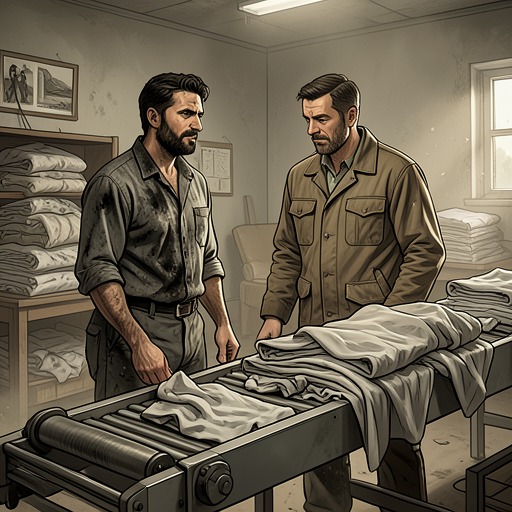
That sense of release erupts when Joe recognizes the hotel manager’s shirt among the soiled clothes. Knowing whose it is, he throws it to the floor and stamps on it, shouting curses at the manager and needing to be restrained. The gesture is directed at a particular shirt and manager, but it also gives his pent-up anger a physical outlet. Martin laughs and holds Joe to his work: the decision to quit has been made, yet Joe must still finish out the remaining days.
New laundrymen arrive on Tuesday night, and the rest of the week is spent teaching them the routine. Joe explains his system but does no more work himself, insisting that he will not lift a finger and that, if the owners fire him, he will quit. The practical transition is visible here: replacements have arrived, and Joe’s departure no longer rests on a drunken impulse alone. He has begun transferring the knowledge of the job while withdrawing his own labor from it.
Parting from Martin
On Saturday, after they draw their pay, the two men reach the point of separation. Joe asks whether there is any use in asking Martin to change his mind and take to the road with him. Martin shakes his head. He is standing beside his bicycle, ready to start, while Joe’s chosen route is toward the freight cars. Their shared decision to leave the laundry does not make them companions on the same journey.
They shake hands, and Joe holds Martin’s hand for a moment as he predicts that they will see each other again before they die. He tells Martin goodbye and says how much he likes him. Martin rides away; Joe remains in the road, watching until Martin turns a bend and disappears. The pause makes the farewell more than a simple exchange of good wishes: Joe watches the friendship separate into two departures, one by bicycle and the other on foot toward the rail line.
After Martin is out of sight, Joe calls him a good Indian, then plods down the road himself. His destination is the water tank, where half a dozen empty freight cars wait on a side-track for the up freight. The scene ends not with Joe already settled into a new life, but with him walking toward the means of leaving, carrying his hope of freedom into an uncertain journey.
Significance of the departure
Joe’s exit gives concrete form to his distinction between employment and living. He has no stated plan beyond taking to the road, and the narrative does not show what happens to him afterward. What it does show is the sequence by which he makes leaving possible: he commits to the choice, arranges replacement workers, refuses further labor, collects his pay, and parts from Martin. His repeated celebration of rest beneath the trees contrasts with the laundry’s demands and the shirt that becomes the focus of his anger.
The separation also marks the limits of the men’s bond. Joe wants Martin to join him, but Martin’s bicycle and refusal establish that their paths have split even as their affection remains explicit. Joe’s prediction that they will meet again is his own confident farewell, not a reunion shown in this episode. The final image returns him to the road and the waiting freight cars, leaving his departure as an escape from the laundry rather than a completed account of where freedom will lead.