Joe Dawson’s alcohol dependence
Martin EdenJoe Dawson’s alcohol dependence is bound to the weekly rhythm of the laundry at Shelly Hot Springs: relentless work, a Saturday release into drink, and a return to labor with the consequences still on him. Joe calls drinking something he cannot help, and Martin Eden gradually recognizes that the drinking follows the work rather than causing the misery that drives it. Their overlapping experiences make Joe’s habit more than a private weakness: it is also an escape from a labor regime that consumes time, strength, and the capacity to think beyond the next task.
The weekly cycle of work and drink
Joe’s pattern is established as Martin joins him at the laundry. Joe says that after working intensely through the week he has to drink; without it, he fears he would harm himself or set the premises on fire. At the same time, he is glad that Martin has stopped drinking and urges him to remain sober. The exchange presents Joe as aware of the danger and cost of his habit, but unable to imagine enduring the workweek’s aftermath without alcohol.
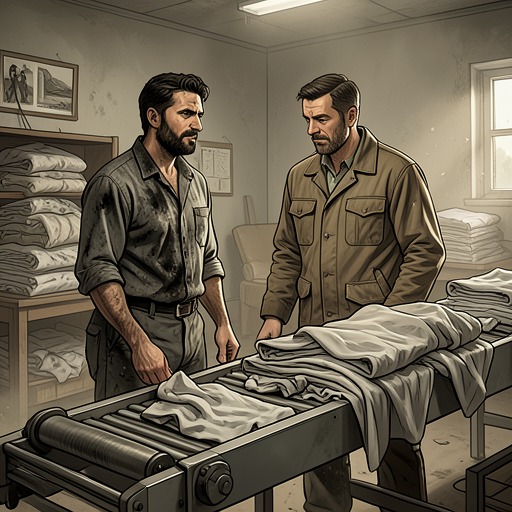
The cycle is tied to the laundry’s schedule. The men work at a punishing pace, moving from task to task with almost no interval; their labor includes handling hot starch and ironing shirts in a room filled with heat and steam. Joe is exceptionally fast and teaches Martin how to save motions, but that skill does not give him control over the conditions or duration of their work. When Saturday afternoon finally brings a pause, Joe heads to the village and drinks. The respite is brief: on Monday morning he is back at work, groaning, swearing, and wearing a towel tightly around his head as he runs the washer and mixes soft soap.
The recurrence gives Joe’s drinking the shape of a ritual rather than an isolated lapse. He explains that Saturday drinking is unavoidable for him, and the narration shows him returning to it after successive weeks of labor. The weekend offers temporary forgetfulness, not lasting recovery; Monday restores the same work and the same cycle.
Joe’s own explanation
Joe connects drinking directly to the effort of the job. He compares laundry workers with cooks and bakers, saying that people in such occupations drink because of the work. For him, alcohol is a response to having labored like a slave all week. He describes it as the thing that keeps him from breaking loose against the establishment, casting his drinking as both self-destruction and a way of containing anger that might otherwise turn outward.
His account distinguishes this work-driven need from drinking as a constant desire. Joe recalls having typhoid in the hospital and says he did not want alcohol while he was there. He even remembers the hospital stay as beautiful. The contrast supports his claim that it is the labor, rather than an undifferentiated craving in every circumstance, that brings on his urge to drink. The story does not establish a diagnosis or offer a treatment; it gives Joe’s own explanation and places it beside the conditions of his work.
Joe is not indifferent to Martin’s attempt at sobriety. When Martin first tells him he is on the water wagon, Joe admits that he wishes he could do the same, though he says he cannot. Later, when Martin returns to the village after weeks of avoiding alcohol, Joe greets him by recalling that he had believed Martin was sober. Joe’s regret is genuine but does not prevent him from drinking himself. His response reveals a divided position: he recognizes another possible course and even encourages Martin toward it, while continuing to experience his own drinking as compulsory.
Martin’s parallel and the meaning of the habit
The laundry’s effect on Martin makes Joe’s explanation legible through repetition. Martin initially remains sober and tries to preserve fragments of his former life, including reading and long bicycle rides between the laundry and Oakland. Yet the pace of the work narrows his attention until he can scarcely think beyond the task in his hands. In one account, the hotel manager seems to command not only his labor but his thoughts; memories of Ruth Morse arrive only in fleeting moments at night or in the morning.
As the weeks pass, Martin’s exhaustion deepens into self-disgust and a sense that his ambition and imagination have gone dark. After Ruth returns his poems, he reads them as failures, but he has so little energy that even carrying them to the furnace seems too much effort. He eventually goes drinking with Joe. The first drinks seem to restore the dreams and imaginative brightness that the labor had suppressed. This is temporary relief, not a solution: the parallel shows how alcohol can feel like a return to life after the work has made life seem absent.
Martin later identifies the distinction that clarifies Joe’s dependence: the work is the cause and the drinking its effect. After three months, another trip to the village makes Martin see that he is becoming a work-beast, not because he drinks, but because the labor is degrading him; the drinking follows that condition. This insight does not erase Joe’s responsibility for his actions, but it resists treating his alcohol use as detached from the circumstances he describes.
Escape imagined, and the cycle renewed
Joe sometimes imagines alternatives to both the laundry and the bar. While drinking, he sketches a plan to save money, stop drinking, and establish a steam laundry of his own. He imagines a workplace with enough machinery and workers to finish within decent hours, no children working, and no one laboring after six in the evening. He even offers Martin a position as superintendent. The plan gives shape to Joe’s anger at the conditions he endures, but it remains a drinking-side vision rather than an achieved change.
On another Saturday, Joe proposes that he and Martin quit and go tramping, attracted by the prospect of having nothing to do. His account of the hospital, where illness removed him from work, again presents enforced rest as a welcome escape. Martin sometimes resists the bar: after oiling his bicycle, he rides the seventy miles to Oakland and back, reaching work Monday weary but still sober. Yet even these rides become another exhausting effort, and after several weeks he eventually returns to drinking with Joe.
Joe’s alcohol dependence therefore remains part of a repeated, unresolved pattern. He knows that the work drives him toward drink, imagines a more humane way to organize labor, and wishes at moments that he could stay sober. But neither his wishes nor his schemes alter the conditions awaiting him each Monday. The narrative’s central contrast is between the fleeting release of intoxication and the persistent toil that makes release seem necessary: the bar can briefly make the week recede, but it cannot make the next week different.