Kreis
Martin EdenKreis is a former university professor who makes his living by whatever means are available and whose deepest commitment, as Russ Brissenden describes it, is philosophical monism. He enters the novel as a sharp, unconventional thinker in a poor laborers’ household, where argument is not an abstract exercise but a force that can seize a room. His later visit to Martin Eden reverses their earlier positions: Kreis comes seeking money, while Martin, now wealthy and indifferent to wealth, offers it in recognition of an intellectual experience he cannot repay in any other way.
Identity and Background
Brissenden introduces Kreis as a former professor dismissed from a university, with a mind he considers exceptionally quick. Kreis has supported himself in varied ways, including working as a street entertainer when he was in severe financial difficulty. Brissenden characterizes him as unscrupulous, describing his willingness to do whatever was necessary to survive. The account sets his lack of conventional respectability against the polished intellectual traditions he knows: Kreis can discuss Nietzsche, Schopenhauer, and Kant, yet Brissenden insists that his lasting allegiance is to monism.
That allegiance has a particular intellectual shape. Kreis follows Ernst Haeckel and argues from a materialist position, treating the explanation of phenomena through facts as a guiding principle. Brissenden describes Haeckel as central to Kreis’s convictions and says that an attack on Haeckel would offend him more than attacks on the other philosophers he can discuss. Kreis is thus presented not as a detached surveyor of competing systems but as a committed partisan, willing to press his ideas with both intellectual confidence and personal intensity.
The Rooms and Their Intellectual Circle
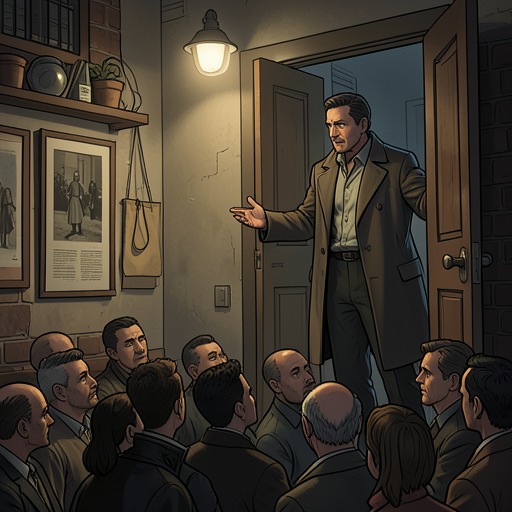
Kreis lives in two rooms on the upper floor of a corner building, above a saloon and grocery. The upstairs is shared by the group Brissenden calls his circle; Kreis alone has two rooms. The modest household is also a working domestic space: Mary washes dishes in the small room used as kitchen and dining room, while the front room serves as both bedroom and living room. Washing hangs overhead, and the room accommodates the people who gather there as well as their conversation.
Brissenden brings Martin to this gathering and introduces him to Kreis, Andy, and Parry. Parry recounts a prize fight he has seen; Andy helps summon the other lodgers; and Brissenden serves drinks before steering the company toward philosophy. Hamilton and Norton arrive among the group. The gathering’s range is reflected in Brissenden’s introductions: Hamilton is a socialist and former organizer of a cooks’ and waiters’ strike, while Parry is known for an extraordinary store of statistical and sporting facts. Kreis’s rooms have also served as the setting where Hamilton planned the strike, although Brissenden says Hamilton did not remain involved with the union afterward.
The room matters because it brings intellectual debate into a setting far removed from the institutions where Martin had encountered philosophy as printed work. The discussion unfolds among lodgers in the labor district south of Market, with Martin listening as the books and doctrines become arguments embodied in the people who hold them. The contrast is not between learning and ignorance, but between knowledge as something encountered on a page and knowledge made active through disagreement.
Debate with Norton and Martin
Brissenden presents Martin, a committed admirer of Herbert Spencer, to Kreis as a possible convert to Haeckel’s system. Kreis takes up the challenge, but Norton intervenes, and the contest shifts into a direct dispute between the two men. Norton argues for idealism, a position that Martin has not previously found attractive. Its logical case nonetheless impresses him. Kreis and Hamilton dismiss Norton as a metaphysician; Norton answers by accusing them of manipulating words and building theories from labels rather than reasoning from facts. They, in turn, regard the starting point of their own method as precisely the facts themselves.
Their argument ranges over phenomenon and noumenon, consciousness, and the relation between facts and theory. Norton invokes Kant, and Kreis responds with a pointed joke about German philosophy and Oxford. When Norton brings up Hamilton’s Law of Parsimony, Kreis and Hamilton claim that their own reasoning already applies it. The exchanges are not presented as a settled victory for either system. Instead, Martin is absorbed by how readily each side tests the other and how alive the philosophical questions become in the room.
Kreis’s part in the scene is therefore larger than his role as a representative of materialist monism. He provokes debate and subjects Martin’s Spencerian convictions to challenge, while Norton’s intervention gives Martin a first substantial encounter with idealism. Brissenden has arranged the meeting as a philosophical contest, but the outcome for Martin is not conversion: it is the discovery that ideas he had known from books can acquire force through sustained argument among people who believe them.
Later Visit and Martin’s Gift
Much later, Kreis visits Martin with a speculative business scheme. Martin receives him with relief, finding the proposal interesting as material for a fiction writer rather than as an investment. In the course of presenting the scheme, Kreis acknowledges that he had been mistaken about much of The Shame of the Sun. The concession gives their later meeting a different intellectual tone from the earlier confrontation, though the evidence does not describe a full recantation of his philosophy.
Kreis asks Martin whether he will invest a thousand dollars. Martin refuses to put money into the scheme, but offers Kreis the same amount for another reason: he remembers the night in Kreis’s rooms as the greatest of his life and says that Kreis gave him something money could not buy. Now that Martin has money he does not value, he wants to give it to someone who needs it in return for that earlier experience. He presents the payment as a gift, not as an investment or a reward for the proposed venture.
The exchange completes Kreis’s significance in Martin’s story. In their first meeting, Kreis helps create the intellectual encounter that Martin treasures; in the later one, Martin can name its value only by refusing to treat it as a commodity. Kreis remains the visitor who asks for capital, but Martin’s response turns the old evening of debate into the true subject of their transaction: what Kreis gave him then cannot be priced, even when Martin tries to answer it with money.