La Grippe
Martin EdenLa Grippe is the illness that brings Martin Eden’s prolonged hunger and exhaustion to a bodily crisis. Delirium, aching eyes, and weakness keep him from work and reading, while Maria Silva’s practical care sustains him through the worst of it. The sickness also produces a sharp, temporary reversal in his sense of the future: after receiving a letter from the Transcontinental, he imagines giving up literature for a salary and a home with Ruth Morse.
Onset and Physical Ordeal
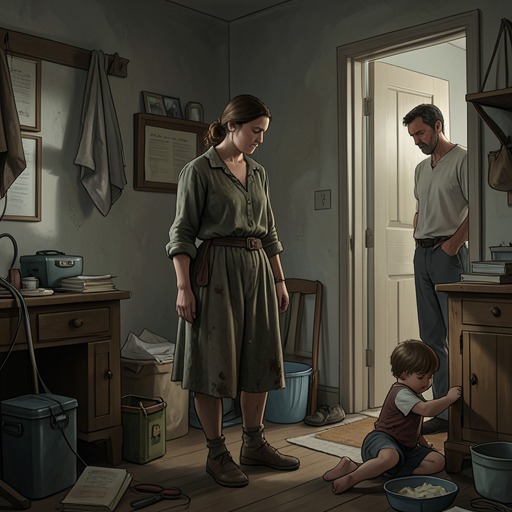
Martin does not go out to look for work the morning after his illness takes hold. He remains in his room, and it is late afternoon before the delirium clears enough for him to look around with aching eyes. Mary, an eight-year-old member of the Silva household who has been keeping watch, cries out when she sees him regain consciousness. Maria comes in from the kitchen, places her calloused hand on his hot forehead, and feels his pulse. His fever is not described through a diagnosis from a doctor; instead, the scene establishes it through his impaired awareness, his hot skin, and the people around him noticing his return.
Martin is unused to being sick and tries to get up and dress. The effort takes nearly all his will, but he cannot stay on his feet: his senses fail him at the table, and half an hour passes before he can make his way back to bed. There, with his eyes closed, he studies his pains and weakness rather than attempting another task. The attempt matters because it shows how abruptly illness has made ordinary self-direction impossible. A man accustomed to driving himself through work and study cannot even cross a room and remain upright.
Maria’s Care
Maria treats Martin with the resources at hand. During the night, after hearing his groans through the thin partition, she comes to his room with hot flat-irons for his body and damp cloths for his aching eyes. Later, she changes the cold cloths on his forehead several times. Her care is attentive but restrained: she leaves him in peace rather than trying to fill the room with conversation, and the narration presents this quiet judgment as a kindness that moves him to gratitude.
When Martin asks what is wrong, Maria identifies the illness as grip and tells him to expect to recover in two or three days. She advises him not to eat yet, with food to follow as he improves. Martin has no appetite; after the delirium, eating seems so remote that he wonders how he could ever have been hungry. His gratitude also takes a practical form. He reassures Maria that he will still arrange the milk ranch for her, a promise that links his brief helplessness to the future assistance he has wanted to provide. Even laid low, he measures what he owes her and what he hopes to make possible.
Hunger, Exhaustion, and Reconsideration
As Martin lies recovering, he connects the illness to the privation that preceded it. He recalls the letter from the Transcontinental as if it belonged to a distant past and sees himself as having spent his strength in a final effort, only to end up on his back. He reasons that starvation left him run down and unable to resist the disease. The explanation makes the illness more than an interruption from outside: it is the consequence of the physical cost of his struggle to live and write without adequate means.
In that weakened state, Martin asks himself what is gained by writing a whole library if the work costs him his life. He declares that literature is over for him and imagines an alternative: a counting-house, a ledger, a monthly salary, and a small home with Ruth Morse. The prospect is strikingly conventional beside his ambition to become a writer, but the scene locates the change in the immediate experience of bodily collapse. His imagined security answers the vulnerability of being sick and impoverished; it does not establish that he has permanently abandoned writing. The decision belongs to a moment when the physical ordeal has made survival and dependable income newly urgent.
Partial Recovery and Its Limits
Two days later, Martin has managed to eat an egg and two slices of toast and drink a cup of tea. He asks for his mail, an indication that he is turning again toward the correspondence that shapes his prospects. Yet recovery has not restored his capacity to read: his eyes still hurt too much. He asks Maria to read the short letters and set aside the long ones, but she cannot do it and suggests that Teresa, who goes to school, might be able to help.
The illness thus ends neither with a sudden return to strength nor with a completed change of course. Food and the ability to ask for his mail mark improvement, while the pain in his eyes keeps him dependent on others and delays his access to what has arrived. La Grippe briefly recasts Martin’s writing ambition as a danger to his life, then leaves that ambition suspended alongside his unread correspondence. The passage makes the body, not an abstract verdict on his talent, the immediate limit on what he can do.