Lizzie Connolly
Martin EdenLizzie Connolly is a working-class woman whose encounters with Martin Eden make class difference visible first as a social boundary and later as a choice he cannot simply undo. Martin initially sees her through the contrast between her station and Ruth Morse’s refinement; years afterward, Lizzie’s enduring devotion gives him the chance to choose a different kind of happiness. He refuses, and their parting reveals both the generosity of his regard for her and the distance his transformation has placed between them.
First Encounter and Social Position
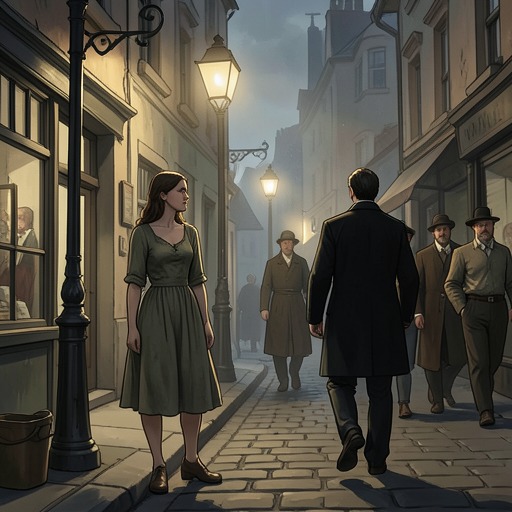
Martin encounters Lizzie on Broadway while walking with Ruth. The electric lights briefly bring the two women into view at once: Lizzie is with a giggling friend, wearing the inexpensive finery and distinctive hat Martin associates with working-class girls. He hesitates only for an instant before raising his hat. The gesture is more than an acknowledgment of an acquaintance. Martin feels that he cannot be disloyal to his own kind, and his greeting also recognizes the social world from which he has come.
Lizzie returns the greeting boldly. Her handsome, hard gaze moves beyond Martin to assess Ruth’s face, dress, and station. Ruth, in turn, notices Lizzie and calls her pretty; when the pair speak about her later, Ruth’s response is sympathetic. The brief exchange sets their different positions beside one another without making either woman merely an abstraction: Lizzie looks directly and appraisingly, while Ruth’s quick glance registers her as a working-class girl in cheap finery. Martin stands between these two ways of seeing, still attached to the people he came from but increasingly drawn toward the world Ruth represents.
Lizzie in Martin’s Class Consciousness
That night, alone before his looking-glass, Martin turns the encounter into an accusation against himself. He asks where he belongs and answers that he belongs with the workers, among drudgery and dirty surroundings, and with girls like Lizzie. The contrast is painful because his self-education has opened books, music, painting, and cultivated speech to him, while his love for Ruth seems to carry him beyond his origins. In this inward reckoning, Lizzie becomes a figure for the working-class identity Martin fears he must leave behind if he is to reach Ruth.
Martin’s later understanding complicates that division. When Ruth’s jealousy gives way to tears, he recognizes that women across class lines share fundamental human feelings. He takes consolation in the thought that Ruth, beneath her culture and idealized beauty, is human in the same basic way as Lizzie. This conclusion makes Ruth seem reachable to him: class, he decides, is external and can be overcome. Lizzie therefore occupies an important place in Martin’s reasoning even when she is absent. He uses the perceived common humanity she represents to challenge the imagined distance between himself and Ruth, though this insight does not erase the social distinctions that shaped his earlier self-contempt.
Reunion at Shell Mound Park
Years later, Martin meets Lizzie again at Shell Mound Park. He has returned to people who knew him before any book of his was published, and their welcome pleases him because they value him for himself rather than for a public reputation. During the dancing, he sees Lizzie passing in the arms of a young workingman; later, he finds her seated at a refreshment table and leads her away from the music so they can talk. From the moment he speaks to her, he recognizes her renewed attachment to him in her proud yet humble expression and the attention she gives his words.
Martin also sees how she has changed. She is no longer the young girl he remembers but a woman whose beauty has grown more composed without losing its wildness. He understands that she would follow him if he asked, a recognition that makes the reunion more than a nostalgic encounter. Lizzie tells him that the man she had been keeping company with is nobody important to her and that she would leave him for Martin. She explains that loneliness led her to that companionship, but that she never forgot Martin. Her declaration establishes the constancy of her attachment while making clear that she has continued her life in his absence.
Refusal and Farewell
In the afternoon, Martin and Lizzie spend more time together. They eat an elaborate lunch, dance until she is tired, and later sit among the trees in a familiar arrangement: Martin lies with his head in her lap while she fondles his hair. Lizzie tells him that she has remained true over the years. Martin believes her, and the knowledge brings a powerful temptation: he could marry her and take her with him to a grass-walled home in the Marquesas. He imagines that he could give her happiness, especially when he feels denied of it himself.
He nevertheless refuses to return to the easy, uncommitted life of his past. Martin says he is not a marrying man, then explains that he will neither marry nor pursue a relationship without marriage. His restraint is presented not as doubt about Lizzie’s loyalty but as a consequence of how profoundly he has changed. He tells her that her generosity challenges him to answer with equal generosity, and that he will not exploit the trust she places in him. Lizzie’s readiness to accept almost anything from him makes his refusal more painful, not less; he insists that precisely because she is so vulnerable to his choice, he cannot take advantage of her devotion.
At good night, Lizzie leans toward him wistfully. Martin responds by embracing and kissing her, and recognizes the sincerity of the kiss he receives. Lizzie breaks away and runs up the steps, overwhelmed; Martin is left with tears in his eyes. Their farewell closes the possibility suggested by the afternoon without diminishing the love between them. Lizzie’s role in Martin’s story thus turns on a stark contrast: she offers a real, available attachment, while his governing ideal and his altered sense of himself prevent him from accepting it.