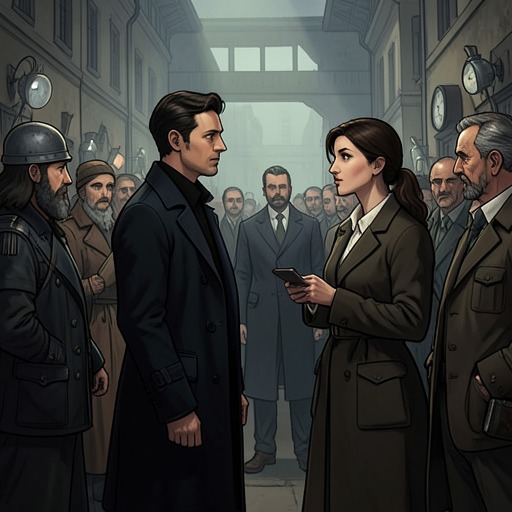
Martin Eden and Cheese-Face
Martin EdenMartin Eden and Cheese-Face share a rivalry that begins in childhood, survives years without a decisive outcome, and returns in adulthood as a contest Martin experiences as the completion of an old account. Its defining pattern is not a succession of clear victories but Martin’s persistence through repeated defeat: he stays, remembers staying, and eventually treats that endurance as part of what makes his final win meaningful.
Childhood Rivalry
The remembered contest starts with a fight Martin loses. Six months later Cheese-Face defeats him again, although Martin manages to blacken his opponent’s eye. Martin regards this small reversal as progress, but the wider pattern remains unmistakable: fight after fight, Cheese-Face wins and exults, while Martin is repeatedly beaten. What Martin carries from these encounters is not a record of success but the fact that he never runs away. In memory, remaining in the contest becomes a source of strength even when the immediate result is defeat.
The fights form a routine around Martin’s school days. He hurries from school to the Enquirer alley, where the encounters recur so often that the stretch of time seems to him like an endless ordeal. The accumulation takes its toll: he is stiff and lame, his arms are bruised, and his body aches. He does not play at school or study, and even sitting at his desk becomes difficult. The rivalry thus occupies more than the moments of combat; it reaches into his ordinary schedule and interferes with both recreation and lessons.
For Martin, the apparent way out is not to withdraw but to defeat Cheese-Face. He wonders why his opponent cannot simply be beaten, imagining that outcome as a release from the repeated misery. Yet the possibility of ceasing to fight does not enter his thinking. The contrast gives the childhood rivalry its particular force: Martin is trapped in a cycle he wants ended, but he understands its end as victory rather than refusal. His endurance is therefore both a source of pride and a measure of how completely the contest has taken hold of him.
An Unfinished Contest
One day Martin reaches the alley and Cheese-Face is absent; he does not return. The other boys congratulate Martin and tell him that he has beaten his rival. Martin rejects their conclusion. Neither boy has defeated the other in the final reckoning he recognizes, and the problem, in his view, remains unsolved. Only afterward do they learn that Cheese-Face’s father died suddenly that same day. The absence has an explanation, but it does not supply the decisive outcome Martin wants. The rivalry is suspended by circumstance, not settled between the two boys.
That interruption gives the later meeting its force. The childhood sequence appears in Martin’s vision as he watches, dissolving into the series of fights that followed; from there, memory carries him forward to a night when he is seventeen and newly returned from the sea. The narrative links the boy who endured defeat to the young man who encounters Cheese-Face again, making the adult fight the return of a conflict preserved in memory rather than an unrelated quarrel.
The Adult Encounter
At the Auditorium, a disturbance begins when someone is bullying another person. Martin intervenes, and Cheese-Face confronts him. Their recognition turns the disturbance into a renewal of their longstanding rivalry. The terms imposed on the encounter make its stakes explicit: it is to be a grudge fight, with no handshaking and no one yielding. The two are not presented as settling their differences through conversation; the conflict resumes in the form that has defined their relationship since childhood.
The fight continues past exhaustion. Eventually the crowd, whose appetite for the contest has been satisfied, becomes alarmed by its persistence and asks both men to stop. Cheese-Face is close to collapse and hesitates, but Martin presses the fight onward. The ending reverses their childhood pattern: the boy who was repeatedly defeated is now the one who does not give way, while the former victor can no longer sustain the contest. Martin’s persistence has become decisive rather than merely defensive.
Victory and Significance
Afterward Martin declares that he has beaten Cheese-Face and measures the time it took in years: eleven, by his account. The declaration makes clear why the earlier fights matter to him. The adult victory is not just the result of one encounter; he understands it against a long history in which he stayed despite losing, and against the childhood day when Cheese-Face’s absence left the contest unresolved. The claimed win closes that personal sequence on terms Martin accepts.
The rivalry also shapes the way the story presents Martin’s endurance. As a child he interprets remaining in the fight as evidence of strength, even when the repeated defeats bring him pain and disrupt his school life. As a young man, the same refusal to stop carries him to victory, but the crowd’s plea for the fighting to end marks the cost of carrying that principle too far. The relationship is therefore both a literal contest between two opponents and a formative memory through which Martin understands persistence, defeat, and the satisfaction of an eventual reckoning.