Martin Eden and Ruth Morse’s romantic relationship
Martin EdenMartin Eden and Ruth Morse’s romantic relationship turns on a striking imbalance of timing: Martin says he has loved Ruth from their first meeting, while Ruth discovers that she loves him only in the moment of their first embrace and kiss. That bodily recognition becomes an engagement without a proposal, and a private family understanding without public announcement. The relationship begins not with negotiated promises but with a sudden change in what each believes the other means to them; Ruth’s family then tries to contain that change by waiting for it to pass.
The sudden recognition of love
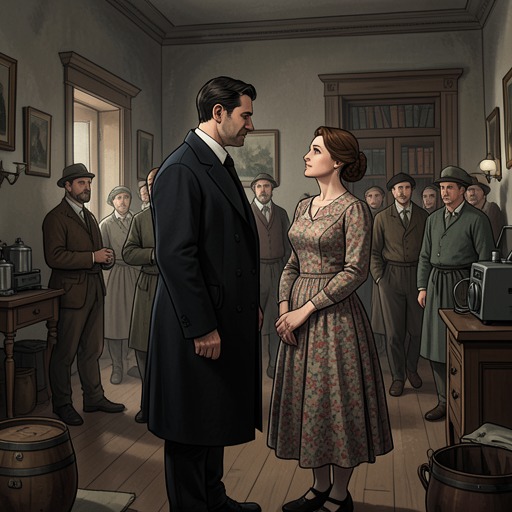
The decisive encounter unfolds in silence. A book slips from Martin’s hands, and the two sit looking out across the bay. Ruth feels herself drawn toward him, moves close enough for their shoulders to touch, and does not pull away when she feels his answering pressure. Martin’s arm slowly comes around her. She waits, caught between expectation and uncertainty, until she rests her head against his breast; when he bends to kiss her, she meets him. The progression is reciprocal, but not evenly understood: each gesture carries Ruth further into a feeling she has not yet named.
The narration makes the physicality of the moment central to her recognition. Ruth experiences herself as no longer directing her actions by deliberate choice; she describes being swept into a condition in which the usual distinctions between decision and impulse fall away. Her pulse, breath, and anticipation register before she can settle on an explanation. Only after kissing Martin does she identify the feeling as love. The scene therefore presents love not as the result of a declaration or a reasoned choice, but as something Ruth understands through what her body has already done.
Martin’s response reveals a different history beneath the same embrace. When Ruth asks when he began to love her, he says that his love began at their first meeting and has grown more intense in the time since. His joy is so overwhelming that he describes himself as nearly beside himself. For him, the kiss confirms a long-standing attachment; for Ruth, it makes that attachment suddenly real. Their mutual feeling is genuine, but its discovery is asymmetrical.
From a kiss to an engagement
Neither speaks during the embrace, and no formal proposal occurs. Afterward, Ruth asks how Martin made her love him and says that she had not expected to marry him until that moment. Her account establishes the relationship’s defining paradox: she is sure of her love and marriage-minded at once, yet the decision arrives as a surprise even to herself. She also remarks that the experience differs from what she had imagined love would be, marking the distance between an abstract expectation and the force of the actual encounter.
Ruth soon tells Mrs. Morse that she and Martin are engaged. When her mother asks what happened, Ruth explains that Martin said nothing: he put his arm around her, they kissed, and she realized she loved him. Her declaration gives a name and consequence to a scene that had contained no spoken agreement. She does not describe the engagement as a bargain or as a promise extracted from Martin; rather, she treats their physical intimacy and her newly recognized love as sufficient grounds to say they will marry.
Ruth’s certainty survives her mother’s alarm. She calls her love an accident and fears that she will be difficult to forgive, but she refuses the suggestion that Martin might release her. She says that she wants to marry him if her parents will allow it. Her language contains both distress at having crossed an expected boundary and an emphatic defense of the feeling itself. She compares her love for Martin with her mother’s love for her father, insisting that the feeling comes from something in herself and in Martin that she had not previously recognized.
Family resistance and the suspended engagement
Mrs. Morse considers how to respond, while Mr. Morse interprets Ruth’s awakening as likely to have happened sooner or later. He attributes its direction partly to circumstance: Martin is the only man Ruth has been in contact with closely, and so, in his view, she has fallen for the accessible man at hand. The parents do not treat the match as impossible because Ruth lacks affection; they object to Martin’s social position. Their expectation is that she will marry an honorable man of her own station, chosen by herself once she loves him.
Rather than directly forbid the relationship, Mrs. Morse decides to work on Ruth slowly and indirectly. Mr. Morse advises letting the couple see each other while surrounding Ruth with young men of her own class, whom he expects will make Martin appear inadequate by comparison. He dismisses the attachment as youthful infatuation and assumes that Ruth and Martin will grow out of it. The strategy turns the family’s class judgment into a planned test: Ruth’s love is to be weakened not by argument alone, but by contrast with the gentlemen her parents consider more suitable.
The family reaches an indefinite agreement to wait. Within the household, Ruth and Martin are accepted as engaged, but no announcement is made because the family does not expect the engagement to become a marriage. It is tacitly understood that the engagement will be long. The Morses neither tell Martin to take a job nor ask him to stop writing, but the evidence makes clear that this is not encouragement: they do not intend to help him improve his prospects. Their passive waiting conceals an active hope that the relationship will dissolve on its own.
Private commitment and material circumstances
Martin is not positioned to marry, a circumstance that makes the family’s expectation of delay practically consequential. Several days later, he tells Ruth he has decided that boarding with his sister costs too much. He has rented a small room in North Oakland and bought an oil-burner so that he can cook for himself. Ruth is delighted by the plan, particularly by the oil-burner. The detail gives their newly declared engagement an everyday material setting: their relationship is not followed by a wedding plan, but by Martin’s effort to arrange a cheaper, more independent way of living.
The relationship’s beginning thus joins emotional certainty to unresolved social and economic conditions. Ruth names herself engaged and resists being released, while her family treats the bond as temporary and withholds the support that might help Martin become a viable husband in their eyes. Martin and Ruth’s private understanding is real, but its public future remains suspended between their declaration and the family’s confident expectation that it will not last.