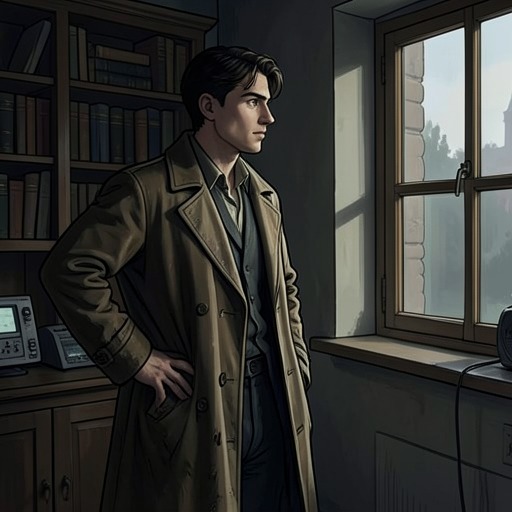
Martin Eden decides to become a writer
Martin EdenMartin Eden decides to become a writer during the return voyage from the South Seas, converting months of self-education, a newly felt sense of his own potential, and an encounter with beauty into a life plan. The decision is at once artistic and personal: he wants to give form to what he has seen, to reach a wider audience, and to prove himself worthy of Ruth Morse. The narrative makes his vocation begin not with publication or recognition, but with the conviction that writing can join perception, work, and love.
Preparation at Sea
The decision follows eight months in which Martin has been changing himself through deliberate study. After repeatedly working through grammar, he began learning twenty dictionary words a day. At the wheel or on lookout, he reviewed pronunciations and definitions, and practiced phrases in order to speak the English used by Ruth. He repeated difficult sounds until his speech grew cleaner and more correct than that of some officers and the gentleman-adventurers who had financed the expedition. The effort is concrete and repetitive: the new vocation grows out of the same disciplined labor he has already applied to language.
His access to Shakespeare gives that labor a literary model. The captain owned a complete set of the plays and allowed Martin to read it in return for washing his clothes. Immersion in the plays shaped the way Martin imagined the world, trained his ear for elevated English, and left him with an appreciation for language, though also with archaic expressions. This education is not formal preparation for a profession. It is pieced together from work, borrowed books, repetition, and the impressions that stay with him.
The Decision and Its Artistic Impulse
By the end of the eight months, Martin is both conscious of how little he knows and newly persuaded that he has capacities he has not yet used. He sees a difference between himself and his shipmates, but understands it as a difference in potential rather than completed achievement: what he can do, they might also do, yet he feels a ferment within himself that signals unrealized possibilities. That distinction gives his ambition its urgency. He is not claiming to have already attained mastery; he believes that work could disclose what he is capable of becoming.
The immediate stimulus is the beauty of the world around him. Martin is moved by it and wishes Ruth were present to share it. At first he imagines describing the South Sea scenes to her; then the creative impulse expands beyond their private exchange, and he wants to recreate that beauty for a larger audience. His decision to write therefore arises from both the desire to communicate with one person and the recognition that the experience might be made available to many readers.
He imagines an expansive career, not a narrow one: poetry and prose, fiction and description, even plays like Shakespeare. In his conception, writers are among the world's giants, finer than men such as Mr. Butler, whose wealth and possible public standing had once represented a different kind of power. Literature promises Martin a means of making and shaping meaning, not merely a route to a salary. The scale of the dream exceeds what he has yet learned to do, but its breadth is part of the decision itself.
Ruth, Work, and the Future He Imagines
The open sea gives Martin distance from Ruth's world and lets him picture it as a whole. He does not yet understand all its details, but believes he can see a way to master it: writing. On returning to San Francisco, he plans to begin with an account of the treasure-hunters' voyage and sell it to a newspaper. He intends not to tell Ruth in advance, hoping that she will be surprised and pleased when she sees his name in print. The plan joins his new vocation to courtship through a specific, practical gesture: a published article will present himself to Ruth in a form he hopes she will value.
Martin does not expect immediate greatness. He allows that success may come slowly and initially proposes earning enough from writing to continue studying. Only after learning and preparing himself does he expect to write major work and become widely known. He also imagines the steam yacht possessed by other writers, but this material prospect is secondary to the larger purpose he assigns his ambition. Fame matters less than demonstrating his worth to Ruth. The dream is thus divided between a career's public rewards and a private ideal, with the latter described as its deepest motive.
Return and Narrative Significance
The decision quickly becomes action. Back in Oakland, Martin takes up his old room at Bernard Higginbotham's and begins the treasure-hunters article without first telling Ruth he has returned. He measures its length against a Sunday-supplement article in the San Francisco Examiner, writes a draft in three days, and then learns from a rhetoric book that manuscripts require paragraphs and quotation marks. After copying it again, he discovers newspaper submission rules about rolling pages and writing on one side only. His first practical steps expose the distance between the grand conception of authorship and the unfamiliar mechanics of getting work into print; they also show him responding to each mistake by learning and revising.
The event establishes the tension that will define Martin's pursuit: he imagines literature as both a means of entry into Ruth's world and a calling that answers his own creative response to life. His resolve is not simply a wish for fame, since he anticipates study, labor, slow earnings, and delayed achievement. Nor is it detached from love: he explicitly makes proving himself worthy of Ruth the highest purpose of the dream. The return voyage marks the moment these desires coalesce into a vocation, while his first article begins the demanding process of testing that vision against the actual conditions of writing and publication.