Martin Eden rescues Arthur Morse from the hoodlums
Martin EdenMartin Eden rescues Arthur Morse from the hoodlums on a ferry in an episode whose significance extends beyond the fight: the rescue earns Martin an appreciative welcome, but its retelling also makes him acutely aware that he does not belong to Arthur’s social circle.
The Rescue and Its Retelling
The book presents the confrontation through its aftermath rather than depicting the fight directly. Arthur recounts his adventure with the drunken hoodlums for what the narrator calls the twentieth time, describing how Martin rushed in and rescued him. Martin gives a more blunt account: the gang had been looking for trouble, Arthur had done nothing to provoke them, and Martin intervened, striking several of the men. The encounter cost Martin skin from his hands and some teeth from the gang.
The Rescue’s Social Aftermath
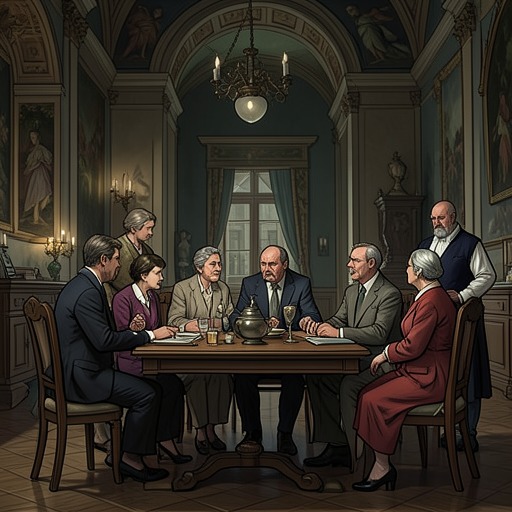
The rescue is retold in the Morse home, where Ruth Morse praises Martin for helping Arthur despite being a stranger. Martin has just spoken with embarrassed bluntness about the strength of his arms and the damage his hands take when he hits someone; he is disgusted with himself for bringing up what he considers unsuitable subjects. Ruth recognizes his discomfort without understanding its cause and tactfully returns the conversation to his courage. Martin understands the kindness behind the redirection, and his gratitude briefly quiets his shame.
Arthur’s repeated account of the ferry incident sharpens a different discomfort. As the story is told yet again, Martin worries over how badly he is conducting himself among people whose habits and speech he does not share. He concludes that he cannot convincingly pretend to belong to their circle: he is not of their tribe, and masquerade would violate his nature. Instead, he resolves to speak in his own manner, moderated enough to be understood, and not to claim familiarity with what he does not know. When the brothers use the university abbreviation trig, he asks what it means. The rescue has brought him into the Morse household, but it also makes the distance between his background and theirs newly visible to him.
The First Encounter in the Morse Home
The rescue’s aftermath places Martin in front of Ruth Morse, whose frank handshake and composed ease immediately unsettle his expectations. The narration renders his first impression as a portrait gallery: women he has known crowd into view only to be displaced by Ruth, who becomes the measure against which he judges them. The contrast reaches across the factory girls and women of the cattle camps he remembers to Japanese and South Sea Island women he has encountered abroad. This sweeping comparison makes Ruth’s entrance more than a new acquaintance; in Martin’s perception, she stands apart from the varied worlds of women he has known.
Ruth’s attention, meanwhile, makes Martin newly conscious of his own body and appearance. She notices the healing abrasions on both hands, several scars, the red mark where a stiff collar rubs his neck, and the cheap, wrinkled coat stretched across his shoulders. Martin struggles to settle into a chair, worries that his hands are in the way, and longs for Arthur to remain in the room. The ease with which Ruth sits sharpens his sense of his own awkwardness—a self-consciousness he says has never before occupied him. The rescue has carried him into a setting where even a handshake, a collar, and the act of sitting reveal how unfamiliar he is with its social codes.
The Rescue as a Test of Belonging
Martin treats the intervention as ordinary, insisting that Arthur had not provoked the gang and that anyone would have stepped in; his admission that he would not have missed the fight, however, gives the act a personal charge beyond its retelling as Arthur’s rescue. The contrast between Martin’s unembellished account and the household’s repeated heroic version makes the episode a measure of how differently he and the Morses frame the same deed: for Arthur, it is a story of rescue, while for Martin it is also an encounter he cannot separate from the difficulty of finding his place among them.