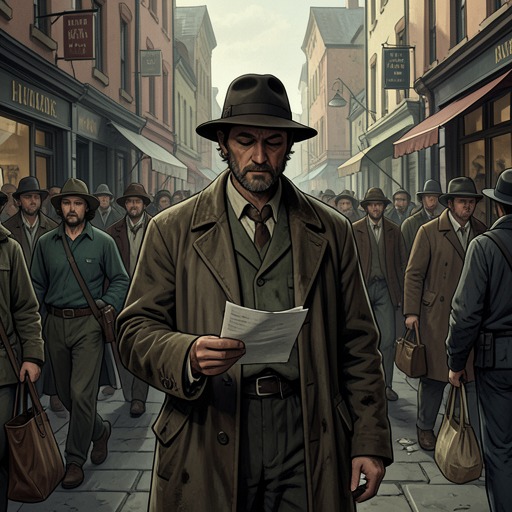
Martin Eden's black suit
Martin EdenMartin Eden's black suit is both a piece of clothing and a fragile ticket to social access: when poverty sends it to the pawnshop, he cannot present himself at the Morse home, and when he recovers it, that small material victory helps restore his confidence. Its repeated pledging measures the pressure of his finances, while its importance shows how much a respectable appearance can determine where he is able to go and whom he can see.
Appearance and Social Access
The suit is introduced as Martin's one good outfit. In desperate circumstances, he pawns it while promising Maria Silva a generous future: a complete milk ranch, with a house, barns, animals, and enough income to support her family. The contrast is sharp. He can imagine abundance for Maria, but the promise is drawn from a future he does not possess; in the present, he has to surrender the clothing that makes him presentable. The novel ties that sacrifice directly to his separation from Ruth Morse. He has no second-best suit fit to wear, and although he can still visit a butcher, a baker, or occasionally his sister, he cannot imagine entering the Morse home so disreputably dressed.
The suit therefore marks a boundary rather than merely covering Martin. His working clothes do not prevent him from carrying out ordinary errands, but the prospect of appearing in them before the Morse family feels beyond daring. The difference is not simply between having clothes and having none: it is between being able to move through familiar, practical spaces and being able to enter a household where appearance carries social weight. The black suit makes that distinction tangible, exposing how economic hardship can restrict intimacy as well as comfort.
Pawn, Recovery, and Renewed Access
Martin's finances remain precarious even as he continues to write. Three dollars earned from triolets help him survive until a check from White Mouse arrives. When it does, he cashes the forty-dollar check with his grocer rather than taking it to an Oakland bank, pays his bill there in full, settles other tradesmen's accounts, redeems his suit and bicycle, and pays rent on his typewriter. He also pays Maria the overdue month's room rent and one month in advance. After these obligations, he has nearly three dollars left for emergencies. Recovering the suit is one part of a carefully itemized effort to put his life back in order, not evidence that his financial insecurity has ended.
With the clothes back in his possession, Martin goes to see Ruth. The coins in his pocket seem to him like winged victories, and even the weather appears brighter now that debts are mostly paid and he can again imagine success. The suit's recovery belongs to this change in feeling: after a period of deprivation, a presentable outfit and a little cash make return to Ruth possible. Yet the reprieve is limited. As his resources again come under pressure, the black suit returns to the pawnshop, showing that the earlier recovery has not secured lasting independence.
A Choice Between Time and Respectability
At another low point, Martin keeps the black suit in pawn instead of surrendering his bicycle. Walking between North Oakland and Ruth's house takes too much time; the bicycle gives him exercise, saves hours for work, and still lets him see Ruth on afternoon rides. Knee-length duck trousers and an old sweater serve as an adequate costume for cycling together. This is a practical rearrangement of scarce resources: the suit would enable formal respectability, while the bicycle supports both his writing schedule and a less formal way of maintaining the relationship.
His access to Ruth's home is diminishing for reasons beyond his clothes. Mrs. Morse is intensifying her program of entertaining, and Martin has fewer opportunities to see Ruth there. The visitors who once seemed exalted now bore and irritate him; he judges their minds against the thinkers he has encountered in books. The pawned suit thus belongs to a broader change in his relation to the Morse circle. Its usefulness as an entry pass has not disappeared, but the social world it once seemed to promise no longer commands his unquestioned admiration.
The Suit as a Measure of Precarity
By Thanksgiving, Martin's earnings from hack-work still do not cover his expenses, and the black suit is again pawned. Unable to accept the Morses' dinner invitation in his present circumstances, he tells Ruth that he will come after all: he plans to collect the five dollars owed to him by the Transcontinental Monthly in San Francisco and use it to redeem the suit. To make the crossing, he borrows ten cents from Maria. Before entering the office, he calculates that if he fails to collect the money, he may have no way to return to Oakland. The plan to recover his clothes is therefore tied to a very immediate risk, not just to pride or appearance.
When Martin reaches the office, he is wearing a second-best suit that is also his worst: ragged and beyond repair, though its trousers bear a careful crease made with Maria's flat-irons. This is not the black suit he hopes to redeem; the contrast makes the black suit's absence visible through the inadequate substitute. The editor welcomes Martin and praises the breadth and maturity of his story, while the garment on Martin's body records the poverty his writing has not yet relieved. Across its appearances, the black suit moves between pawned necessity and restored access. It never solves Martin's precarious finances, but its repeated absence and recovery give that precariousness a concrete form: an unpaid debt can cost him not only clothing, but the ability to appear where he longs to belong.