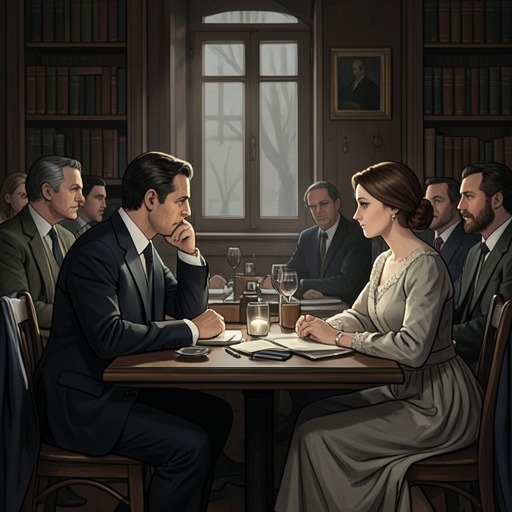
Martin Eden's first meeting with Russ Brissenden
Martin EdenMartin Eden's first meeting with Russ Brissenden turns an unpromising social encounter into the beginning of a consequential literary friendship. Martin initially reads Brissenden as feeble-minded, intrusive, and finally boorish; only after they leave the gathering together and talk at the Grotto does he recognize in Brissenden a living intelligence whose verbal gifts exceed what he has encountered in books. Their connection forms through sharp disagreement as well as admiration, and Brissenden's attention to Martin's writing and hunger makes the encounter personal from the start.
A Stranger at the Morse Gathering
The meeting occurs after dinner at the Morse home. Martin does not know how Brissenden came to be there, whose friend he is, or who brought him, and does not think to ask Ruth Morse. Instead, he judges the stranger by what he sees: Brissenden moves from room to room, looking at pictures and inspecting books and magazines, then withdraws from the company into a large Morris chair with a thin volume from his pocket. As he reads, he absently strokes his hair. Martin finds the behavior intrusive and takes the solitary reading as another sign of poor manners. Later, he notices Brissenden successfully bantering with several young women, but this brief glimpse does not overturn his first impression.
When Martin leaves, he catches up with Brissenden, who is already partway down the walk toward the street. Their first conversation does not immediately resolve the distance between them. After a block of silence, Brissenden asks why Martin goes to such a place; Martin turns the question back on him. Brissenden admits that this is his first such indiscretion and says he must spend the day's hours somehow, then invites Martin for a drink. Martin accepts with a readiness that surprises even himself. He has hack-work waiting at home and a volume of Weismann, as well as Herbert Spencer's Autobiography, to read. Yet the prospect of a public bar draws him: he recognizes that he is lonely and wants the company and atmosphere of men who seem confident and successful, not simply the liquor.
From Dismissal to Recognition
At the Grotto, the two settle into leather chairs and drink Scotch and soda, taking turns ordering. Martin is strong-headed and marvels both at Brissenden's capacity for drink and at the range of his conversation. He soon decides that Brissenden seems to know everything, and recognizes him as the second intellectual man he has met. The comparison sharpens the nature of Martin's response: Brissenden has what Martin believes Professor Caldwell lacks, a fire of insight and a freedom of genius. To Martin, Brissenden's language can cut and sting, turn soft and beautiful, or rise into an account of cosmic struggle. Its force lies not merely in learned information but in the way familiar words seem to carry meanings beyond ordinary expression. The books Martin has studied appear, in Brissenden, to have become a living person.
That recognition reverses Martin's earlier dislike. He privately places himself at Brissenden's feet and speaks aloud of Brissenden's knowledge of biology, only to learn that Brissenden has not studied it. The gap between Martin's expectation and Brissenden's answer is revealing: Martin has found the intellectual presence he longs for, but not in the form of a formal scholar. Their conversation and mutual scrutiny replace his first, superficial classification with a more complicated respect.
Writing, Poverty, and Frankness
Brissenden asks whether Martin writes, and Martin hesitantly explains that he tries to write for magazines. Brissenden responds with a judgment that is both severe and admiring: Martin's failure, he says, deserves respect, because Martin's work contains a quality the magazines exclude. In Brissenden's view, editors want soft, diluted writing, while Martin's work has guts. This assessment gives Martin an unusually direct account of the conflict between his own writing and commercial acceptance. Brissenden does not mistake rejection for proof of artistic worthlessness; he presents it as evidence of a mismatch between Martin's work and the market's demands.
When Martin says he is willing to do hack-work, Brissenden disputes him and looks over his worn tie, frayed collar and cuff, shiny sleeves, and sunken cheeks. The inspection makes Martin's poverty visible rather than abstract. Brissenden needles him with the suggestion that he could insult Martin simply by offering him food. Martin, in turn, retorts that he could eat Brissenden alive, looking at Brissenden's disease-ravaged body. The exchange brings their vulnerabilities into the open: Martin is hungry and poorly dressed; Brissenden is visibly ill. Neither conceals the fact, but the frankness briefly catches Martin in a familiar social prejudice.
Martin laughs at himself for becoming the slave of the herd's little moralities after claiming to reject them. He recognizes that Brissenden's sharp remark has made him feel insulted, even though hunger and another person's awareness of it are ordinary facts. He attributes that reflex to prejudices learned in youth, which still cheapen what he has since learned. The moment shows that their rapport can withstand affront because Martin is willing to examine his own reaction rather than defend it. Brissenden asks whether Martin is sure he can accept food; Martin agrees. When Martin tries to pay for the Scotch and soda with the last change from his two dollars, Brissenden bullies the waiter into returning it to the table. Martin pockets the coins with a grimace, then feels Brissenden's hand rest kindly on his shoulder. The gesture turns the contest over pride into a first act of care.
The Friendship Set in Motion
The meeting proves momentous not because the two instantly agree, but because they recognize something in each other across their differences. They disagree about love, magazines, and other subjects, yet like each other; Martin's liking is profound. In the days that follow, they spend time together, sometimes for no more than the hour Brissenden visits Martin's stuffy room. Brissenden arrives with a quart of whiskey, and when they dine downtown he drinks Scotch and soda throughout the meal. He invariably pays for both, introducing Martin to more refined food, his first champagne, and Rhenish wines. The generosity begun with the returned change becomes a recurring feature of their association.
Brissenden remains difficult for Martin to explain. He has the appearance of an ascetic but is also frank about sensual pleasure; he is unafraid of death and bitter about ways of living, yet fiercely hungry for life. His illness gives the first evening's signs of sunburn and physical frailty a grave significance: he tells Martin that he is a lunger and has spent a couple of years in Arizona living on the climate. Martin's initial pity, which he had felt without understanding its cause, is thus given a basis. Brissenden's account of having gone three days without water by choice, in order to experience the pleasure of thirst being quenched, further conveys his pursuit of intense sensation. Their first meeting therefore establishes not a settled portrait but an enigma, and a bond strong enough to form amid argument, illness, literary candor, and practical kindness.