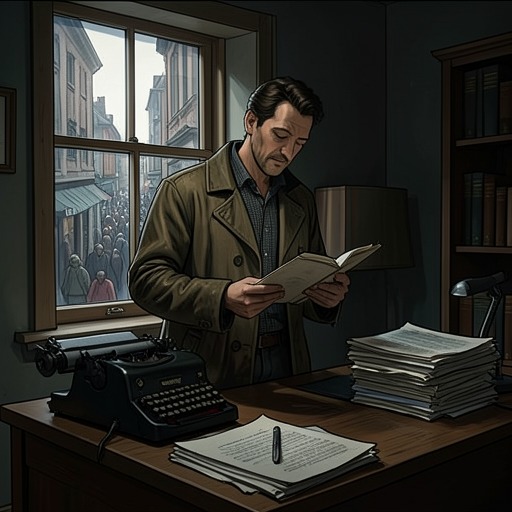
Martin Eden’s financial hardship
Martin EdenMartin Eden’s financial hardship is not a brief interruption in his writing career but the pressure that steadily narrows his choices. The cost of continuing to submit work—postage, rent, food, and the upkeep of his typewriter—falls due whether or not editors respond. His persistence is real, but money gives that persistence a deadline: each returned manuscript demands another expenditure, while each week without a sale brings him closer to having nothing left to send.
The Costs of Persistence
Martin Eden experiences submission as an impersonal mechanism: manuscripts enter one slot and either checks or rejection slips should emerge, yet he has found only the rejection slot. The standardized slips make the process feel more mechanical still. He has received hundreds, sometimes a dozen or more on a single manuscript, without one personal line to suggest that a human being has encountered his work. The material cost compounds this isolation. Postage on forty manuscripts has drained him almost as severely as his board bill, and he has stopped buying books and tried to economize wherever he can.
The economies are difficult to sustain and sometimes conflict with his attachments. Martin Eden does not know how to economize effectively; when he gives his sister Marian five dollars for a dress, he recognizes that the gift brings the inevitable end a week nearer. His financial predicament is therefore not simply a matter of careless spending. Even a small act of family generosity has immediate consequences because his margin has become so narrow. His determination to keep writing and his obligations to other people draw on the same dwindling funds.
Mounting Debt and Isolation
The returning manuscripts eventually accumulate faster than Martin Eden can afford to mail them again. In his small room, long envelopes pile up in a corner because he has no stamps. He is a month behind on rent for Martin Eden’s typewriter and has barely enough for the week’s board and employment-office fees. Looking at the ink-stained table, he finds himself attached to it: it has been a companion to his work, unlike the editors who send back impersonal slips. The affection makes the scene intimate, but it also shows how his writing life has become bound to ordinary objects whose use he may soon be unable to afford.
The hardship also changes how Martin Eden is seen by those around him. Gertrude Higginbotham, who had initially indulged his writing as a sisterly folly, grows anxious as she fears it is becoming madness. Bernard Higginbotham’s contempt is open and nagging, but Martin Eden is more pained by his sister’s worry. Ruth Morse has urged him to study and has not openly condemned his writing, yet she has not shown faith in it either. He has kept his work from her, both out of delicacy and because he does not want to take time away from her university studies. Once she asks to see it after taking her degree, he welcomes the prospect of a personal judgment; the hope of recognition thus remains emotionally important even as the financial crisis worsens.
Food, Credit, and Hunger
As the weeks pass, publishers’ checks remain distant and Martin Eden’s important manuscripts return to him. His hack-work fares no better. In one stretch, a partial sack of rice and a few pounds of dried apricots provide every meal for five days. The Portuguese grocer stops extending credit when the bill reaches three dollars and eighty-five cents, reasoning that without a job he risks losing his money. He offers a drink as a gesture of goodwill, but Martin Eden still goes to bed without supper. Business friendliness cannot replace the food that credit had temporarily supplied.
Other shopkeepers extend small amounts before drawing their own limits: five dollars at the fruit store, two at the baker’s, and four at the butcher’s. Martin Eden calculates that all his available credit amounts to fourteen dollars and eighty-five cents. He is current on the typewriter rent at that point, but estimates that he might obtain two more months of credit, worth eight dollars, before exhausting even that option. A sack of potatoes from the fruit store sustains him for a week, three meals a day. Dinners at Ruth Morse’s home help keep him going, though the abundance there is painful against his hunger; at meals with his sister he eats secretly and cautiously, taking more than he feels he should.
Selling Possessions to Continue
The crisis reaches a sharper point when Martin Eden has gone forty hours without food. Ruth Morse is away in San Rafael for two weeks, and shame keeps him from visiting his sister for a meal. That afternoon the postman brings five more rejected manuscripts. Martin Eden takes off his overcoat and walks down into Oakland; he returns without it and with five dollars. He pays a dollar toward each of four tradesmen, then buys steak and onions, makes coffee, and stews a large pot of prunes. After eating, he completes an essay called “The Dignity of Usury” before midnight. But he has spent the money needed for food and debts, not postage, so the finished essay goes under the table unsent. The episode turns a moment of relief into another obstruction: eating restores him enough to work, but the work cannot enter the market without money to mail it.
Later, Martin Eden pawns his watch and then Martin Eden’s bicycle. He uses the proceeds in part to buy food and in part to put stamps on his manuscripts and send them out again. The choice makes the costs of persistence visible: each renewed attempt consumes something he owns, while the manuscripts still have no assured buyer. His material resources are converted back into postage, keeping the cycle alive without making it more likely to yield immediate income.
The Market’s Closed Doors
Martin Eden also tries to earn money through shorter commercial work, but the apparent alternatives close one after another. He compares his hack-work with what appears in newspapers, weeklies, and cheap magazines and judges his own work superior, yet cannot sell it. Newspapers reject his submissions for plate material because their copy is supplied by an association. A juvenile periodical returns his incident-and-anecdote paragraphs; only later does he learn that its associate and sub-editors supplement their salaries by supplying such material themselves. Comic weeklies return his jokes and humorous verse, and magazines find no place for his light society verse.
He then sends storiettes to two newspaper syndicates. After twenty have failed to place, he stops, even as he continues to encounter stories in print that he believes are inferior to his own. Repeated rejection unsettles his confidence: he wonders whether his judgment is worthless and whether he is deceived by his attachment to his work. The irony is economic as well as artistic. Martin Eden must spend money to reach editors, but the market’s routines and gatekeeping prevent his writing from returning that investment. His hardship thus measures not only his lack of income but the widening distance between the labor he can produce and the recognition or payment that might keep him alive as a writer.