Martin and Joe leave the Shelly Hot Springs laundry
Martin EdenMartin Eden and Joe Dawson leave the Shelly Hot Springs laundry after months of exhausting labor have narrowed their lives to work, fatigue, and the search for escape. The departure is both a practical break with the hotel laundry and a turning point in how Martin understands the work: drinking is not the source of his degradation, he realizes, but a consequence of it. Martin chooses the sea; Joe, unable to make that choice with him, chooses to become a hobo. Their final handshake joins friendship to separation, while the laundry’s waiting freight cars point toward the radically different futures each man accepts.
The Labor Behind the Decision
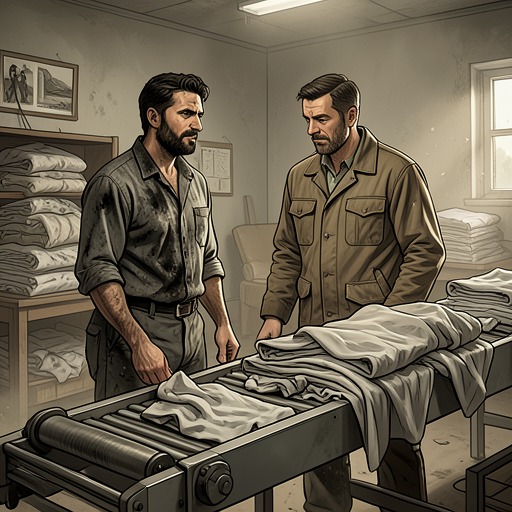
Martin’s exit follows weeks in which the laundry governs his time and attention. He and Joe work at a relentless pace, learning to save motions and keep tasks moving without interruption. Among their work is preparing and ironing two hundred white shirts: Joe operates the heated ironing machine, while Martin catches the shirts and irons their unstarched portions. In the overheated laundry, steam rises from damp cloth, the stove burns red and white hot, and the workers gauge iron temperature by holding the metal close to their cheeks. The process demands not just strength but trained, automatic precision.
That precision comes at the cost of almost everything outside the job. Martin’s hands and mind are absorbed by the next shirt and the next stroke; the hotel manager seems to command his thoughts as well as his labor. He sweats despite drinking enormous quantities of water and has no room, during the workday, to think about Ruth. The reading and writing that had shaped his earlier life disappear under the physical demands of the laundry. By the time a week’s work ends, the brief interval before the next one offers little recovery.
The pattern persists through a fifth and sixth week. At weekends Martin rides his bicycle the seventy miles to Oakland and seventy miles back, an effort he initially treats as a remaining spark of life but which adds further exertion instead of rest. He continues working on Monday, exhausted. At the end of the seventh week, he goes down to the village with Joe and drinks. Three months into the work, he makes that trip again. The repeated cycle connects the laundry’s demands to the drinking that follows them: in Martin’s clear moment of recognition, whiskey may obscure the damage, but the work has made him a beast of toil.
Martin’s Decision and Joe’s Alternative
During the village visit, Martin asks for paper and a pencil while drinks are being shared around the bar. He has the telegram altered so that it accounts for two laundrymen. Joe takes over the wording, making the decision a joint one in practical terms even though their destinations will differ. When Martin asks why Joe is quitting, Joe gives the same reason as Martin. The agreement has a limit, however: Martin is going to sea, and Joe cannot go with him.
Joe’s alternative is the road. He has already imagined hoboing as freedom from labor and obligation, and remembers a spell in the hospital with typhoid as beautiful because illness had spared him from working. Martin accepts the logic of Joe’s choice: a hobo, he says, is better off than a beast of toil, because at least he will live. The exchange gives their departure its central contrast. Martin leaves for the sea, a life he knows from earlier experience; Joe claims the possibility of doing nothing by setting out as a wanderer. Neither man proposes to keep enduring the laundry simply because its wages or routine are familiar.
Joe’s resolve becomes visible before the formal parting. On Monday morning, despite his aching head, he is preoccupied with the sunshine and trees outside rather than with his work. When he recognizes the hotel manager’s marked shirt among the soiled clothes, he throws it onto the floor and stamps on it. The gesture is a small, specific rebellion against the establishment that has commanded his labor. Martin laughs and keeps him at his tasks for the moment; new laundrymen arrive on Tuesday, and Joe explains his system to them without doing any more work himself. He says he will quit if the hotel fires him, but refuses to resume the labor in the meantime.
Parting of the Ways
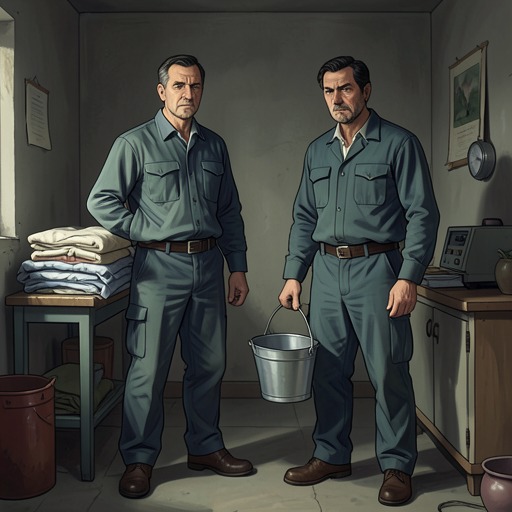
On Saturday the two men draw their pay and reach the parting of the ways. Joe asks, without much hope, whether Martin will change his mind and take to the road with him. Martin is already standing beside his bicycle, ready to start, and shakes his head. The choice is no longer an idea discussed over drinks: Martin is leaving, but he is not choosing Joe’s destination. They shake hands, and Joe holds on briefly as he tells Martin he expects them to see each other again before they die. He says that he likes him. Martin rides away, and Joe watches until the road’s bend hides him.
The final image separates the friends without turning their parting into a quarrel. Joe remains alone in the road, calls Martin a good man, and then plods toward a water tank beside a side-track. Half a dozen empty freight cars are waiting there for the up freight. For Joe, they offer a direction consistent with the hobo life he has chosen; for Martin, the bicycle carries him away from the laundry toward his own route. The men have shared a diagnosis of their life as laundry workers, but the solution they adopt is individual.
Consequences and Significance
The departure marks the end of Martin and Joe’s working partnership and makes the cost of the laundry’s routine explicit. The job has not simply tired Martin: its pace has displaced reading, writing, rest, and even sustained thought. His later recognition that drink follows toil rather than causes his decline reverses the apparent explanation of his behavior. Leaving is his response to the labor itself, not merely to its aftereffects.
The episode also distinguishes escape from renewal. Martin’s strenuous weekend rides had seemed to preserve some remnant of himself, yet the repeated 140-mile round trips only compounded his exhaustion. The actual break comes when he stops treating further exertion as a way to recover and recognizes that the work is making him less, not more, capable of living. Joe’s freedom, meanwhile, takes the form of refusal: he declines to work even while new men are being trained, stamps on the manager’s shirt, and heads toward the freight cars. Their separation is therefore not just a change of employment. It is the point at which two friends, united by their rejection of toil, part over what life beyond it should be.