Martin and Ruth’s engagement
Martin EdenMartin and Ruth’s engagement is a sudden change in their relationship, born in a wordless moment and named only afterward. Ruth recognizes that she loves Martin as they sit together in the hills; she then tells her mother they are engaged, although Martin has made no spoken proposal. The event joins private feeling to a practical conflict: Ruth insists on marrying him, while her parents expect her to choose someone from her own social station.
Setting and Turning Point
The engagement takes place during an outing that Martin identifies as their last in the hills for some time. He has noticed a storm gathering beyond the sea, while Ruth has decided that the day is too beautiful to continue reading. The book slips from Martin’s hands, and they sit in silence, looking out over the bay. These circumstances slow the scene down: a shared pause, rather than a discussion of marriage, becomes the setting for a decisive change.
Their closeness develops through small gestures, and Ruth’s account emphasizes that she had not consciously planned to initiate them. She does not draw back when Martin’s arm comes around her; she eventually rests her head against him, and they kiss. The narrative presents this movement as the point at which her previously unrecognized feeling becomes unmistakable to her. The scene’s turn is therefore not a decision reached through argument or negotiation, but a realization that arrives through their physical closeness and is understood only as it happens.
Mutual Recognition
Afterward, Ruth asks when Martin began to love her. He tells her that his love began at their first meeting and has grown since. Ruth, by contrast, says that her own feeling came suddenly: she had known that Martin loved her, but had not expected to marry him until that moment. Her response makes the engagement reciprocal without making the two experiences identical. Martin describes a long-standing attachment; Ruth describes a new understanding of herself and her relationship with him.
Ruth’s question about how Martin made her love him also reflects her surprise at the change. She does not present the engagement as the fulfillment of a plan she had steadily pursued. Instead, she tries to reconcile the present certainty of loving him with her former expectation that she would not marry him. Her account to her mother repeats this distinction: she says she did not know she loved Martin until they kissed, and that she now regards them as engaged despite his not having spoken a proposal.
Family Response
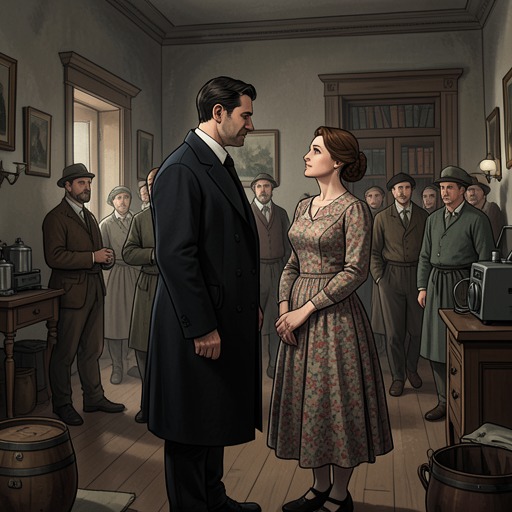
Ruth tells her mother that she and Martin are engaged, taking the relationship from a private realization into the family’s knowledge. Mrs. Morse is bewildered and initially suggests speaking with Martin so that he might understand and release Ruth. Ruth rejects that prospect. She insists that she loves him and intends to marry him if her mother will allow it; the declaration makes clear that she does not regard the engagement as an accident to be undone simply because it was unexpected.
Her mother explains the family’s expectation without claiming to have selected a particular husband for Ruth. She and Mr. Morse had planned for their daughter to marry a good and honorable man of her own station, chosen by Ruth when she loved him. Ruth’s attachment to Martin conflicts with that class boundary. She argues that her love is as real and compelling as her mother’s love for her father, but the conversation does not resolve the disagreement. Ruth and her mother eventually agree to wait for an indeterminate period without acting; Mrs. Morse and Mr. Morse reach the same conclusion later that night.
Significance and Immediate Outcome
The engagement is thus both a romantic commitment and the beginning of a family impasse. Its unusual form matters: Martin and Ruth understand themselves to be engaged before he has formally asked, and Ruth must explain the commitment to her mother after the fact. The absence of a proposal does not make the feeling less decisive for Ruth, but it does leave the relationship without an agreed public resolution at this point.
Mr. Morse interprets the development as foreseeable in retrospect. In his view, Ruth had been bound to awaken to love, and Martin, as the only man with whom she had been in contact, became its object. His explanation differs from Ruth’s account of a particular, sudden realization: he treats the outcome as a consequence of circumstance, while she insists on the reality of her love. The family’s decision to wait leaves these interpretations, and the conflict over social station, unresolved. The scene establishes the engagement as a turning point rather than a settled happy ending: the lovers have recognized their commitment, but parental acceptance remains uncertain.