Martin cares for Maria and improves her laundry operation
Martin EdenMartin’s care for Maria Silva becomes practical intervention in the work on which her household depends. When illness leaves her unable to manage an urgent ironing job, he takes up the iron himself, then improves both her ironing method and her wool-washing operation. The episode brings his experience as a laundry worker into the kitchen: his skill helps Maria and her children, but it also alters the image of him she had cherished.
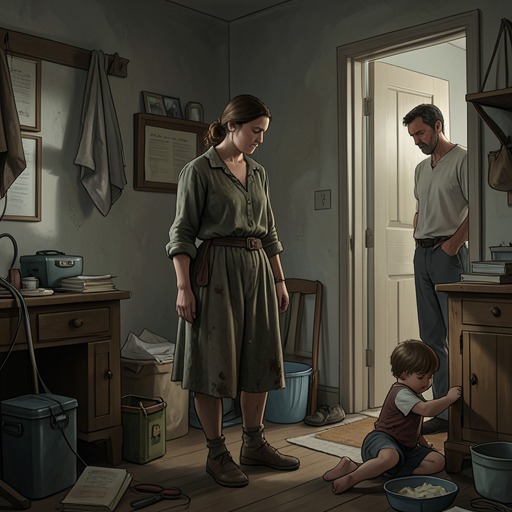
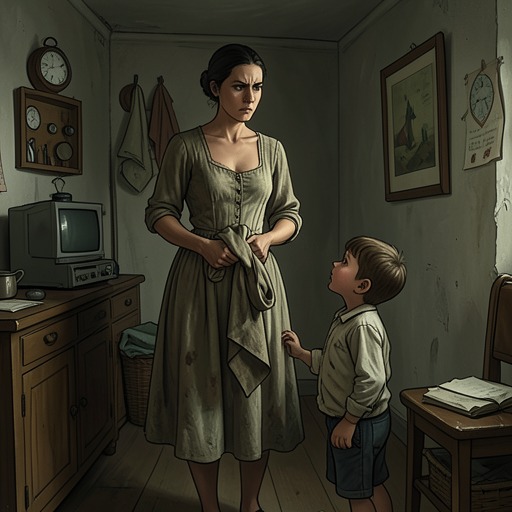
The crisis in Maria’s kitchen
One morning Martin finds Maria groaning with pain and crying from weakness as she tries to finish a large ironing. He recognizes her illness as La Grippe, gives her hot whiskey left from the bottles Brissenden had supplied, and tells her to go to bed. Maria resists because the work must be completed and delivered that night. Without the payment or work, she fears there will be no food the next day for her seven young children. Her insistence makes clear that resting is not a simple choice: the immediate demands of household survival compete with her need to recover.
The urgent garment is a fancy shirt-waist belonging to Kate Flanagan, who has specified that it must be delivered by evening. Maria regards the order as especially important; Flanagan is exacting about her clothes, and she is due to go to Golden Gate Park the next day with John Collins. Martin does not debate the job’s importance or ask Maria to risk finishing it while ill. He takes an iron from the stove and puts the garment on the ironing board, while guiding Maria to a chair so she can watch instead of continuing to work.
Improving the work
Martin completes the shirt-waist in a fraction of the time Maria would have needed, and to a standard she accepts. He explains that he could work faster if the irons were hotter. The scene shows his practical knowledge in action: he is willing to use heat that Maria would not ordinarily dare to use, and he identifies the temperature of the tools as one reason the work can be done more quickly.
He then turns to the method of sprinkling the clothes. Martin judges Maria’s technique inefficient and demonstrates that pressure is needed to distribute the water quickly. His intervention is not limited to taking over one task; he shows her how to change the process so the work can move faster. The attention to pressure and heat makes his help specific to the physical demands of ironing, rather than a general offer of sympathy.
Martin also makes a device for washing woollens. He gets a packing case from the cellar woodpile, fits it with a cover, and uses scrap iron the family had gathered for the junkman. The more elaborate contrivance draws on a method he had learned from Joe at Shelly Hot Springs. An old wheel-hub fixed to an upright pole serves as a plunger; attached to a spring-pole secured to the kitchen rafters, it can pound woollens in a barrel. Martin operates the mechanism with one hand, turning a laundry technique from his former workplace into a tool for Maria’s kitchen.
Once the device is in operation, Maria no longer has to wash the woollens herself. Her children work the pole and hub, sharing the labor through the mechanism Martin has assembled. His intervention thus extends beyond a single emergency: he leaves behind a workable arrangement that changes who performs the task and reduces Maria’s direct burden.
Help, work, and changed regard
The practical success does not simply deepen Maria’s admiration. She had imagined Martin through a romantic glamour, reinforced by his books and by the grand friends who visited him in carriages or brought many bottles of whiskey. Seeing him iron and build a washing device makes his working-class experience unmistakable. She recognizes him as an ex-laundryman and as a man belonging to her own class, not as a distant figure made mysterious by his reading and company.
That shift contains a striking contrast. Martin’s skill makes him more human and approachable to Maria, yet he falls in her estimation because the work exposes the ordinary laborer beneath the romantic image. Her response does not cancel the value of what he has done: he has cared for her while sick, completed the urgent garment, and devised a way to spare her further wool-washing. Rather, the help changes the terms of her regard. He is useful and close, but no longer mysterious.
Significance of the episode
The episode joins care to skilled labor. Martin answers Maria’s illness not with a grand gesture but by taking up the tools, diagnosing bottlenecks in the work, and adapting a device he learned to use elsewhere. The hot iron, the sprinkling technique, and the pole-driven wheel-hub show knowledge carried in his hands as well as in the books that previously distinguished him in Maria’s imagination.
The outcome is therefore both material and relational. The family can complete necessary work with less of Maria’s effort, while Maria sees more plainly the workingman Martin has been all along. His intervention makes him more accessible to her at the same moment that it strips away the romance she had placed around him. The scene gives practical care a double consequence: it eases a household burden and narrows the imaginative distance between them.