Martin takes a laundry job at Shelly Hot Springs
Martin EdenMartin Eden takes a job in the hotel laundry at Shelly Hot Springs when rejected manuscripts and empty pockets force a pause in his attempt to live by writing. The decision is practical, but not a renunciation of his ambition: he chooses hard work that appears to leave him room to study, and arrives carrying books in a breakfast-food box patched into a trunk.
The interruption of writing
The job search begins on a morning when Martin has no story to write. He has studied late, but cannot settle to a chapter of Fiske; instead, he looks through manuscripts piled in a corner, rereading favorite passages. He gives particular attention to “The Pot” and “Adventure,” and admires “Joy,” completed the previous day but left unsent for lack of postage. Their presence makes the change feel like a separation from work he still values. Martin cannot decide whether the trouble lies with his stories or with editors who publish inferior work, but he has no new assignment and no immediate way to keep submitting.
After breakfast, he puts his typewriter in its case and carries it down into Oakland. He owes a month on it, and tells the store clerk that he is going to work and will return in about a month to settle the account. The promise marks the pressure behind the change: he is not simply taking time away from writing, but trying to meet an overdue obligation while finding a way to support himself.
Meeting Joe Dawson
Martin crosses by ferry to San Francisco and goes to an employment office. Asked what work he can do, he offers a wide range of experience—hard labor, sailing, operating a typewriter, riding a horse—and says he is willing to tackle anything. The agent has no suitable opening to offer him. Joe Dawson, a new arrival at the office, interrupts because he needs to hire someone that day. Martin notices Dawson’s handsome but puffed, discolored face and recognizes that he has been drinking.
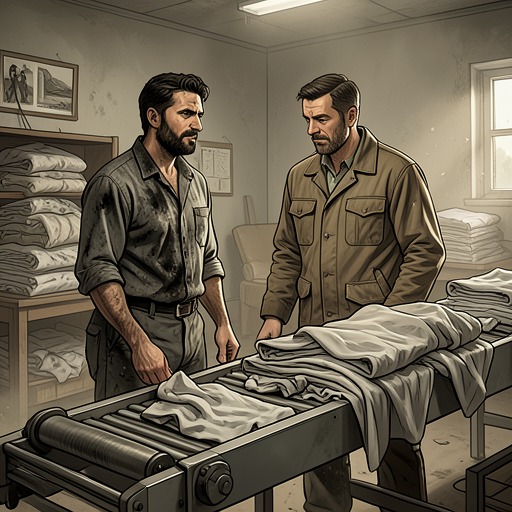
Dawson is looking for an assistant for a small laundry at Shelly Hot Springs, where two men do the work: Dawson as boss and a second man beneath him. Martin initially balks at the prospect of ironing delicate white garments, but says he could do plain washing, which he learned at sea. Dawson asks whether he is willing to learn. Their agreement begins not with a settled match of expertise but with Martin’s readiness to take unfamiliar work and Dawson’s immediate need for help.
Terms and decision
Martin pauses to consider the offer. He sees a possible balance in it: he could work hard, then study hard during his free time. Dawson adds that the position comes with good food and a room of his own. The private room decides the matter for Martin, who wants a place where he can read late without disturbance. The job is valuable to him not only as wages but as a hoped-for setting for continued self-education.
Dawson explains the pay arrangement plainly. The two workers together receive a hundred dollars and board; Dawson has been drawing sixty dollars and the assistant forty. Because Martin is inexperienced, Dawson proposes starting him at thirty dollars and raising him to forty once he can do his share. Dawson expects to perform much of the assistant’s work while training him. Martin accepts and asks whether there is an advance for the railroad ticket and other expenses. Dawson has spent his money drinking and has only a return ticket. Martin, too, is broke once he pays his board, so the agreement begins without spare cash or a cushion against difficulty.
The journey to Shelly Hot Springs
Martin finds a way to get their belongings to the job despite Dawson’s lack of money for travel. He plans to send his trunk on Dawson’s ticket and ride his own bicycle the seventy miles to Shelly Hot Springs, reaching the laundry on Sunday so he can begin work Monday morning. Before setting out, he goes home to pack. There is no one to say goodbye to: Ruth Morse and her family are spending the summer at Lake Tahoe.
Martin arrives tired and dusty on Sunday night. Dawson has already been working through a backlog of washing that accumulated while he was away to recruit him, and welcomes Martin with a wet towel around his aching brow. The supposed trunk that has arrived is a packing case for breakfast food, bought from Bernard Higginbotham for half a dollar and fitted by Martin with two rope handles so it could travel in the baggage car. Dawson watches as Martin unpacks a few shirts and changes of underwear, then books—more books than clothes. The improvised container makes the material narrowness of the move visible, while its contents preserve the purpose Martin had imagined for it.
Significance of the choice
The hiring brings Martin back into the working-class world he knows, even though he recognizes that books have opened a gulf between him and Dawson. He finds that crossing back is not difficult: laboring camaraderie comes naturally to him, and he solves the transportation problem Dawson cannot manage with his aching head. In this episode, intellectual aspiration and physical work are not yet presented as mutually exclusive. Martin takes the laundry job precisely because he hopes it will make sustained study possible, but his first arrival also places him inside an operation already burdened by unfinished washing. The contrast between the life of the mind he seeks and the work waiting at the laundry is built into the arrangement from the outset.