Norton
Martin EdenNorton is a thoughtful and excitable idealist who emerges during a late-night gathering arranged by Brissenden in a crowded lodging-house setting. There, he joins Kreis and Hamilton in a forceful dispute over philosophy, and his willingness to defend Martin Eden from Kreis’s challenge draws Martin into a living argument about the basis and limits of knowledge. Norton’s role is brief but consequential: through him, the abstract ideas Martin has encountered in books become passionate, personal, and open to challenge.
Identity and Introduction
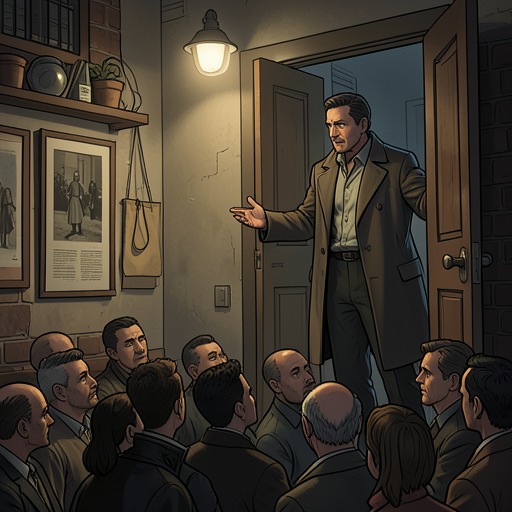
Norton is one of the intellectuals Brissenden brings together in the rooms where Kreis lives. The gathering ranges across literature, drama, labor conditions, politics, and philosophy; its participants are presented as people who have formed opinions for themselves and can connect knowledge across subjects. Norton belongs to this argumentative company, but his presence acquires particular importance when Brissenden identifies Martin as an admirer of Herbert Spencer and invites Kreis to test him. Norton watches the introduction with a sympathetic, almost protective expression, as if to assure Martin that he will not be left alone in the encounter.
That gesture establishes a relationship before Norton makes his case. Martin has entered a discussion in which Kreis and Hamilton share a materialist position, while Norton stands apart as an advocate of idealism. Yet the exchange is not simply a contest between a prepared thinker and an uninformed newcomer. Norton addresses Martin directly, and the debate gives Martin a chance to hear philosophical commitments enacted by people who argue over them with urgency. The scene places Norton among the gathering’s participants while making him, for a time, Martin’s defender and intellectual guide.
Intellectual Method and Temperament
Norton’s idealism has not previously attracted Martin, but Norton’s account makes its logical plausibility newly apparent to him. That effect matters: the argument changes Martin’s sense of what philosophy can be, even though the gathering does not settle the dispute. Kreis and Hamilton dismiss Norton as a metaphysician; Norton, in turn, accuses them of relying on words rather than reasoning from facts. The charge exposes a difference in method beneath the clash of positions. Kreis and Hamilton regard starting from facts and naming them as a basic discipline of thought, whereas Norton questions whether their claims can establish what they take them to establish.
His exchanges range through the distinction between phenomenon and noumenon and the problem of explaining consciousness. Norton objects to what he sees as word-juggling and challenges the assumption that positive science can serve as a foundation for every kind of inquiry. He invokes John Locke’s rejection of innate ideas to argue that human knowledge begins without innate contents and is limited to appearances received through the senses. From that starting point, he presses a difficulty for his opponents: if the mind receives only phenomena, it cannot simply claim knowledge of ultimate reality. His reasoning turns their own premise against their confident conclusions.
Norton’s manner is intense without becoming uncontrolled. As the night advances and the argument continues, he grips his chair as though restraining himself from rising, while his expression hardens and his eyes flash. The description presents an interlocutor keenly affected by the dispute, but still able to hold his position and assemble a sustained attack. His sensitivity is part of his intellectual presence: the argument is not detached performance but something he feels, even as he keeps its claims in view.
The Debate with Kreis and Hamilton
The gathering first gives Martin a broad impression of its members’ intellectual range, but the dispute over idealism sharpens the scene into a direct confrontation. Kreis begins by challenging Martin, and Norton repeatedly intervenes until the exchange between Norton and Kreis takes over. Hamilton also joins the discussion. The debate becomes an event Martin could scarcely reconcile with the setting: in a working-class district south of Market, philosophy is not presented as an academic exercise conducted at a distance, but as an animated argument among people whose attention and emotion are visibly engaged.
Norton’s case against the materialists draws on Berkeley and the limits of Spencer’s answer to him. He tells Martin that Berkeley’s challenge has never been adequately answered and maintains that even Spencer’s followers do not claim more than a near-success. Hamilton responds by recalling Hume’s judgment that Berkeley’s arguments admit of no answer and produce no conviction. Norton distinguishes Hume’s personal response from the validity of the argument: Hume, he says, could not answer Berkeley, but was candid enough to admit it. The disagreement thus concerns not only what can be known, but also whether a thinker’s inability to accept an argument amounts to a refutation of it.
The contest is not framed as a simple triumph for Norton. He can make idealism persuasive to Martin, while Kreis and Hamilton remain unconvinced and continue to challenge his premises. The narrative emphasizes the force of the exchange and the competing habits of reasoning rather than announcing a settled philosophical verdict. Norton’s intervention nevertheless broadens Martin’s understanding: Spencer is no longer the only compelling voice in the room, and a position Martin had not favored now appears intellectually serious.
Narrative Role and Significance
Norton gives the philosophical discussion dramatic shape through a combination of protection, opposition, and explanation. His sympathetic look toward Martin precedes his defense of him; his argument then shifts the focus from Martin’s admiration for Spencer to a larger disagreement over idealism and materialist monism. As Norton and Kreis contest each other, the books become present in the room as arguments people can inhabit, test, and oppose. Martin’s experience of philosophy consequently changes from reading printed doctrine to witnessing ideas animated by disagreement.
Norton’s importance rests on this concentrated effect rather than on a fully narrated personal history. The evidence presents no account of his life beyond the gathering, and his characterization is formed through his conduct there: his alertness, his emotional investment, his defense of Martin, and his sustained challenge to Kreis and Hamilton. In the scene, he demonstrates that intellectual authority need not silence conflict. His arguments leave the debate open, but make its stakes newly legible to Martin, whose intellectual world has just widened.