Overdue
Martin EdenOverdue is Martin Eden’s novel of twentieth-century sea adventure and romance, a work in which he tries to unite an absorbing surface story with a universal account of life. Its making marks both a high point in his confidence as an artist and a stark contrast between the mastery he feels at his desk and the deprivation surrounding him. Published after his prolonged struggle for recognition, it becomes a bestseller and helps turn his private labor into public fame.
Conception and Design
Martin begins Overdue from a story idea he had sketched weeks earlier and that had continued to press upon him. He imagines a brisk adventure and romance involving real characters in a real world under real conditions. Yet the plot is not the work’s deepest purpose: beneath its accessible action he intends to place a meaning that a casual reader need never consciously detect, and that will not lessen the reader’s enjoyment. For Martin, the particular story is a vehicle for a universal motif. He first finds the general idea, then searches for the people and the time and place through which it can take form.
He estimates that the novel will run to no more than sixty thousand words, a modest undertaking by the measure of his productive energy. At the beginning, the scale of the project matters less than his changed relation to his craft. After months of intensive study and application, he no longer fears that a failure of technique will cut into the work. He believes he can attend to its larger design with a sure hand, rather than remain preoccupied with the basic tools of writing.
Artistic Method and Ambition
Martin sees the story as both particular and expansive. Its characters and events should be convincing in their own right, while also expressing truths that hold across time, the sea, and human life. He connects this confidence to Herbert Spencer and to evolution, which he regards as a master key for understanding life’s relationships. That intellectual framework informs the novel’s ambition: the sea story is not merely an adventure plot, but a means of shaping a comprehensive vision within fiction.
The project also tests Martin’s sense of his place among writers. He compares his still-unwritten story with existing sea fiction and judges it immeasurably superior. His expectation that it will succeed with magazine readers accompanies an almost extravagant confidence in its artistic stature. He imagines that even the admired sea writer Conrad might recognize the achievement. The scene presents ambition not as a later response to acclaim, but as part of the novel’s conception: Martin believes in the work before it has reached its final pages or any audience.
Composition During Crisis
Martin has reached roughly the halfway point when he reads from Overdue to Brissenden. He has already sent other work into the publishing world, including The Shame of the Sun and Ephemera, but the novel is the writing occupying him directly. The reading gives Brissenden access to the developing work while it remains unfinished; Martin’s confidence in its force is already established before the later strain of completing it.
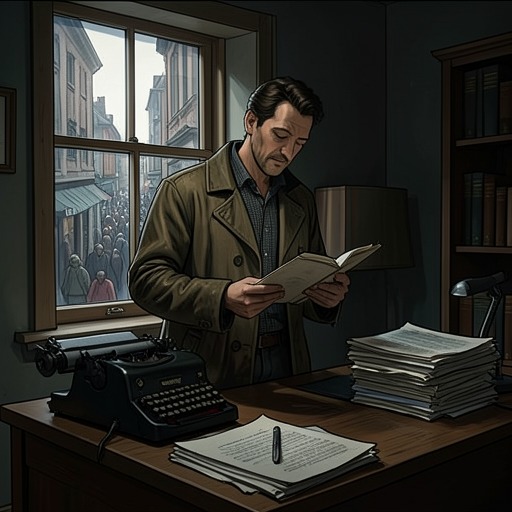
After Ruth’s family rejects him, Martin returns to his room in North Oakland in a state of stunned detachment. He notices Overdue on the table and takes up his pen. The unfinished novel gives him a task that can be completed, even when he cannot imagine what should follow in his own life. His impulse toward completion is almost mechanical: one project has ended, and this remaining one must now be brought to its end. He writes for five days, going nowhere, seeing nobody, and eating meagrely.
A letter then brings news that The Parthenon has accepted Ephemera. Martin sends the magazine a collect telegram authorizing publication, with only five cents left for his fare home. He returns to Overdue. Although he has composed the story chapter by chapter in advance, he discovers a stronger opening and develops it, adding twenty thousand words. The change is not prompted by a practical need to lengthen the novel; his artistic standards compel him to make the work better. The revision shows that his craftsmanship remains active even as he feels detached from the world around him.
When the novel is finished, the typewriter firm’s agent has come to collect the machine. Martin types the final pages on his one chair, writes the final word, and watches the typewriter leave. He is faint with hunger and has eaten nothing for thirty-six hours. The completion brings relief, but not renewed purpose: he lies down in a daze, and the work’s ending coincides with a profound sense of finality in his own life.
Publication and Reception
The Meredith-Lowell Company rushes Overdue onto the market when Martin is at the height of his popularity. As fiction, it sells even more strongly than The Shame of the Sun. For week after week, Martin has two books at the top of the bestseller list. Readers drawn to The Shame of the Sun also respond to the sea novel, whose confident command of a large vision gives the adventure story an appeal beyond its immediate genre.
The success confirms Martin’s unusual double achievement as critic and creator: he has first addressed the literature of mysticism and then supplied a work of the kind he had examined. Money and fame arrive in abundance, and he watches the commotion with more amusement than interest. The acclaim is striking partly because it comes after the period in which his work had gone unrecognized and his material circumstances had become desperate.
Significance in Martin’s Arc
Overdue joins artistic completion to material and emotional exhaustion. Martin can enlarge and refine the novel according to his standards even when he is hungry, isolated, and unable to care about the future. Its successful publication later demonstrates the distance between the value he had already placed in his work and the recognition that the literary marketplace withheld until after the effort was complete.
The novel’s reception also sharpens Martin’s doubts about what public esteem measures. Judge Blount invites him to dinner after Martin’s books have appeared, although Martin recalls that the judge had not done so when they met earlier. Martin concludes that the invitation follows not from a change in his character or from work newly performed, but from the work’s newly visible status as published achievement. Overdue thus becomes part of the reversal at the center of his fame: the labor existed before the public rewarded it, while the book’s commercial success changes how society treats its author.