Shelly Hot Springs
Martin EdenShelly Hot Springs is an up-country hotel whose small steam laundry becomes the setting for Martin Eden’s most concentrated encounter with industrial routine. He takes the job because he expects that a few months of hard work will give him time to study, but the laundry’s pace overturns that calculation: the work occupies his hours, exhausts his body, and narrows his attention until intellectual life recedes. The skills he acquires there do not disappear with the job; years later, he uses a technique learned from Joe to improve Maria’s laundry.
Setting and Work Arrangement
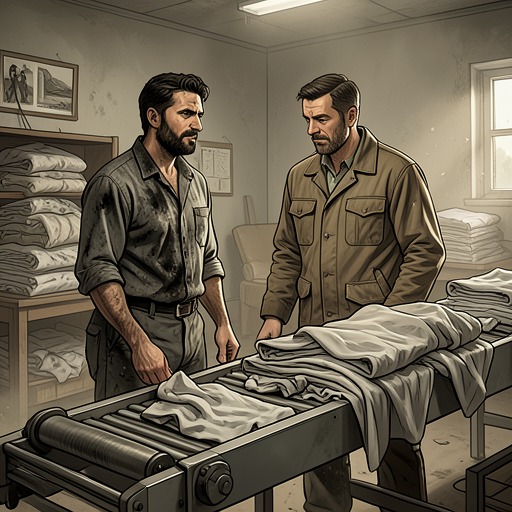
The laundry belongs to the hotel at Shelly Hot Springs and is staffed by two men: Joe, the boss, and an assistant. Joe proposes that Martin work under him and learn the trade. The offer includes meals and a private room, and Martin sees the position as a practical arrangement that might let him work hard while preserving time for study. His arrival already hints at the contrast between his ambitions and the material conditions of the job. He rides his bicycle the seventy miles to the hotel and unpacks a few shirts and changes of underclothes from a makeshift trunk, followed by his books.
The workplace is equipped with modern machinery, but mechanization does not make the labor easy or self-directed. The machines can perform only part of the process; Martin and Joe must sort, feed, wring, dry, starch, iron, fold, and keep the work moving. Their tasks are joined in a continuous sequence, with each man’s pace affecting the other’s. The hotel’s guests enjoy cool verandas and iced drinks while the laundry workers process the linen that sustains that comfort.
The Rhythm of the Laundry
Martin begins by sorting soiled clothes and helping with the wringing. A spinning receptacle removes water from the garments, after which he alternates between the wringer and dryer and shakes out socks and stockings. Later, the men iron and fold clothing well into the evening. On his first day, work continues after supper until ten o’clock; Martin has spent fourteen hours on his feet. He tries to read afterward, but falls asleep over his book and wakes in the night with stiff muscles and too little rest.
Joe teaches through the precise economy of his movements. He shows Martin how to reduce a task from five motions to three, or from three to two, and Martin absorbs these instructions as a practical discipline of eliminating wasted movement. They process two hundred white shirts, dividing the work between Joe at the machine that irons the yoke, bands, and bosom and Martin, who irons the portions left unstarched. The work requires judgments that become almost automatic: the men gauge an iron’s temperature by holding it near the cheek, and cool an iron in water when it is too hot. Martin admires the accuracy these repeated decisions demand, but there is little leisure to contemplate it; another garment is waiting as soon as one is finished.
The workload intensifies when the hotel is full and additional fancy-starched garments arrive. The men work late under electric lights, eat hurriedly, and sometimes fit in work before breakfast. At the busiest point, Martin has abandoned his cold baths, and the weeks become a sequence of tasks with scarcely an interval. The laundry’s heat and speed are not incidental hardships but part of the labor system: the men have to maintain the pace required to supply clean linen, while rest and personal time are repeatedly displaced.
Effects on Martin
Martin’s original plan depends on keeping work and study alongside one another. In practice, even the first day defeats it. During the long hours, his attention contracts around the garment in front of him, the iron’s movement, and the next task. The broad intellectual questions that had occupied him give way to the immediate demands of the work; even his memories of Ruth surface only briefly when he is going to bed or getting up for breakfast. The change marks more than fatigue. The job temporarily takes command of the mental space in which Martin’s ambitions and relationships ordinarily exist.
His attempted escape from the weekly routine also becomes another form of exertion. At three o’clock on Saturday, he oils and adjusts his bicycle and rides the seventy miles to Oakland; on Sunday, he rides the same distance back so he can begin work again on Monday. He repeats this round trip for weeks, but it does not restore him. After seven weeks, he goes to the village with Joe and drinks; later, after three months, he recognizes that the work itself is making him feel like a creature of toil. In his understanding, drinking follows the labor rather than causing the underlying condition. The realization overturns his initial belief that endurance at the laundry can serve as a route toward intellectual and artistic achievement.
When Ruth and her family return to Oakland, Martin has stopped writing and is recovering from the work’s effects. He later explains to Ruth that the laundry was an excess of toil, not evidence that he feared hard work, and says he intends to go to sea once more before returning to the magazines. The episode gives him material for a possible essay on the degradation of toil and working-class drinking, though the evidence presents that as a proposed subject rather than a completed work.
Skills and Later Significance
Shelly Hot Springs remains present in the narrative through the practical knowledge Martin carries away. When he later sees Maria struggling with woollens in her kitchen laundry, he constructs a simple pounding device using a barrel, a wheel hub fixed to an upright pole, and a spring-pole attached to the rafters. The wheel hub acts as a plunger, allowing the woollens to be worked with one hand. Martin learned the contrivance from Joe at Shelly Hot Springs; what began as a method for speeding laundry work becomes a way to reduce Maria’s burden and involve her children in the task.
The location therefore holds two connected meanings. At the hotel, the laundry’s efficiency depends on workers giving nearly all their time and concentration to repetitive labor; the process leaves Martin little room for the study that brought him there. Later, the knowledge acquired in that same workplace proves useful beyond the hotel and helps him improve another household’s work. The narrative’s contrast is not between useful skill and useless labor, but between the value of practical knowledge and a working rhythm so consuming that it suppresses the worker’s capacity to think, rest, and pursue other aims.