Social Darwinism
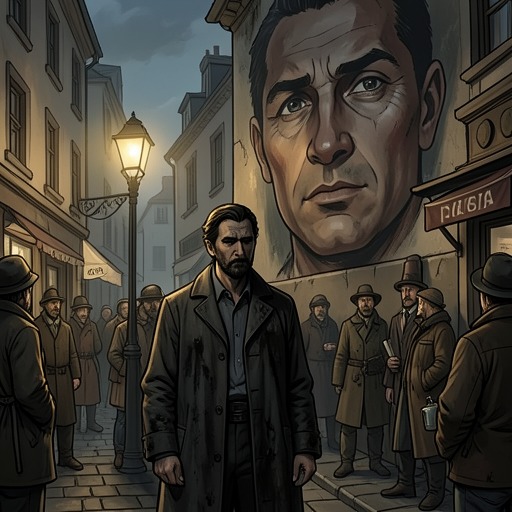
Martin EdenSocial Darwinism in Martin Eden is presented chiefly as Martin’s attempt to turn a biological account of development into a social and political law. At an Oakland socialist meeting, he argues that society cannot escape the struggle in which the strong survive and the weak tend to perish; a society that protects everyone, he insists, would frustrate development and deteriorate. The idea gives Martin a forceful language for opposing the Socialist movement, but the novel also shows the strain between his abstract ranking of people and his responses to particular lives.
The doctrine and its logic
Martin’s argument begins from selection. Observing a frail speaker and the working-class audience, he imagines them as representatives of those whom Nature rejects in favor of exceptional individuals. He extends that interpretation from individuals to entire societies: if the weak are preserved and allowed to reproduce on equal terms with the strong, he contends, each generation will lose strength rather than increase it. In this reasoning, biological development becomes a standard by which political arrangements are judged.
At the meeting, Martin cites Herbert Spencer and Malthus and describes his claims as biology rather than sentimental ethics. He argues that a society organized around the weak must annul the law of development, yet cannot offer a replacement law capable of maintaining its strength. His conclusion is categorical: such a society will deteriorate as the people composing it deteriorate. The argument makes social hierarchy appear not merely desirable but inevitable, as though a political order reproduces a law of nature rather than a historically made arrangement.
Martin’s imagery sharpens that claim. He contrasts the figure on horseback with the many people he calls slaves, and describes the rise of traders and money-lenders in the United States as a new form of mastery. He accuses that class of controlling judges and legislatures and points to children laboring and millions of people inadequately housed or fed. These examples expose an important tension in his position: he denounces the exploitation of the weak while treating their subordination as part of the struggle he believes no society can abolish. His sympathy for the oppressed remains constrained by a theory that interprets weakness as evidence of biological failure.
The Oakland debate
The doctrine becomes a public performance when Brissenden urges Martin to address the packed hall. Martin is initially allotted five minutes, but the audience, interested in the force of his opposition, presses for him to continue. He speaks directly against the listeners’ doctrines and identifies them with the slaves in his argument. His confidence rests on a distinction between attacking their politics and accepting their moral premises: he presents himself as stating biological necessity, not appealing to compassion.
The audience does not simply submit to his argument. After Martin sits down amid uproar, speakers rise one after another to answer him, and the meeting becomes an intellectual battle. Their replies shake him with new lines of thought—not, as the narration emphasizes, new biological laws, but new ways of applying the old ones. This response matters because Martin has treated his own deductions as conclusive; the exchange reveals that the same general ideas can be interpreted and applied differently. The scene gives the Socialist movement an active intellectual presence rather than reducing its members to the weak figures in Martin’s private schema.
The test of personal feeling
Martin’s confidence in his hierarchy falters when he encounters its implications within his own family. After the controversy surrounding his socialist speech, he meets Gertrude, who tells him that Bernard is furious and has barred him from the house. She asks Martin to go away, find work, and return when the scandal has passed; she even offers him money. Martin refuses, although he knows he will soon need to visit a pawnbroker. To his family, getting a job is the practical answer to disgrace and hardship. He regards their advice as the language of people confined by their own class position, but he cannot explain his intellectual stance to them.
As Gertrude leaves in tears, Martin feels sorrow at the sight of her and recognizes her as someone trampled by the strong. The recognition unsettles the Nietzschean structure he has built around himself. He sees the contradiction: pity and compassion, which his doctrine classifies as products of the weak, are precisely what he feels for his sister. This does not produce a new political theory or erase his contempt for what he calls slave morality. Instead, it makes the abstract opposition between strong and weak harder for him to sustain when it touches someone he loves.
Social consequences and estrangement
The public consequences of the socialist controversy intensify the separation between Martin’s theory and his social world. In the aftermath of a cub reporter’s work, a grocer refuses him further credit, neighborhood opinion turns against him, and children call him a hobo and a bum. Maria remains loyal, while the Silva family defends his honor in fights that bring black eyes and bloody noses. Gertrude’s account of Bernard’s anger makes the cost within Martin’s family equally plain. These reactions do not resolve the argument he made at the meeting; they show how a political position, once turned into a public label, alters ordinary dealings and relationships.
Martin’s alienation extends beyond his family and the working people he once knew. After joining old companions in a fight, he quickly loses the exhilaration of combat and feels himself separated from their way of life. He thinks that books have opened a distance between them, yet the bourgeoisie cannot understand him either, and neither can Lizzie. The episode underlines a limit in his belief in individual superiority: intellectual distance may distinguish him, but it does not provide a community in which he belongs.
Fame, identity, and the limits of the theory
When Martin becomes famous, he rejects the public image created around him. He distinguishes the lived person—once a sailor and hoodlum, a reader who struggled through the library, and a writer who worked through the night—from the famous author assembled in the mob’s mind. The magazines compete to claim that they discovered him, turning his reputation into a public possession. His analysis of the crowd echoes his earlier distrust of collective judgment, but it also exposes another kind of power: the public can create and consume an image of an individual without knowing him.
This later crisis should not be reduced to a direct consequence of Social Darwinism. The evidence instead places Martin’s doctrine within a broader pattern of estrangement and disillusionment. His thoughts circle around work performed, and he concludes that the famous Martin Eden is a vapor projected onto his former self. When he recognizes that he is in the Valley of the Shadow, life itself has become bitter to him; sleep, once a theft from living, is now something he longs for because he resents life. The doctrine that once promised to explain society through strength and survival offers no remedy for this exhaustion. The novel’s treatment of Social Darwinism therefore turns on a revealing contrast: Martin can argue that human worth follows the law of selection, but neither his sister’s suffering nor his own isolation fits comfortably inside that abstraction.