The Debate Between Idealism and Realism
Martin EdenThe Debate Between Idealism and Realism is both a philosophical contest and a test of Martin Eden’s intellectual and artistic independence. In a discussion among Norton, Kreis, and Hamilton, Martin encounters idealism not as a remote doctrine in books but as an urgent exchange between people; he is excited by its force without abandoning his realist convictions. Later, he applies the same divide to his conflict with Ruth Morse, arguing that the bourgeois culture she represents would have formalized his writing and estranged him from what he regards as vital reality.
A philosophical argument brought to life
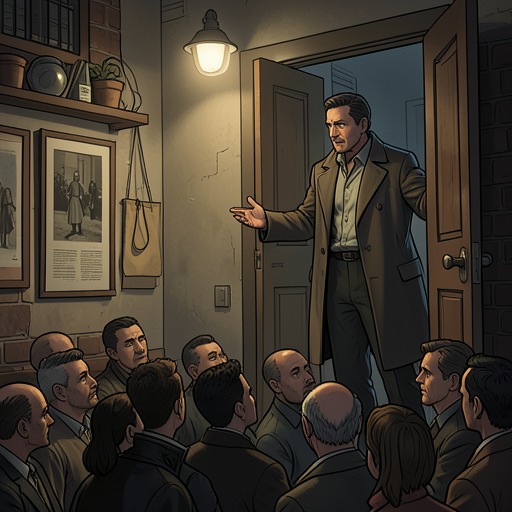
The debate takes place in a labor neighborhood south of Market, where Martin has expected neither this kind of gathering nor this intensity of intellectual exchange. Kreis initially engages him, but Norton intervenes, and the discussion turns into a personal contest between Norton and Kreis. Hamilton and other listeners join in at intervals. Martin watches the argument with astonishment: philosophy, previously encountered in books by figures such as Kant and Herbert Spencer, now seems embodied in the speakers’ excitement and in the attentive faces around them. The scene makes intellectual life tangible to him without separating it from the social setting in which he finds it.
The exchange is not a simple opposition between one idealist and two identical materialists. Norton presents idealism in a way Martin has not previously encountered, while Kreis and Hamilton challenge him from a position they associate with positive science and materialistic monism. They accuse Norton of metaphysical reasoning; he, in turn, accuses them of reasoning from words to theories rather than from facts to theories. Their shared insistence on naming facts does not settle what can be known from them. The argument exposes a dispute not only over conclusions, but over the proper starting point and limits of philosophical reasoning.
Knowledge, appearances, and the limits of science
Norton’s case presses on the materialists’ own account of knowledge. Drawing on John Locke’s rejection of innate ideas, he argues that a mind beginning without innate content receives appearances through the senses, while ultimate reality, or noumena, cannot simply enter that mind by some other route. He turns this reasoning against those who claim to know matter as it is in itself: on their own account, they know matter only through its appearances and changes, including changes that affect consciousness.
From that premise Norton challenges positive science when it moves beyond phenomena to claims about ultimate reality. If scientific knowledge concerns appearances, he argues, it cannot by itself establish what lies beyond them. He therefore objects when science is used to assert either the non-existence of God or the existence of matter as an ultimate reality. For the sake of argument, he temporarily grants matter’s reality, but insists that this concession does not resolve the deeper ontological question. The force of his challenge lies in turning his opponents’ stated limits of knowledge back upon their own conclusions.
The debate also moves through Berkeley, Hume, Herbert Spencer, and Hamilton’s Law of Parsimony. Norton maintains that Berkeley has not been answered, and says Herbert Spencer came nearest without coming close enough; Hamilton invokes Hume’s view that Berkeley’s arguments admit of no answer and produce no conviction. Norton replies that this describes Hume’s own mind, not a conclusive refutation. When Norton wanders into Kant, Kreis jokes that good German philosophies go to Oxford after death; later, Norton invokes the Law of Parsimony, which his opponents claim for their own reasoning. The fast changes of target and tactic give Martin a view of philosophy as active disputation rather than settled doctrine.
Martin’s response and continuing realism
Martin does not leave the gathering converted. On the ferry back to Oakland, he tells Brissenden that the discussion has made life seem worth more by showing him people so absorbed in ideas. He admits that he had not appreciated idealism before, and says the encounter has left his mind active with questions. Yet he identifies himself as a realist by nature and cannot accept idealism. He also thinks he might have answered both Kreis and Hamilton and challenged Norton, and remains unconvinced that the debate has damaged Herbert Spencer’s position.
That unresolved reaction matters: Martin’s intellectual openness does not require him to surrender his judgment. He plans to read Saleeby and take part in a future discussion, treating the encounter as a reason for further study rather than as a verdict. The ferry scene gives the debate an immediate consequence in his life: it turns a once-abstract disagreement into a question he wants to investigate for himself, while confirming that excitement and persuasion are not the same as conversion.
Realism as artistic and class conflict
Later, in speaking to Ruth Morse, Martin recasts realism as more than a philosophical preference. He argues that it is imperative to his nature and that the bourgeois spirit fears it because it is afraid of life. In his account, Ruth’s well-meant efforts would have destroyed his writing and career by formalizing him, compressing him into a narrow model of acceptable life, and remaking him according to her class’s ideals, values, and prejudices. This makes the earlier philosophical disagreement part of a larger conflict over who has the authority to define what counts as truth and respectable art.
Martin’s language also reveals a gap in communication between them. He believes Ruth remains unable to grasp what he means: what he considers vital reality sounds to her like fantasy, and she is, at best, puzzled and amused that someone who has risen from poverty should judge her class as vulgar. His accusation is therefore not only that their values differ, but that she cannot recognize the reality from which his judgment comes. Ruth has protested that she meant well; Martin accepts that intention while insisting that its consequences would still have been destructive to him.
The concept holds together two stages of Martin’s development without making them identical. In the gathering, realism names his resistance to idealist conclusions even as he welcomes the challenge and resolves to study further. In the later confrontation, realism names the artistic and social independence he believes he must defend against bourgeois refinement and class conformity. The debate’s significance lies in that continuity: Martin remains willing to encounter opposing ideas, but refuses to let either philosophical authority or social approval determine the reality his writing should face.