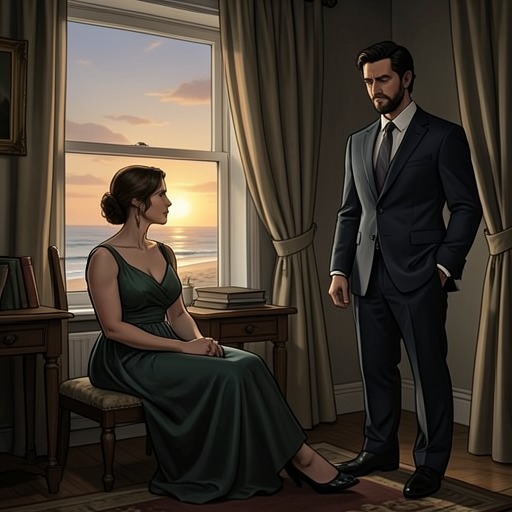
Colleen Sherman’s Disappearance at Sea
Match PointColleen Sherman’s Disappearance at Sea is the apparent loss of Willa Ashford’s closest friend and beach-volleyball partner: a storm at sea, a missing woman, and an investigation that could not establish what had happened. The incident was treated as a presumed drowning, but the absence of a body and the details surrounding the voyage left a persistent gap between the authorities’ conclusion and what could be known. Recalled by Willa and later reinterpreted by Colleen’s own reference to her forced time away, the disappearance becomes both a formative bereavement and a false ending.
Background and the Voyage
Before Colleen vanished, she and Willa were bound by more than their work as elite athletes. They had been teammates and best friends since Willa switched to beach volleyball ten years earlier. Willa had arrived with an indoor-volleyball gold medal, while Colleen was the experienced beach player who taught her the circuit. Their partnership grew into a sister-like bond. After their parents died in a plane crash over the Adriatic Sea while traveling to an event in Croatia, neither had siblings to rely on; each became the other’s only family. That history explains why Colleen’s loss struck Willa not simply as the disappearance of a teammate, but as the loss of the person she turned to when life became unbearable.
Colleen was an expert sailor. Her father had taught her when she was young, and she had continued sailing; Willa believed that Colleen might even have been capable of making the Olympic sailing team had she not chosen volleyball. On the day she disappeared, Colleen went out on her boat with Corey Baxter, her fiancé. Willa could not confidently identify the boat’s type, recalling it as either a sloop or a ketch. A storm arrived and the wind rose. Corey later said that he was struck by the boom and knocked unconscious. When he awoke with a severe headache and a large knot on the back of his head, Colleen was gone.
Search and Official Explanation
A search lasted three days. Willa spent hours looking for Colleen, but the searchers found no trace of her and never recovered her body. The authorities concluded that Colleen had been thrown overboard, probably after being struck and rendered unconscious, and drowned. Her skill as a swimmer made that conclusion especially painful for Willa, though the authorities’ theory was that Colleen, like Corey, had been knocked unconscious. The lack of a body meant there was no direct confirmation of what had happened; the presumed drowning was an explanation for the evidence, not an observed final moment.
Corey’s account was examined against the available records. He called for help as soon as he realized Colleen was missing, and the Coast Guard pinpointed his location. He refused to leave the area but was taken to a hospital for treatment of a severe concussion. Authorities checked video feeds showing that both he and Colleen had left the marina that morning, while the boat’s GPS placed their journey only as far as the location where Corey was found. Those details supported the known outline of the trip, but did not resolve how Colleen disappeared.
Suspicion nevertheless fell heavily on Corey, and he remained a prime suspect. The possibility raised in discussion was that he might have knocked Colleen unconscious or strangled her before putting her overboard, then injured himself to support his story. Willa rejected that interpretation. She considered Corey’s distress genuine, believed that he loved Colleen, and pointed to his call for help and cooperation with the search as consistent with his account. Yet her confidence in him could not supply the missing evidence, and the case remained troubling to those who knew Colleen. Vic Bello later told Colt Fontaine that the body had never been found and that the circumstances did not add up: Colleen was an expert sailor who would have taken precautions.
Loss and Its Consequences
For Willa, the disappearance became a period of grief so severe that she could not imagine continuing to play. She had once vowed that she would never return to the sport after hanging up her bikini. Instead, she took an unpaid assistant-coaching position at a high school and discovered that she loved teaching the game. The young players absorbed what she taught them, and she began considering other openings, including head-coaching positions. Her move away from competition was therefore not a rejection of volleyball: she still loved both indoor and beach play, but coaching offered a way to remain connected without replacing Colleen as her partner.
That withdrawal was unsettled when the United States faced the final opportunity to earn a place in the next Olympic Games. Executives, sponsors, and donors asked Willa to come out of retirement for the tournament in Serenidad; without a successful result, the country would have no representation at the Games. After searching herself and talking with Vic, Willa agreed to compete. She understood the decision as carrying forward the legacy she and Colleen had made together, rather than allowing it to disappear with her friend. The return was difficult: Willa had only six days to develop chemistry with Tabby, a last-minute partner after Denise Salazar broke two bones in her leg. The brief preparation underscored how irreplaceable Willa believed Colleen had been.
Reinterpretation
The disappearance initially functions as a death without a body: Willa grieves Colleen as dead, while the authorities’ explanation remains an inference and Corey remains under suspicion. That distinction matters to Willa’s inability to find closure. She continued to visit and clean the home associated with Colleen, and later acknowledged that she may never have believed Colleen was truly gone. The missing body kept uncertainty alive even as grief and the presumed-death explanation shaped her choices.
Colleen’s later conversation with Willa changes the meaning of that absence. Colleen says she does not know whether she will return to volleyball, needs time to adjust to life again, and might finish a book she had been working on during her forced time away. Her words establish that the presumed death was not the truth: she had been alive during an absence imposed on her. The available account does not supply the circumstances of that period, so it does not settle every question raised by the disappearance at sea. It does, however, recast Willa’s loss. Her grief, retirement, and eventual effort to preserve their shared athletic legacy followed from believing that Colleen had died; the revelation of Colleen’s survival makes the disappearance not a confirmed death, but a rupture whose consequences endured even after the missing friend was again present.