Partner Chemistry
Match PointPartner Chemistry is the practical and relational coordination that allows a beach-volleyball pair to defend, attack, and recover as one unit. In a sport with only two players on each side of the court, talent alone does not guarantee a successful partnership: players must communicate responsibilities, read each other’s timing, and stay aligned under pressure. Willa Ashford’s partnerships with Colleen Sherman and, later, Tabitha Hubbard show both the depth that chemistry can acquire over years and the progress a new pair can make in days.
Communication and Shared Courtwork
With only two defenders, partners have to agree on which areas each will cover. Before a decisive Olympic point, Colleen signaled behind her back that she would block the angle area, then locked her fingers together and gave Willa a double-thumbs-up. The gestures conveyed a tactical plan without interrupting the point’s rhythm. Their shared signal was also a recurring ritual: Colleen had made the same gesture before their first gold-medal victory four years earlier. In this instance, a small, coordinated action carried the weight of accumulated experience as well as immediate game strategy.
That example makes chemistry visible rather than abstract. It appears in the division of responsibility and in the ease with which one player can act on information from the other. Willa later reflects that two strong individual players are not automatically a strong team; chemistry with a teammate matters. The partnership must work on the court, where each player’s choices affect the other’s ability to respond.
Colleen Sherman as the Benchmark
Willa and Colleen had played together since Willa changed to beach volleyball ten years earlier. Willa arrived with a gold medal in indoor volleyball, while Colleen was the experienced beach player who taught her the sport’s demands. Their relationship was not confined to competition: they became as close as sisters, and after both lost their parents in a plane crash into the Adriatic Sea, each became the other’s only family. Their years of playing together and their closeness form the standard against which Willa measures a new partnership.
That standard is difficult to reproduce quickly. When Willa considers teaming with Tabby, she remembers that she once had the best partner imaginable. Their shared understanding had grown over a decade; it was not a quality that a newcomer could simply inherit. Even after Willa returned to competition, the contrast remained emotionally present: during a match, she sometimes looked toward the place where she expected Colleen to be, then had to remember that Colleen was gone. The old partnership therefore remains both a source of sporting knowledge and an absence that shapes Willa’s return.
Building a New Partnership Under Pressure
Willa’s return was prompted by a national qualification crisis. The United States had one final opportunity to secure a place in the next Olympic Games, and executives, sponsors, and donors urged her to come out of retirement. The Olympic place would be awarded through tournament results, not automatically to the defending champions; moreover, earning a place for the country would not itself decide which pair would compete. Willa agreed to play in part because she did not want her and Colleen’s legacy to disappear.
Tabby entered the partnership at short notice after Denise Salazar, her established partner, fell and broke two bones in her leg. Willa and her coach, Vic Bello, had reviewed videos of possible partners, and Tabby became the available choice after Denise’s injury. Tabby had competed on the national level with Denise for four years, but their results had not included a major tournament victory, and they had narrowly missed qualification among the top seventeen ranked teams. Before meeting with Vic, Willa arranged an informal session to hit the ball around with Tabby. She wanted both to assess Tabby’s ability and to discover whether their games could fit together.
They had only six days to develop as a team before the tournament in Serenidad. Willa understood that individual skill could not erase the compressed timetable, and she worried that the pair might not become competitive against the world’s best so quickly. Vic judged their initial compatibility better than most, though not as smooth as Willa’s partnership with Colleen. Tabby, meanwhile, lobbied hard for the opportunity. Their starting point was therefore promising but explicitly provisional: they had to turn a brief trial and complementary abilities into working coordination before competition began.
Chemistry Tested in Competition
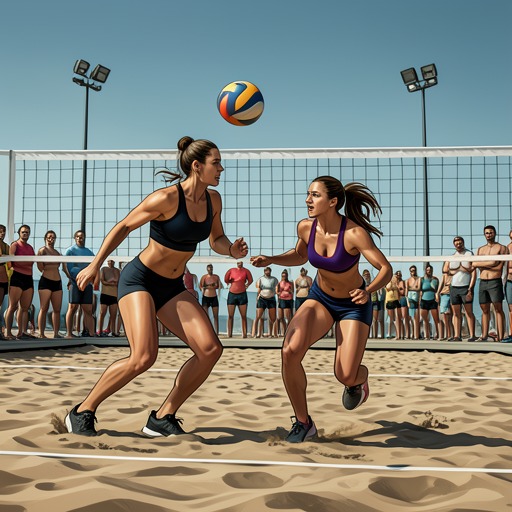
As Willa and Tabby played, Willa found that their styles complemented each other and that Tabby’s competitive streak ran deep. During a match, Tabby pulled up from a hit she thought would land out, then disputed the line judge’s call when the ball came close to the boundary. The official pointed to its mark in the sand. Willa called Tabby back to the game and tapped her temple, directing her attention away from the argument and toward the next play. The exchange shows chemistry as active adjustment: Willa recognized that her partner’s intensity could disrupt focus and intervened in the moment, rather than treating individual competitiveness as sufficient.
Their results gave the new partnership room to grow. Willa and Tabby defeated Lydia Zeller and Suzette Nupiere in two sets, and Suzette wished them luck after their post-match handshake and embrace. They later beat Noki and Norm in two hard-fought sets. By then, Willa could see the pair reading one another and synchronizing their timing. Vic was pleased with their progress and believed they could be competitive in the tournament. The change was meaningful precisely because the team had started with only days to prepare: coordination was developing through shared play, not presumed from talent or enthusiasm alone.
The next challenge also carried a pointed comparison. Doreen Parke and Ginger Rush had beaten Willa and Colleen in their first match together. Willa knew the retired pair would remain formidable, even as she recognized that she and Tabby were bonding well. The coming match would test whether the new partnership’s emerging rhythm could hold against an experienced team that had already defeated Willa alongside her former partner.
National Qualification and the Pair’s Limits
The Serenidad tournament placed this partnership inside a larger, three-day qualification contest. Sixteen teams entered a format that began with single elimination; losing teams could later continue through an elimination bracket, and the main-bracket winner would meet the elimination-bracket winner for the title. Five matches separated Willa and Tabby from securing an Olympic place for the United States. The demanding format made cohesion consequential, but the national place and the identity of the eventual Olympic team remained separate decisions.
The outcome ultimately underlined that distinction. The international governing body’s executive board awarded the final Olympic place to the United States in an emergency meeting. Willa believed she and Tabby probably would have won if their match had been contested, but the country’s qualification had been the goal, and she accepted the result. A later qualification process would select the pair that would represent the United States; Willa would not be that athlete. Partner Chemistry thus matters at two scales in the story: it is the immediate work of making two players function together, while the institutional objective they pursue can outlast their particular pairing. Willa and Tabby’s rapid progress does not recreate Willa and Colleen’s decade-long bond, but it demonstrates that a new team can develop real coordination even when the prize they seek is ultimately awarded beyond the court.