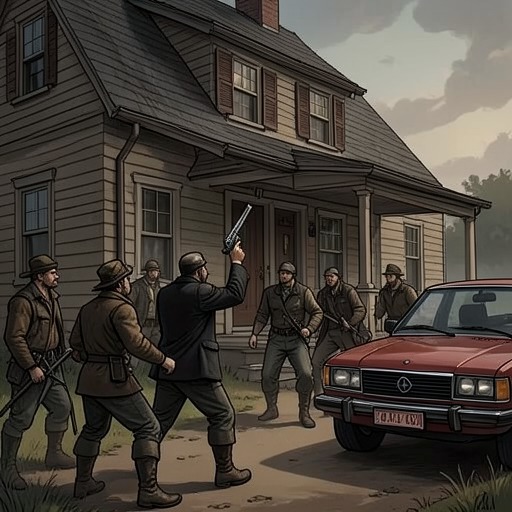
Threatening letters to Willa Ashford
Match PointThreatening letters to Willa Ashford are not merely warnings to leave volleyball: they make Willa Ashford’s attempt to return to competition seem inseparable from the unresolved death of her closest friend and former partner, Colleen Sherman. Sent as typed, anonymous threats, the letters try first to make Willa withdraw and then to make her fear that Colleen’s death was no accident. Their eventual connection to Corey Baxter’s efforts to stop Willa exposes how written messages can both threaten a target and misdirect the people trying to understand the threat.
Form and First Threats
The first clear document in the sequence is a typed threat delivered to Vic Bello. Its message is blunt: “Willa Ashford drops out of the tournament, or she dies like her partner.” Vic receives it in the mail and keeps both the letter and its envelope. The envelope bears his typed name and address but no return label, details that leave the sender unidentified while giving Colt Fontaine material to submit for forensic examination. Vic agrees to send the items to Colt’s company, whose forensic experts he says may be able to recover prints or DNA from the envelope or stamp. The evidence establishes that the materials were preserved and sent for examination, not what any examination found.
The threat arrives while Willa is preparing to compete in Serenidad. She has come out of retirement to help the United States secure an Olympic place, after years away from playing following Colleen’s disappearance and presumed death. The return is already shadowed by grief and guilt: Willa and Colleen had been teammates and best friends for ten years, and after their parents died in a plane crash into the Adriatic Sea, they had become each other’s family. Against that history, the letter’s reference to Colleen turns a demand to quit into an insinuation about the event that devastated Willa.
Willa Receives a Related Letter
Willa has received a threat of her own by the time she confronts Vic and Colt. She says it came in the previous day’s mail and that she opened it that morning. Its wording is less explicit than the message sent to Vic: it tells her to stop competing or she will be sorry. When Colt gives her a similar letter, she reads a more direct allusion to what happened to Colleen. The difference matters. One note threatens consequences without explaining them; the other places those consequences beside Colleen’s death, making Willa question whether that death was accidental.
The letters also reveal a breakdown in how information about Willa’s safety is being handled. Colt and Vic exchange a meaningful look when Willa mentions that someone nearly ran her and Tabby off the road. Willa recognizes that they know more than they have told her, and demands an explanation. Colt initially remains silent, while Willa reads his reserve as the result of Vic’s protectiveness. When Vic finally nods, Colt hands over the other letter. The paper changes the conversation: Willa is no longer confronting only a concealed security concern, but a threat that reaches back to Colleen’s fate. The sender remains unknown at this point; Vic can only tell her that they will investigate.
Messages, Misattribution, and Exposure
The letters belong to a wider pattern of attempts to make Willa abandon volleyball. Willa later hears an altered-voice voicemail warning, “Quit now or you will be sorry. You won’t get another warning.” She cannot tell whether the speaker is a man or a woman. The call appears under the name Hazel Reyno, a name Willa does not recognize. The message extends the pressure beyond mailed paper, but neither the altered voice nor the caller identification establishes who made it.
A separate typed confession later seems to supply an answer. In it, the writer claims to have sent notes to stop Willa from playing, tried repeatedly to frighten her away, and ultimately shot her. The apparent confession also claims responsibility for other killings. Its statements cannot be treated as a reliable account of authorship simply because they appear in a confession: Willa later accuses Corey of killing Drew Black and framing him with that letter. She identifies the confession as Corey’s, and Corey’s response describes his efforts to make her quit, including attempts he characterizes as peaceful warnings before he resorted to violence. The apparent confession therefore forms part of the deception around the threats rather than a trustworthy resolution of who wrote them.
Function in the Story
The letters’ progression raises the stakes in stages: a demand that Willa leave the tournament, a reference to Colleen’s death, and a broader campaign that includes an altered-voice warning. Their anonymity gives the threat immediate force while withholding the information Willa and Vic need to assess it. Their physical traces—the typed address, missing return label, saved envelope, and stamp—make investigation possible in principle, but the supplied evidence does not report a forensic identification. The texts themselves are consequently evidence of the campaign, not a complete explanation of it.
Their most consequential effect is to make Willa’s return to sport appear dangerous to herself and to those around her. The demand targets a choice she has made to preserve the legacy she shared with Colleen, while the reference to her partner exploits the grief that had once persuaded her to retire. The later revelation about Corey reframes the letters as part of deliberate coercion and concealment: what initially looks like an unknown person invoking Colleen becomes connected to Corey’s effort to stop Willa and his attempt to shift blame. In that reversal, the threatening letters do more than announce danger; they expose how a message can be used to control a survivor and distort the search for the truth.