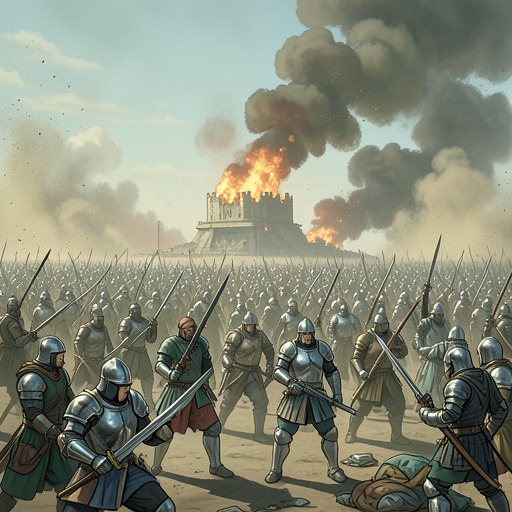
Achilles and Cycnus in Battle
Metamorphoses (Ovid Edition)Achilles and Cycnus in Battle is a decisive episode of the Trojan War in which Achilles confronts a fighter whom weapons cannot wound. The encounter begins amid the slaughter of the Sigaean shore and ends not with a pierced body but with a transformation: after Achilles strangles Cycnus, Neptune preserves the dead warrior by turning him into a bird. The battle therefore shifts from heroic force to frustrated force, then from death to metamorphosis.
Battlefield and Opposing Champions
The episode is set during the Greek assault on the Trojan ranks. The Sigaean shore has been strewn with corpses and stained with blood, establishing a battlefield where Achilles’s violence has already proved overwhelming. Wherever he fights, he searches out the most formidable resistance, and the passage names Cycnus alongside Hector as a warrior sought through the fields. Hector, however, is not yet present in this encounter; the narrative postpones that greater confrontation and places Cycnus before Achilles as the immediate challenger.
Cycnus is not merely another Trojan combatant. The battle reveals that his body cannot be entered by ordinary weapons. His immunity changes the conditions of heroic combat: Achilles can throw with force and precision, but the expected relation between weapon and wound has been suspended. The conflict thus opposes Achilles’s martial mastery to a defense that appears absolute, while the surrounding carnage makes Cycnus’s exceptional survival increasingly conspicuous.
The Failure of Weapons
Achilles announces that he will use the same weapon against Cycnus that he has used successfully against other enemies, wishing for the same success. While speaking, he throws the weapon with unerring fury, aiming at Cycnus’s left shoulder. The spear reaches its mark but finds no entrance. The expected wound does not occur, and the failure is emphasized by the blood visible on the weapon: it is not Cycnus’s blood, but blood previously drawn from the slain Menoetes.
This detail produces the episode’s first sharp reversal. What appears to be proof that Achilles has wounded his opponent is exposed as residue from an earlier death. The weapon carries the evidence of Achilles’s power, but not evidence of power exercised successfully in the present. The visible blood briefly supports the illusion of victory before the narrative withdraws it, making Cycnus’s invulnerability legible through a failed recognition.
Achilles does not retreat when the spear fails. He leaps headlong from his lofty chariot and renews the war on foot. The change of position is also a change of method: the warrior abandons the distance and momentum of the chariot for close combat, where repeated blows might overcome what the thrown weapon could not. He attacks with heightened disdain, but his contempt cannot restore the ordinary rules of battle.
From Assault to Strangulation
The duel intensifies as Achilles continues pressing Cycnus. The contest becomes physically and psychologically oppressive. A sickly sweat appears, night shades the warrior’s sight, and nature itself seems inverted before him. These signs mark the collapse of confidence that accompanies the discovery that force alone is insufficient. Achilles’s opponent has not simply endured one blow; he has made the attacker’s familiar competence uncertain.
The change in value is unmistakable. At the beginning of the encounter, Achilles’s offensive power carries the charge of near-certainty: the battlefield is already marked by his victories, and he expects another. Cycnus’s unwounded body reverses that expectation, turning dominance into frustration. Achilles responds by pressing harder, allowing neither rest nor respite. The fight becomes a contest of endurance and coercion rather than a clean demonstration of superior arms.
A stone lies at hand, and Achilles continues the attack with whatever the battlefield provides. When weapons and repeated blows fail to produce a wound, he turns to the opponent’s body itself. He unlac es Cycnus’s helmet, ties the loosened chin strap around his neck, and dismisses the strangled soul. The killing method is intimate and improvised: Achilles wins not by piercing Cycnus’s invulnerable flesh, but by depriving him of breath.
Divine Metamorphosis and Aftermath
Achilles immediately moves to strip the dead warrior, expecting the body to remain as the tangible proof of victory. Instead, the body vanishes from his arms. The disappearance prevents the usual spoils of combat from completing the scene. Cycnus cannot be treated simply as a defeated man whose armor confirms Achilles’s success, because the corpse itself has been removed from the victor’s possession.
The explanation is divine. Neptune, Cycnus’s father, has transformed him into a bird bearing his name in order to immortalize his frame. The metamorphosis does not undo the strangulation, but it changes its consequence. Cycnus dies as a combatant and survives as a memorial form, while Neptune’s intervention answers Achilles’s physical triumph with a supernatural preservation. The episode’s final movement is therefore from battlefield mortality to commemorative transformation.
A truce follows the labors of the day. The pause gives the episode a formal closure after the relentless sequence of attack, failure, renewed assault, and strangulation. Yet the truce does not restore a simple heroic order. Achilles has killed Cycnus, but Cycnus has escaped the victor’s complete possession; the dead body has become a bird, and the enemy’s identity continues beyond the battlefield in altered form.
Narrative Significance
The episode is built around a compact conflict between expected causality and its interruption. A spear aimed accurately should wound; blood on the spear should belong to the newly struck enemy; a dead warrior should remain available to be stripped. Each expectation is frustrated. The resulting reversals give the combat its distinctive shape and make metamorphosis the necessary culmination rather than an ornamental afterthought.
Within the larger world of the poem, the story also belongs to the recurring pattern in which violent human action meets a limit imposed by divine or supernatural power. Achilles’s skill remains real, but it is not sufficient to explain the whole event. Cycnus’s body resists the heroic code of penetration, and Neptune’s final act preserves the defeated figure in another natural form. The battle consequently joins martial narrative to the poem’s broader meditation on change: death is not always the end of identity, and victory does not always leave the victor with an unaltered body or an unquestioned possession of the past.
The scene is narrated as ordinary third-person main narration, with rapid movement from battlefield summary into the focused duel and then into the abrupt metamorphic aftermath. Its emotional center lies in the interval between the first failed spear-cast and the successful strangulation. Achilles must discover, through repeated failure, that the contest cannot be won by the means he first trusts. Cycnus’s transformation then converts that hard-won victory into a more ambiguous kind of remembrance, preserving the warrior whom Achilles could kill but could not wholly claim.