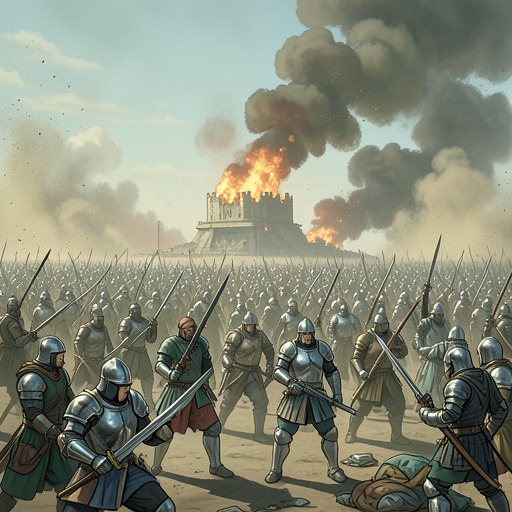
Achilles' Death
Metamorphoses (Ovid Edition)Achilles' Death is presented as the catastrophic reversal of Greek martial supremacy. The foremost Greek warrior, whose exceptional strength had made him the dominant force in the war, is killed not by an equal combatant acting independently, but by Paris's arrow directed by Apollo. The scene turns Achilles' near-invulnerability into the precise condition of his fall: the hero can be pierced only at one vulnerable place, and that singular weakness becomes the target through which divine anger, Trojan resistance, and tragic irony converge.
Causes and Background
The episode follows a revelatory contrast between the celebration of victory and the grief of the defeated. After the Trojans have feasted and drunk, weariness and wine finally drive them from the table to rest. At the same time, the sire of Cygnus, monarch of the sea, mourns his son, who has been slain in battle. His lament broadens the meaning of Achilles' military success: the hero has not merely won an isolated duel, but has destroyed Trojan lives and undone the labor invested in defending the city.
The grieving father declares that Achilles still lives to boast of the ruined town and the wasted common labor. His regret takes the form of a belated wish that he might confront Achilles himself and prove that his trident is not powerless against him. Yet the narrative does not permit that direct contest. The sea monarch allows Paris to try his dart against the one part of Achilles that can be penetrated, transferring the force of the threatened retaliation from a god's own weapon to a mortal archer's shot.
Divine Intervention and the Arrow
Apollo responds to the superior throne's anger and adds his own resentment to it. He bows before that higher authority, then conceals himself in a cloud and travels to the place where Greeks and Trojans are mingled in mortal combat. The movement is swift and purposeful: divine decision becomes battlefield action, while the cloud allows Apollo to enter the struggle without presenting himself openly as its combatant.
Apollo seeks out Paris, who is described as lurking where he stands rather than meeting Achilles in an openly balanced contest. The god reveals himself to Paris alone and directs the attack. He guides the poisoned shaft accurately and gives the fatal flight its power, making the arrow an instrument of both mortal agency and divine design. Paris releases the missile, but Apollo determines its course; the killing therefore belongs simultaneously to the archer who fires, the god who directs, and the larger conflict of divine anger surrounding the war.
The Fall of Achilles
Achilles falls as the foremost of the Greek name. The language of the event emphasizes rank before it emphasizes death: the fallen man is not simply another casualty, but the champion whose presence has defined Greek military power. His death thus functions as a peripeteia, a sudden reversal in which the warrior who has seemed to command the field is reduced to the target of a single fatal shot.
The scene also preserves the scale of Achilles' earlier prowess. He is associated with the spear and sword that none but Achilles could wield, and with movement so overwhelming that he could mow down the standing field. Those weapons and that momentum establish why his death requires extraordinary circumstances. The hero is not defeated because his strength has gradually faded; he is struck through the exceptional weakness that his otherwise inviolable body conceals.
The method of death intensifies the irony. Achilles' martial identity is built around direct force, visible weapons, and domination of the battlefield, whereas his end comes through a poisoned missile whose flight is guided from above. The most celebrated Greek warrior is therefore destroyed by distance, concealment, and supernatural precision. His apparent invulnerability does not prevent tragedy; it concentrates tragedy into the single place where protection fails.
Paris, Troy, and the Aftermath
The immediate reversal belongs to Paris as well as to Achilles. Paris, identified by the narrative as the base adulterer, boasts the fame of killing the greatest Greek warrior. The moral contrast is deliberately sharp: the man whose conduct has marked him as dishonorable receives the public credit for an act whose decisive force came from Apollo. Fame and merit are separated. Paris possesses the reputation, while the god possesses the accuracy and power that made the shot fatal.
Achilles' death brings public joy to the Trojan side. His body becomes a spectacle that gladdens the Trojan train, converting private grief into collective triumph. Yet the triumph carries an unstable foundation. Troy celebrates the fall of its greatest enemy, but the victory has been made possible by divine intervention and by the exploitation of a singular vulnerability rather than by a straightforward defeat in arms.
Narrative and Thematic Significance
The episode organizes its tragedy through a chain of reversals: feasting gives way to mourning, mourning produces a wish for vengeance, divine anger becomes intervention, Paris's lurking becomes apparent success, and Achilles' unmatched battlefield power ends in sudden death. Its compressed structure moves from a wide field of Greek and Trojan combat to one exact penetrable place, showing how an immense war can turn on a minute bodily weakness.
The action also exposes the difference between agency and credit. Apollo's concealed participation determines the outcome, yet Paris receives the fame; Achilles' earlier labor has made him the foremost Greek, yet his death is remembered through the weapon of a lesser moral figure. The final spectacle therefore does more than announce a casualty. It reveals a world in which heroic excellence does not guarantee survival, divine purposes can redirect mortal weapons, and public glory may belong to the person least entitled to it.