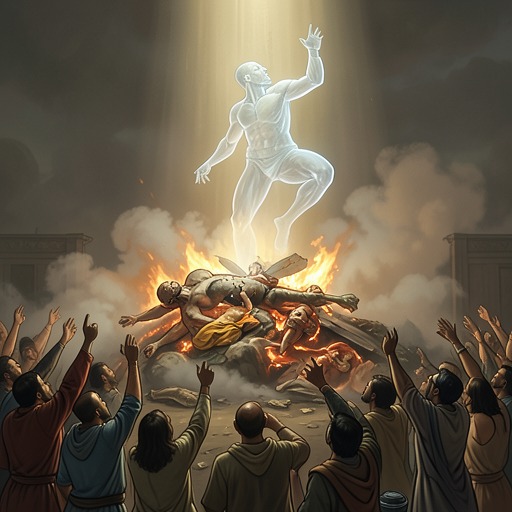
Aeneas's Apotheosis
Metamorphoses (Ovid Edition)Aeneas's Apotheosis marks the point at which Aeneas's mortal history is absorbed into Rome's sacred history. After surviving the long hostility of Saturnia and fulfilling the fate that fixes Rome's immortal greatness, he is removed from ordinary human time and receives divine honors. The episode therefore does more than reward a hero: it turns exile, warfare, dynastic succession, and the future of Rome into parts of a providential order, while extending the poem's central principle that bodies and identities may change without simply being erased.
Causes and Political Destiny
Aeneas's transformation is prepared by the completion of his ordained task. The poem presents him as having survived the whole period of Saturnia's hatred, and an irrevocable decree has established Rome's immortal majesty. His apotheosis thus follows not an isolated miracle but the consolidation of a future city and people. The language of fixed destiny makes Rome's rise appear permanent, while Aeneas's change gives that permanence a sacred ancestor and a divine foundation.
The appeal for his elevation is made by his mother, the goddess who bore Aeneas. She addresses the supreme arbiter and asks that a hero fit for the company of his kindred stars should not remain merely mortal. Her request places family connection, divine descent, and imperial succession within one argument: Aeneas's status as the ancestor of Rome is treated as evidence that his final honor should correspond to the destiny he has enabled.
The Divine Council and Transformation
The gods assemble in a formal conclave, with Juno seated in the shining senate. This council gives the event a public and juridical character rather than presenting apotheosis as a private vision. The assembly also carries the memory of conflict into the scene: Juno, whose former revenge had opposed Aeneas, now feels remorse for that past hostility. The divine order is therefore shown not as untouched by history but as capable of recognizing, and in some measure settling, the antagonism that had endangered the hero.
The transformation is enacted through a carefully staged movement from mortal remains to divine identity. Aeneas's fleeting spirit is carried away fresh from his wounds and changed into a star. The wound-marked spirit preserves the cost of his earthly career even as the star removes him from mortal frailty. The metamorphosis is consequently both elevation and reinterpretation: suffering is not denied, but it becomes the material from which lasting celestial honor is made.
Purification and the Name Indiges
The poem then turns from the sky to the river landscape. A divine presence descends in a blaze of light, borne by turtles, and alights where Numicius moves through the reeds toward the sea. There, the god who is supplicated washes away what remains of mortality. The water functions as a boundary between the human condition and divine status, cleansing Aeneas before his final recognition.
After this purification, the goddess scatters fragrant gums over him and breathes ambrosial dew upon his features. These gestures complete the alteration of his body and face, replacing the vulnerability of the wounded mortal with the incorruptible signs of divinity. Rome responds by decreeing shrines, festivals, and new honors, and by styling him Indiges. His apotheosis therefore becomes a civic institution: the transformed hero is not merely admitted among the gods but maintained within Roman public memory through worship and recurring ceremony.
Continuity from Aeneas to Rome
Aeneas's elevation stands at the hinge between heroic legend and Roman history. After his transformation, Ascanius holds the Latin scepter, so the episode joins divine memorialization to political succession. The mortal founder disappears from direct rule, but his authority continues through the dynasty and the city that descend from him. This arrangement makes departure productive rather than terminal: the hero's absence creates the sacred ancestry that allows later Roman power to claim continuity with him.
The larger poem repeatedly presents transformation as a passage between forms, and Aeneas's apotheosis gives that pattern its most overtly political expression. The work begins by announcing that it will sing of bodies changed into various forms, and its episodes move between human, animal, vegetal, aquatic, celestial, and divine states. In Aeneas's case, change does not operate chiefly as punishment or loss. It converts a wounded spirit into a star, a mortal founder into Indiges, and an individual life into a permanent Roman cult.
Aftermath and Significance
The event also prepares the final movement toward the apotheosis of Julius Caesar. Later, the poem describes Aeneas's divine mother as the source of the line that leads to the Roman ruler, and asks that Julius's spirit, fresh from his wounds, likewise be carried upward and changed into a star. Aeneas's elevation thus supplies the precedent through which Roman political authority can be represented as celestial inheritance. The chain runs from divine parentage to Aeneas, from Aeneas to Rome, and from Rome to Julius Caesar and Augustus.
In this structure, apotheosis is both religious transformation and political theology. The gods' recognition validates the destiny of Rome; the city's shrines and festivals make that validation socially durable; and the names attached to transformed rulers turn history into genealogy. Yet the episode retains the poem's characteristic awareness that every elevation begins in vulnerability. Aeneas reaches the stars only after wounds, hatred, exile, and mortal struggle. His final glory therefore gathers the book's central tensions into one image: human suffering is absorbed into divine order, and the transience of an individual life is made to support the enduring memory of Rome and its rulers.