Aulis
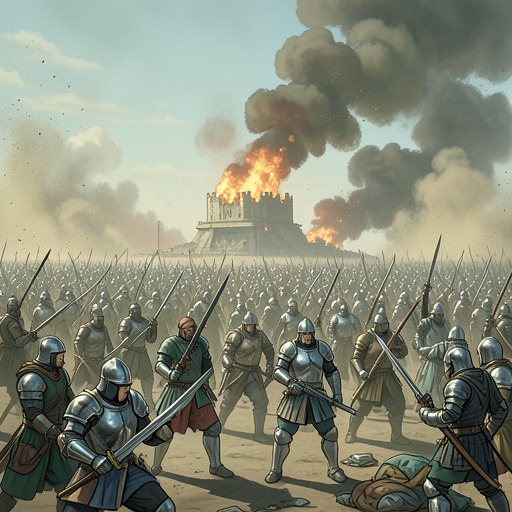
Metamorphoses (Ovid Edition)Aulis is the assembly point of the Greek expedition against Troy and the place where the war’s immense human undertaking first encounters resistance from the elements. The site concentrates the poem’s contrast between military purpose and forces beyond mortal command: a thousand ships are prepared, the allied powers meet, and yet the fleet cannot depart because winds and waves refuse to carry it forward.
Setting and Function
Aulis appears in the account of the Trojan War as the place where the Greeks gather with united forces. Their purpose is both punitive and imperial: they have drawn together to avenge the rape of the Spartan queen and to subdue Asia. The scale of the undertaking is emphasized by the thousand ships manned for the voyage, making Aulis the staging ground for a pan-Greek response rather than a local campaign.
The location therefore functions less as a developed landscape than as a strategic threshold. The army and fleet have completed their preparations, but the expedition remains suspended between intention and action. Aulis holds the Greeks at the very moment when political unity and martial energy seem complete, exposing how little human planning can accomplish without favorable conditions.
The Fleet Delayed
At Aulis, the assembled forces are detained by cross-winds and calms. The sea does not merely slow the expedition; it opposes the movement on which the entire campaign depends. The Greeks raise an altar on the shore while they wait, so military preparation and ritual activity occupy the same interval of enforced stillness. The site consequently becomes a place where action is converted into expectation and where the army’s impatience is framed by religious observance.
The same obstruction is recalled when the Greek leaders are described as having met at Aulis to avenge the Spartan prince’s injury. Again, either dead calm or adverse blasts reign over the assembly. This recurrence makes Aulis a remembered point of interruption in the war’s origin: the expedition is united in purpose, yet its departure is repeatedly shown as contingent, delayed, and vulnerable to powers outside the commanders’ control.
A Threshold in the Trojan Narrative
Aulis marks the passage from grievance to organized war. The Greek response begins with a particular offense, but at the site that offense is transformed into a vast mobilization directed against Troy and Asia. The gathering thus gives physical form to the expansion of private resentment into collective violence. The ships, altar, and assembled powers stand together as signs of a campaign that is at once political, military, and sacred.
Its obstruction also supplies a counter-image to the confidence of the expedition. The Greeks possess numbers, organization, and a common cause, yet the first decisive movement is not conquest but delay. In this sense, Aulis represents the unstable border between human resolve and the larger order governing the poem’s world, where winds, gods, and transformations can redirect even the most carefully prepared enterprise.
Memory and Narrative Significance
Although Aulis is not developed as a permanent home or city, its narrative importance exceeds its brief appearance. It is the place repeatedly associated with the fleet’s frustrated departure, and its name carries the pressure of the entire Trojan undertaking: vengeance, alliance, ritual, waiting, and the first sign that the war will not proceed according to human will alone.
Within the broader architecture of Metamorphoses, Aulis also belongs to the poem’s movement from legendary history toward Roman and divine history. The Trojan expedition helps connect Greek conflict with the later chain of migrations and foundations that culminates in Rome, while the poem eventually turns to the apotheosis of Julius Caesar and the future greatness of Augustus. Aulis is therefore an early hinge in a much larger sequence: a shore where a fleet waits, and from which the violent and dynastic history leading toward Rome is set in motion only after nature has first refused to let it sail.