Cadmus
Metamorphoses (Ovid Edition)Cadmus is a founder, wanderer, and dynastic figure whose story links the loss of Europa to the establishment of Thebes and ultimately to the transformation of himself and his queen into serpents. His importance lies not in a single isolated metamorphosis but in the way his family history becomes a chain of searches, violent encounters, forbidden desire, divine punishment, and altered forms. Through Cadmus, the poem turns political foundation into a deeply unstable inheritance: the city is established through the slaying of a monstrous guardian, yet the founder’s own lineage remains marked by death, transgression, and transformation.
Identity and Mission
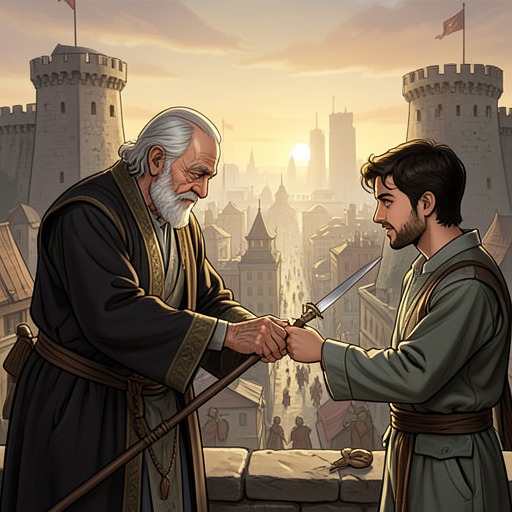
Cadmus enters the narrative after Agenor has lost his daughter Europa. Agenor sends his son to search every coast and sternly commands him to restore her to his arms. Cadmus therefore begins as the agent of a family quest, compelled to cross unknown territory because of a father’s demand and a sister’s disappearance. His identity is defined by kinship before it is defined by kingship or city-building: he is the son charged with repairing a broken household.
The search gives Cadmus a quest-like role, but the expected recovery never simply restores the old order. His pursuit of Europa carries him into a new landscape and toward a new political destiny. The family mission becomes the founding movement of Thebes, so that the loss of one woman produces a city, a dynasty, and a mythology of origins. The narrative thus makes displacement productive without making it benign; what is founded in response to abduction remains haunted by the violence that caused the journey.
The Dragon and the Founding of Thebes
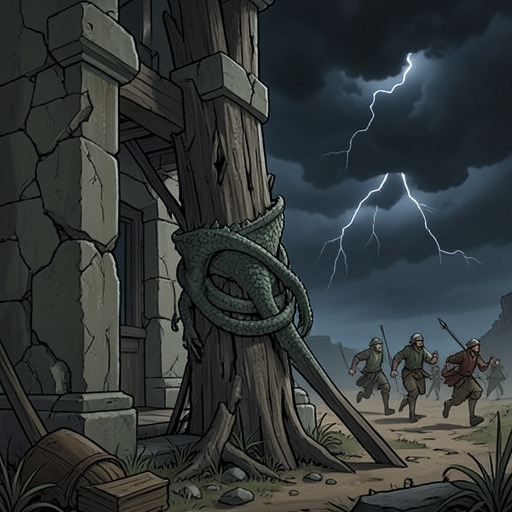
Cadmus’s search brings him to an ancient forest in Thessaly, enclosing the pleasing valley of Tempe. There, amid dense cover, he finds a hollow den vaulted by rocks and shelving arches. The place is sacred to Mars, and within it lies a mighty dragon, swollen with poison to monstrous size. The setting concentrates the opposition between cultivated human settlement and an older, dangerous sacred world: before Cadmus can found a city, he must confront the nonhuman power occupying the ground.
The dragon is not a minor obstacle but the guardian of the site. Its presence makes the foundation of Thebes an act of violent substitution, in which Cadmus’s human project can proceed only after the monster has been removed. The encounter joins heroic adventure to political construction. Cadmus is remembered as a founder because he survives the passage from wandering exile to civic origin, but the city’s beginning is inseparable from the dragon’s lair and the sacred violence enacted there.
Family, Forbidden Desire, and Dynastic Disorder
Cadmus’s descendants continue the poem’s examination of kinship as both social bond and source of danger. The story of Byblis centers on her forbidden love for her brother Caunus. She confesses that her beloved wishes for the health that only she can give him, converting familial closeness into an illicit erotic claim. Her speech exposes how the language of care and the language of desire can overlap until the boundary between legitimate affection and forbidden love collapses.
The same dynastic instability appears in the story of Myrrha and Cinyras. Myrrha is told that neighboring monarchs, led by her beauty, contend in crowds for her marriage and that the world is open to her choice except for one man. That excluded figure is her own father. Later, while the fatal secret threatens to be revealed, she is drawn forward to complete the transgressive act and is presented to Cinyras with the words, “Receive thy own.” Their bodies are joined as kin to kin, and the union makes the family bond itself the instrument of catastrophe. Cadmus’s family world is therefore not a stable genealogical refuge: descent repeatedly generates desire, secrecy, punishment, and new forms of life.
The poem also places Cadmus’s lineage beside the claims of divine and semi-divine ancestry. Niobe invokes her lineage from Tantalus, described as the only mortal guest ever admitted to the feast of the Gods, and uses that inheritance to challenge divine authority. Such appeals show how genealogy functions as a claim to status, yet the wider cycle repeatedly demonstrates that exalted descent offers no protection from suffering or metamorphosis. Cadmus’s dynasty inherits prestige and vulnerability together.
Transformation and the Fate of the Founder
Cadmus eventually mourns without understanding that those who have fallen mortal have risen immortal, a reversal that makes grief itself a form of incomplete knowledge. His story culminates in the transformation of Cadmus and his queen into serpents. The change is both bodily and dynastic: the founder who once confronted a dragon becomes associated with the very animal form that marked the threshold of his city’s beginning.
This ending does not erase Cadmus’s earlier identity as founder. Instead, it folds the origin of Thebes back into the larger logic of metamorphosis. The human ruler, the city-builder, and the serpent become successive states of one figure. The transformation suggests that no civic foundation can remain purely human or permanently fixed; the founder is returned to an animal form that recalls the monstrous and sacred forces he overcame. His ending is therefore not simple annihilation. It is a change of being that preserves the memory of the founding while exposing its instability.
Narrative Role and Significance
Cadmus functions as a bridge between separate narrative movements. His search for Europa opens the Theban sequence, his encounter with the dragon supplies the city’s violent origin, and his later transformation closes the founder’s human career. Around him, stories of Diana and Actaeon, Semele and the birth of Bacchus, Tiresias, Narcissus and Echo, and Pentheus and Bacchus extend the Theban world into further conflicts between divine power, human desire, and altered embodiment.
His significance is consequently structural as much as biographical. Cadmus’s story follows a recurring pattern in which loss produces motion, motion produces encounter, encounter produces foundation, and foundation ultimately gives way to metamorphosis. The pattern recurs elsewhere through Daphne’s transformation into a laurel, Io’s transformation into a heifer, and Salmacis’s union with Hermaphroditus, but Cadmus’s case is distinctive because the transformed body belongs to a founder and ruler. His final serpent form makes the origin of a civilization look less like a clean beginning than like one stage in the endless circulation of human, divine, and animal identities.