Cadmus and the Dragon
Metamorphoses (Ovid Edition)Cadmus and the Dragon is a foundational transformation narrative in which exile becomes settlement, a dragon’s guarded wilderness becomes the site of a city, and violent death is converted into the origin of a people. Cadmus does not discover a ready-made home; he reaches one through wandering, divine instruction, combat, and the extraordinary sowing of dragon teeth.
Exile and the Search for a Homeland
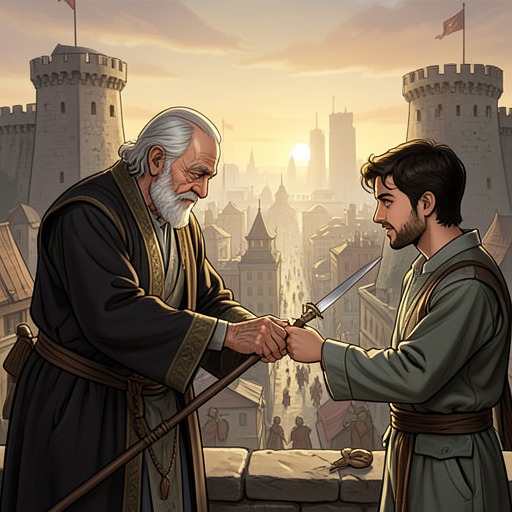
Cadmus enters the story as a restless youth searching throughout the world. His wandering is connected with the difficulty of locating Jupiter in the midst of the god’s amorous affairs, and the search leaves Cadmus without an established home. At the Delphic oracle he asks what appointed dwelling will finally end his travels and relieve his labors. The question makes settlement itself the event’s first stake: the future city is not simply founded by choice, but sought as an answer to displacement.
The oracle directs him to watch for a solitary cow, untouched by yoke and unbroken to the plow, and to follow wherever it leads. This sign replaces ordinary geographical knowledge with divine guidance. Cadmus’s route is therefore neither a military expedition nor a planned colonial venture. His destination is disclosed through an animal that belongs to cultivated life but remains outside human labor, a creature whose freedom marks the boundary between the wild and the settled world.
The Sacred Grove and the Dragon
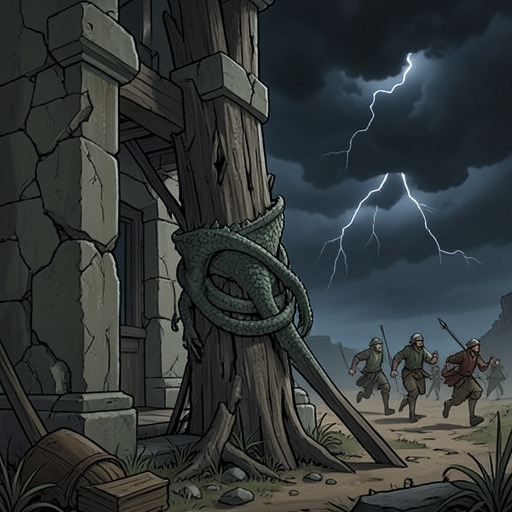
Cadmus follows the appointed sign until the new country is reached. When his companions need water, he sends servants to seek it, but the water lies within a dangerous place. In the thicket they find a hollow den vaulted by rocks and shelving arches. The setting is not an open field ready for habitation; it is a concealed, gloomy enclosure, removed from daylight and sacred to Mars.
Deep within this den lies a mighty dragon. It is swollen with poison and grown to monstrous size, and its presence makes the spring or water source inseparable from violence. The first obstacle to Cadmus’s settlement is therefore not human resistance but a nonhuman guardian occupying sacred ground. The dragon stands between the travelers and the water necessary for life, turning the act of founding a home into a confrontation with a power that has already claimed the place.
Cadmus approaches the fatal site after seeing his servants lying breathless on the grass and discovering the scaly enemy amid their corpses. Their deaths establish the cost of the expedition before Cadmus himself fights. He is prepared by experience in bloodshed, by the far-destroying dart, and above all by an undaunted heart. The encounter gives the founding narrative its decisive value shift: the prospect of relief and settlement becomes immediate danger, while the death of the servants turns the search for a homeland into an obligation to avenge and overcome the guardian.
Combat and Divine Instruction
Cadmus confronts the dragon in the sacred enclosure and defeats it. The combat clears the site, but victory alone does not explain how a solitary exile can generate a population. The dragon’s death is only the first half of the foundation. Its body becomes the source of a new and more perilous act, linking the defeat of the old guardian to the birth of the community that follows.
As Cadmus stands astonished and looks around in inward horror, Pallas descends swiftly from the skies. The goddess is presented as the guardian of the bold and wise, and her intervention gives intelligence a role equal to courage. Cadmus has already shown physical bravery; Pallas supplies the interpretation that makes the dragon’s remains usable. She commands him to plow the field and scatter the dragon’s teeth, and she tells him what his astonished eyes will soon witness: armed armies will rise from the ground.
The instruction turns agriculture into a military and cosmogonic act. Plowing normally prepares earth for seed and harvest, but Cadmus now prepares it for warriors. The dragon teeth function as a buried inheritance of violence, and the furrows become a threshold between the dead monster and the living society that will emerge from it. Pallas’s command does not remove danger from the foundation; it reorganizes danger into a new form.
The Sown Warriors and the First Community
Cadmus obeys Pallas. He sows the teeth and flings the future people from his hand. The earth responds almost as though it possesses its own heat and agency: the clods grow warm and crumble where he plants them. From the furrows rise embattled men, so that the hoped-for population appears first as an army rather than as peaceful settlers.
The new warriors immediately reproduce the hostility associated with the dragon. Their emergence does not complete the city; it threatens to destroy the founder before the community can exist. The field becomes a scene of internal conflict, and the origin of collective life is marked by combat among beings born from the same buried source. In this structure, civilization does not begin outside violence but through its dangerous transformation.
The battle leaves the furrows swimming in blood. Of the vast increase, only five survive. The number sharply contracts the miraculous multiplication of the warriors and gives the foundation a second mortality: first the servants die before the dragon, then the dragon dies before the sown army, and finally almost the entire army dies in its own struggle. The survivors are not an untouched multitude but the remnant of successive destructions.
Echion is singled out among the five. At Pallas’s command he lets the guiltless weapon fall from his hand and makes a peaceful treaty with the others. This gesture supplies the political principle that violence alone cannot provide. The survivors become capable of community only when the weapon is relinquished and mutual peace is established. The founding sequence thus moves from exile to oracle, from water and corpses to dragon combat, from teeth and armed emergence to slaughter, and finally from disarmament to agreement.
Founding Significance and the Logic of Metamorphosis
The episode belongs to the larger poem’s sustained concern with bodies and forms changed by divine or extraordinary forces. Its most distinctive change is collective rather than individual: the dragon’s teeth become men, and a site of death becomes the beginning of a people. The event therefore extends metamorphosis beyond the conversion of one body into another. Material remains carry violence forward into a new social form, while the survivors alter that inheritance by choosing peace.
The story also places Cadmus between human initiative and divine direction. His courage allows him to face the dragon, but the oracle determines the destination and Pallas determines the method by which the future population will be produced. The founder acts decisively, yet the city’s possibility depends on signs, commands, and transformations beyond ordinary human control. The narrative presents founding as an exchange between mortal endurance and divine design rather than as a purely political achievement.
Its deepest contrast is between wilderness and civic order. The dragon’s den is hidden, rocky, poisonous, and sacred to Mars; the sown warriors rise in military formation; and the blood-filled furrows threaten to preserve perpetual conflict. Against these images, Echion’s dropped weapon and peaceful treaty offer the first recognizable form of civic life. Thebes is imagined as emerging not when violence disappears, but when violence is first subjected to a rule of restraint.
Cadmus and the Dragon consequently makes origin inseparable from danger and loss. The homeland promised by the oracle is reached only after servants have been killed, the dragon has been destroyed, and nearly all the miraculous warriors have perished. The surviving five do not erase that history. Their treaty converts it into a founding memory, preserving the paradox at the center of the episode: the city begins in blood, but it becomes possible only when its first inhabitants stop fighting.