Chaos
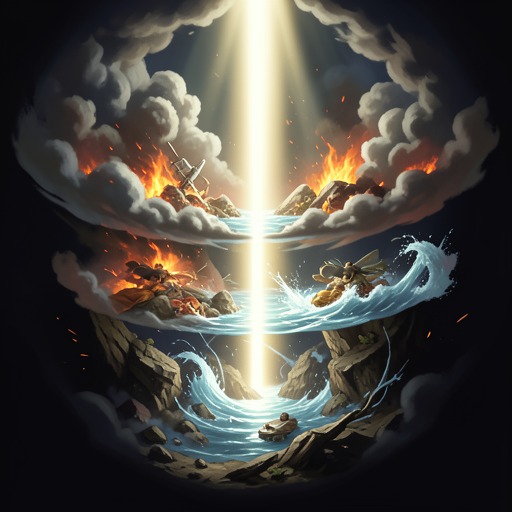
Metamorphoses (Ovid Edition)Chaos is the primordial setting and material condition preceding the created world. Before the seas, the terrestrial earth, or Heaven’s canopy existed as distinct realms, Nature had only one undifferentiated face: a rude, indigested mass without form, life, or frame. From this disorder the poem develops its first decisive transformation, making Chaos the origin against which every later act of separation, shaping, building, and metamorphosis is measured.
Definition and Primordial Appearance
Chaos contains the world before the world has become legible. Its substance is described as a lifeless lump composed of jarring seeds, with no stable outline and no completed structure. The elements that will later occupy separate cosmic regions remain mixed within it: hot and cold, soft and hard, light and heavy are fixed together in internal conflict. The condition is therefore more than darkness or vacancy. Chaos is crowded with incompatible potential, a material fullness that has not yet acquired order.
The absence of the heavenly lights reinforces this primitive confusion. No sun has been kindled to reveal the world, and no moon yet renews her horns. Without these recurring measures of visibility and time, the cosmos has neither a clear horizon nor an established rhythm. Chaos is consequently both a place and a state: the first spatial condition of the universe and the suspension of the distinctions by which place, motion, and sequence will later be understood.
The Separation of the Elements
The first cosmic action is the ending of the elements’ intestine discords. God, or Nature, intervenes while the contrary substances contend within the single mass. The narration leaves the ordering power deliberately open between divine agency and natural process, but the result is definite: earth is driven away from air, and the seas are driven away from earth. What had been fused becomes differentiated, and the possibility of an inhabitable cosmos begins with this partition.
This separation gives Chaos its structural importance in the poem’s cosmology. Later landscapes, sanctuaries, cities, temples, and seas depend on the first act of distinction that Chaos itself lacks. The ordered world is not created from nothing; it is extracted from confusion. Every recognizable region therefore retains, in conceptual form, the memory of an earlier condition in which boundaries had not yet been drawn.
Chaos and the Production of Space
The poem repeatedly contrasts unformed material with spaces made intelligible by design or growth. The distinction is visible in the work of Daedalus, who constructs a hidden enclosure for the two-formed creature. His plan consists of rooms encircled within themselves, a deliberately fashioned labyrinth whose complexity depends on walls, passages, and controlled exclusion. The labyrinth is not Chaos, because its apparent confusion is the product of an intelligible design; its disorder is enclosed and made by an artist rather than existing as primordial matter.
A similar contrast appears when a humble hut is transformed into a stately temple. The cottage expands upward, its branches become columns, and its pavement becomes polished marble. Here space is reorganized through metamorphosis into a monumental human and sacred form. The transformation is meaningful precisely because the original hut and the finished temple are distinguishable states. Against such ordered spaces, Chaos represents the condition before architecture, hierarchy, and function have separated one region from another.
Boundaries, Enclosures, and Threat
The terrifying gate before the tower of brass provides another spatial counterimage. Before a lofty adamantine gate, the Furies sit in misshapen and dreadful forms. The gate marks a threshold and the tower an enclosed domain; entry is controlled, and danger is concentrated behind a boundary. Chaos, by contrast, has no such gate, wall, or threshold. Its defining feature is the absence of partitions, the collapse of distinctions that later spaces use to contain violence and assign it a location.
The contrast also clarifies why the poem’s later scenes can make places feel unstable without returning literally to the primeval mass. A private haunt in a shaded vale, a temple rising from a cottage, or a labyrinth hidden from sight all depend on the shaping of space. Their identities can be protected, revealed, or transformed because the cosmos has acquired boundaries. Chaos remains the imagined ground of the opposite condition, where no refuge, enclosure, or named region yet possesses independent form.
Narrative and Thematic Significance
Chaos establishes the governing logic of the poem: form is temporary, but change is continuous. The opening movement from a confused mass to separated earth, air, and sea supplies the largest possible model for the transformations that follow. Bodies become plants, animals, stones, stars, or divine forms, while buildings and landscapes also change their material identity. The later metamorphoses are not isolated marvels; they repeat on smaller scales the original passage out of Chaos and imply that order always contains the possibility of further alteration.
The location also frames the poem’s relation to history. The work announces a course extending from Nature’s birth to Caesar’s times, so the first condition of the universe stands at the far beginning of a narrative that will eventually reach Roman history and the fate of Aeneas. Aeneas is presented as having survived the period of Saturnia’s hatred by an irrevocable decree of Fate, a later instance of movement through a world governed by powers, boundaries, and destinies that did not exist in recognizable form within Chaos. The primordial disorder thus functions as the poem’s deep background: the condition overcome at creation, continually echoed by catastrophe and transformation, yet never finally erased from the universe’s capacity to change.