Echo
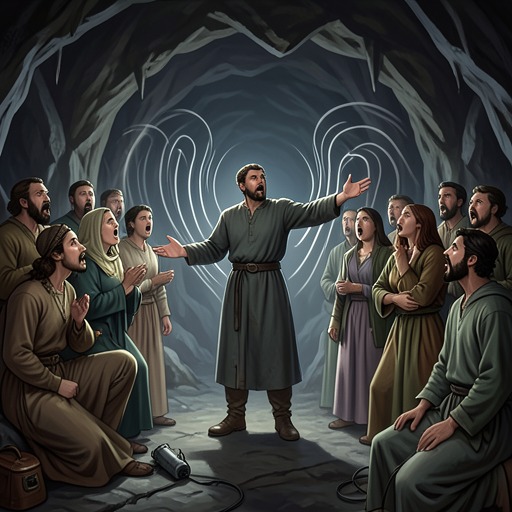
Metamorphoses (Ovid Edition)Echo is a woodland nymph whose story turns speech into both power and deprivation. She can preserve and return the words of others, yet cannot begin an utterance of her own. Her love for Narcissus therefore becomes a tragedy of expression: she sees him, follows the openings his words accidentally provide, and still cannot make herself fully known. Rejected, she retreats into the woods, losing her bodily presence while surviving as an echoing voice.
Identity and Defining Limitation
Echo is presented as a nymph associated with the woods and with a peculiar mode of speech. Her silence is not absolute; she can speak when another voice has already begun, but she cannot originate the conversation. Her language depends on repetition, rebound, and response, so that communication remains possible only through the words of someone else.
This condition gives her a double identity. She is at once a speaker and one who has been deprived of speech, capable of returning sound but unable to frame an independent declaration. The limitation is especially consequential in a story of love, because desire ordinarily requires a subject to name what she wants. Echo possesses feeling in abundance, but her language can convey it only indirectly and incompletely.
Encounter with Narcissus
While Narcissus is pursuing the chase in the woods, Echo sees his face and falls in love with him. The setting makes the encounter significant: her own natural domain becomes the place where she discovers a desire that she cannot express freely. Narcissus’s presence supplies the voice on which her speech depends, but his words do not grant her an independent voice; they merely provide material for repetition.
Echo attempts to approach him through this constrained exchange. She waits for a phrase that she can return, catching his voice and sending its sound back to him. Her response is therefore both an act of pursuit and an admission of dependence. She can remain near Narcissus only by converting his speech into her own available form of utterance.
Love, Rejection, and Withdrawal
Echo’s love-sick state is explicit, but her confession cannot be delivered as an original declaration. She pursues Narcissus emotionally while remaining linguistically unable to meet him on equal terms. The mismatch makes her affection vulnerable: he encounters the returning sound without necessarily receiving the person and desire behind it.
When nothing can move Narcissus, Echo’s love is slighted. Her reaction is marked by shame and retreat. She remains in the shadowed cover of the woods rather than continuing to press her suit, and the narrative turns her rejected desire into a gradual disappearance. The movement from pursuit to withdrawal gives her story its decisive reversal: the voice that once sought contact becomes the remnant of a presence that can no longer appear in full.
Transformation and Narrative Significance
Echo’s transformation is not simply a change of shape but a reduction of embodied agency. The nymph withdraws from the visible world until what remains is her capacity to repeat sound. Her fate externalizes the condition that governed her speech from the beginning: she survives only as an answering voice, permanently tied to words produced by others.
The story makes language itself the instrument of both connection and loss. Echo’s repetitions bring her close to Narcissus, yet they also expose how little access she has to self-expression. Her failed courtship is thus not caused by a lack of feeling; it arises from the distance between inward desire and the words available to communicate it. In the wider pattern of metamorphosis, her ending preserves one defining property while sacrificing the rest of her former identity: the nymph disappears, but the echo endures.