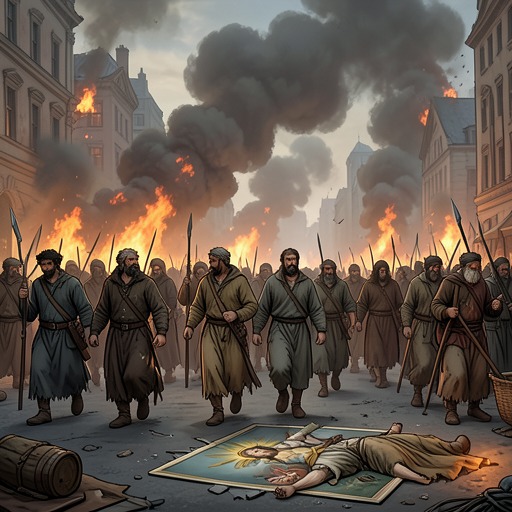
Hecuba
Metamorphoses (Ovid Edition)Hecuba is the surviving queen of Troy after the fall of King Priam and the city. Her significance lies in the way the poem carries the consequences of war beyond the battlefield: Troy is destroyed, her household is broken, and her grief does not resolve into restoration. Instead, suffering drives a final metamorphosis, turning the queen into a barking creature whose altered voice preserves the memory of what she has endured even as her human identity is taken away.
Identity and Catastrophe
Hecuba appears at the point where the long Trojan conflict reaches its ruin. With old Priam, Troy falls, but the queen survives. Her survival is not presented as a return to safety or power. It extends the catastrophe, leaving her alive to witness and undergo the completion of Troy's woes. The contrast between the city's destruction and the queen's continued existence gives her a distinctive tragic function: the war's aftermath is concentrated in the body and consciousness of one remaining royal figure.
Her status as queen is therefore inseparable from dispossession. The fall of Troy removes the political world that had defined her, while her survival preserves the memory of that world in a form marked by grief. Hecuba becomes a figure of endurance without recovery, a survivor whose continued life is itself evidence that the defeat has not ended.
Grief After the Fall of Troy
After Troy's destruction, Hecuba grieves in borrowed sounds and no longer possesses a human face. The transformation makes literal the poem's interest in the unstable boundary between human identity and other forms of life. She remains recognizably connected to the suffering queen who endured the fall of Troy, yet the visible and vocal signs through which a human being would ordinarily express that suffering have been replaced by animal cries.
The change is especially severe because it does not erase memory or the history behind the grief. Hecuba's altered form is a monument to completed woes, not an escape from them. Her voice can no longer speak in her accustomed human manner; it barks and exposes the yelping brute. The metamorphosis thus converts personal mourning into a public sign of catastrophe while making the mourner less able to communicate as a person.
Transformation and Its Consequences
Hecuba's feeble steps carry her toward the shore with a limping pace and torn, disheveled hair silvered by age. There she asks for an urn and seeks the cleansing flood, intending to wash away the stains of guiltless blood. The gesture joins bodily exhaustion, ritual purification, and moral protest. She is not simply lamenting loss; she is attempting to respond to bloodshed that she regards as undeserved and contaminating.
Her transformation interrupts that human action. Where she once used her accustomed language for sharp invective, she can now only bark, revealing the monstrous alteration. The shift from invective to yelping is both a loss of agency and a preservation of resistance: the queen's speech is destroyed, but her sound continues to mark the violence that produced it. The place remains a sad monument, and its name is derived from this monstrous change, so Hecuba's altered body gives geographical form to the remembrance of her suffering.
Narrative Role and Significance
Hecuba belongs to the recurring pattern in which extreme human experience ends in metamorphosis. Unlike transformations that grant escape, beauty, protection, or divine status, hers is punitive in appearance and commemorative in effect. She is neither restored to her former rank nor rewarded for surviving. The change instead makes the cost of Troy's fall permanent, extending the poem's treatment of war from conquest and destruction into bereavement, age, displacement, and the collapse of human speech.
Her story also complicates the boundary between human and animal. The barking creature is described as monstrous, yet the animal form does not make the suffering less real. It exposes the fragility of the human identity that war has already shattered. Hecuba's final condition is therefore both degradation and memorial: she loses the human face and voice through which the queen could be recognized, but the transformation ensures that her grief remains attached to the landscape and to the memory of Troy's destruction.