Hell
Metamorphoses (Ovid Edition)Hell is the book’s most powerful location for making death spatially imaginable. It appears not as an ordinary place but as a realm of enclosure, shade, punishment, and passage, where the dead persist as spectres and the boundaries between mortal life and the world below can be crossed only through extraordinary resolve. Its darkness gives physical form to grief, guilt, vengeance, and the consequences of violating divine or familial order.
Definition and Spatial Character
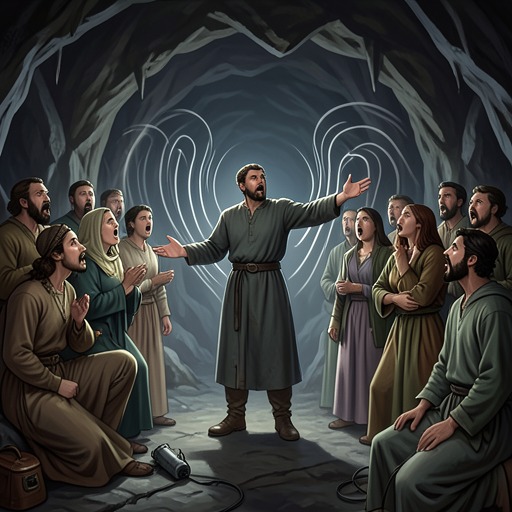
Hell is repeatedly figured through closed and subterranean architecture. One approach runs through a steep, yawning cave beneath arches formed by yews, then through silent labyrinths whose winding passages intensify the sense of disorientation and entrapment. At another threshold stands a lofty adamantine gate enclosing a tower of brass; the Furies sit before it, their misshapen forms making the entrance itself an image of terror. Hell therefore operates as both landscape and institution: its caves conceal, its labyrinths delay, its gates exclude, and its guardians enforce the separation between the living and the dead.
The architecture also gives Hell a graduated horror. Before any monster or punishment is fully confronted, the traveller encounters descent, silence, obscurity, and uncertain passage. The revealed forms of the Furies then make the latent threat visible. This movement from unseen depth to monstrous guardianship makes the underworld frightening not merely because it contains suffering, but because it subjects every entrant to a space whose scale, laws, and inhabitants exceed mortal control.
The Dead and the Routes of Descent
Hell is the destination of the dead and the imagined opposite of the upper world, yet the text presents it as permeable under exceptional conditions. After Eurydice dies from the bite of a venomous viper, Orpheus spends a long period mourning her. Love and despair drive him onto the Tenarian road, where he dares to pass among the gliding spectres of the buried and the phantom people of the world below. His journey makes Hell a place of attempted recovery as well as final separation: the living may enter it, but only by confronting the dead on their own ground.
Orpheus seeks Persephone and the ruler of the underworld, turning the descent into a petition before sovereign powers. The scene establishes that Hell is governed, not empty. Its inhabitants and rulers represent a jurisdiction that even grief cannot simply overrule, so Orpheus’s passage becomes a test of whether love can negotiate with death. The underworld’s power lies precisely in its capacity to make loss present while still refusing to make restoration secure.
Punishment, Confinement, and Moral Order
Hell is also a place where violence is transformed into confinement. When Jupiter abandons the weapons of direct destruction and seeks a safer punishment, he resolves to pour down a watery deluge and drown what he had not dared to burn. Although the flood belongs to the upper world, the logic is continuous with Hell’s: overwhelming power is administered through enclosure, submersion, and the removal of escape. Hell thus forms part of a wider punitive geography in which divine authority reshapes the environment to contain or erase human disorder.
The Furies at the adamantine gate sharpen this punitive dimension. Their placement before a tower of brass associates the underworld with unyielding material, locked structures, and forces that do not yield to ordinary appeals. Hell is not simply where the wicked are imagined to suffer; it is the architectural expression of a cosmic order that converts transgression into boundaries, guardians, and irreversible consequences.
Grief, Burial, and Transformation
The underworld’s presence extends beyond its own gates into mortal acts of mourning. The dead youth Phaethon lies struck by thunder, and the Latian nymphs gather around his smoking body in astonishment. His death becomes the occasion for transformation rather than a completed return to ordinary life, as grief passes into the altered forms of those who remember him. Hell is not always named as the destination of such deaths, but its shadow is present in the repeated problem of what communities do with bodies that cannot simply be restored.
The same tension appears when the ashes of Pyramus and Thisbe are requested for confinement in one urn. Their parents are asked to preserve the lovers together after death, converting separation into a material memorial. Burial, cremation, urn, and transformed body become competing ways of negotiating the border Hell represents: the dead cannot be brought back unchanged, but their identities may persist through objects, plants, ritual, or communal memory.
The funeral of Memnon develops this memorial function on a larger scale. When his limbs are laid upon the pyre, his mother directs her flight toward the heavens while the funeral rite proceeds below. Each year, at the appointed time, the champion birds appear again in fresh array, prepared with vengeful minds and returning for Memnon’s sake. Hell’s finality is therefore countered by recurrence: death remains real, but mourning generates a ritual cycle in which memory repeatedly re-enters the visible world.
Narrative Significance
Hell is the book’s great boundary-space between alteration and extinction. The underworld gathers the dead, but it also makes possible journeys, petitions, punishments, and failed returns. Its caves and labyrinths externalize the difficulty of moving through grief; its gates make moral exclusion visible; its spectres preserve the dead as presences who can still be encountered; and its funerary echoes show how communities transform irreversible loss into remembrance.
Against the changing bodies and landscapes that dominate the larger world, Hell supplies a darker counterimage: a realm where movement is restricted, thresholds matter, and consequences accumulate. Yet even there, transformation continues. The dead become spectres, ashes become memorials, grief becomes song or ritual, and annual birds renew an old conflict. Hell consequently signifies not simple annihilation but the difficult afterlife of events—the point at which death closes one form of existence while opening a persistent, haunted relation between the lost and the living.