Icarus
Metamorphoses (Ovid Edition)Icarus is the young son of Daedalus and the tragic focus of the escape by wings that Daedalus constructs. He embodies the danger of exuberance unchecked by judgment: the invention succeeds, but Icarus’s desire to rise higher than instructed transforms a route to safety into a fall and a permanent emblem of overreaching.
Identity and Background
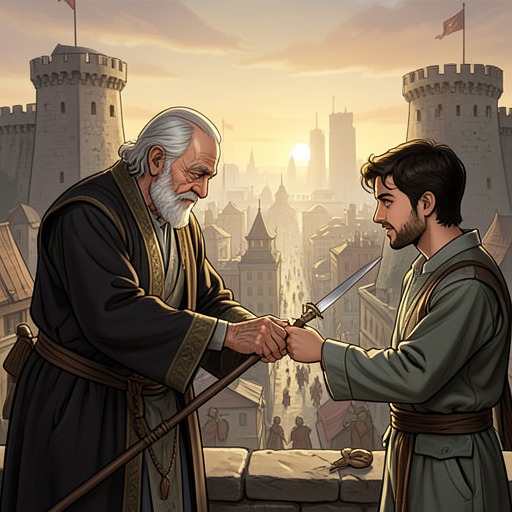
Icarus appears beside Daedalus while his father prepares the artificial wings. He is described as a boy, still unthinking of the fate that awaits him, whose attention is captured by the feathers floating and moving in the air. The scene establishes him through curiosity and delight rather than through speech or prior achievement. His youth matters because the device before him is both marvelous and perilous, while his understanding has not yet caught up with the freedom it promises.
Daedalus’s invention is carefully made: feathers are compacted and bent until the composition becomes real wings. Icarus therefore enters the story at the point where craft has become transformation. He is not the inventor, but he is the person most susceptible to the intoxicating possibilities of the invention. The wings offer an image of escape, yet they also demand discipline; Icarus receives the benefit of his father’s skill without possessing the same measured command of its risks.
The Flight and the Forbidden Height
Before the flight, Daedalus gives Icarus a precise rule. He must guide his course along the middle air. Flying too low would allow the surges to wet and weaken the feathers, whereas flying too high would expose the wings to excessive heat. The instruction defines a narrow middle path between two forms of danger, making moderation not an abstract virtue but the practical condition of survival.
At first Icarus follows the opportunity opened by the wings, but the boy’s thoughts soon aspire to loftier aims. He grows wild and wanton in flight and, emboldened, rises higher. His movement is therefore a self-generated escalation: the danger does not begin with the failure of Daedalus’s workmanship, but with Icarus’s abandonment of the course his father prescribed. The image of increasing height also gives the episode its dramatic direction, as exhilaration carries him away from the safe center.
The flight’s tragedy lies in the contrast between instruction and impulse. Daedalus understands that both extremes are fatal and offers Icarus a balanced route; Icarus treats the open sky as an invitation to exceed that limit. His error is not merely that he flies, but that he confuses greater elevation with greater freedom. The same wings that make escape possible become the instrument of his ruin when his ambition outruns his judgment.
Relationships and Conflict
Icarus’s decisive relationship is with Daedalus, whose role combines father, inventor, instructor, and protector. Daedalus does not simply give his son wings; he gives him a method for using them and warns him about the separate consequences of flying too low or too high. The father’s care is expressed through technical knowledge and a rule of proportion, while Icarus’s response is enacted through increasingly adventurous movement.
The conflict between them is not presented as a prolonged argument. It is built into the flight itself. Daedalus’s spoken instruction remains a governing framework, but Icarus’s childish aspiration gradually displaces it. The episode thus turns a parental warning into a test of obedience under conditions of wonder, where the visible vastness of the sky makes restraint difficult to maintain.
Icarus also functions as Daedalus’s vulnerable counterpart. Daedalus can design and regulate the wings; Icarus experiences them as an exhilarating extension of his own body. Their shared flight begins as an escape undertaken together, but their different responses to the same invention separate them morally and physically: the father preserves the middle course, while the son rises beyond it.
Change and Ending
Icarus changes from an eager observer of the floating feathers into an emboldened flyer who abandons the prescribed height. The evidence presents this change as rapid and behavioral rather than as a long psychological development. His childish thoughts aspire upward, his flight becomes increasingly uncontrolled, and the initial wonder of the wings is converted into fatal excess.
His ending is foreshadowed by the very warning meant to save him. Daedalus identifies the hazards at both boundaries, and Icarus’s decision to pursue the loftier one makes the consequence structurally inevitable within the episode’s moral design. The flight consequently becomes a tragedy of reversal: an instrument created to free the pair from confinement carries Icarus toward destruction.
Icarus’s transformation is chiefly symbolic rather than supernatural. He does not become another creature or gain a new divine status; instead, his identity is fixed by the consequences of his ascent. The boy who delighted in feathers becomes the cautionary figure produced when daring rejects the middle way. His story ends not with a recovered balance but with the irreversible cost of treating a limit as a challenge.
Narrative Role and Significance
Icarus gives the episode its clearest articulation of the conflict between invention and self-command. Daedalus’s craft demonstrates that human ingenuity can cross boundaries, but Icarus demonstrates that technical possibility does not abolish the need for judgment. The narrative makes the danger concrete through the flight’s vertical structure: too low is hazardous, too high is hazardous, and survival depends on remaining between them.
As a character, Icarus is deliberately concentrated around one decisive trait: youthful aspiration that becomes reckless excess. His brevity intensifies rather than diminishes his importance. The story does not need an extended biography because the single movement from curiosity to emboldened ascent supplies a complete tragic arc, joining a recognizable human impulse to a sharply defined consequence.
His role also belongs to the recurring pattern of metamorphic narrative in which a change of state exposes the cost of desire. Elsewhere, transformation may preserve a figure, punish a transgression, or create a new natural form; Icarus’s episode instead makes failed transformation the central spectacle. Wings promise a new condition of being, but the attempt to inhabit that condition without restraint ends in collapse. The result is a durable image of ambition severed from proportion, with the father’s middle course standing as the lost measure against which the son’s fall is understood.