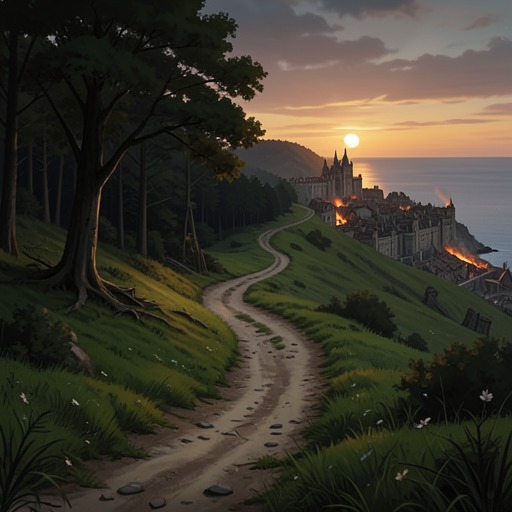
Iron Age
Metamorphoses (Ovid Edition)The Iron Age marks the terminal decline of human society in the poem’s sequence of world ages. Hard steel replaces the softer materials associated with earlier times, and humanity becomes morally as stubborn as the metal it employs. Truth, modesty, shame, faith, piety, justice, hospitality, and communal ownership give way to fraud, avarice, force, warfare, private boundaries, and betrayal. The age is therefore not merely poor or technologically harsh: it is a transformation of the social order in which material power and possession overrule inherited obligations.
Definition and Place in the Ages of Man
The Iron Age follows the earlier stages of human history as the most degraded condition described in the poem. Its arrival is announced through the succession of hard steel and hardened men: the metal is both an instrument of violence and a moral image of those who wield it. The change is presented as collective rather than confined to one ruler or one nation. Human beings as a whole abandon the restraints that had once made social life possible, turning the age into a general history of ethical disintegration.
The passage gives the Iron Age a strongly cumulative structure. It begins with the abandonment of inward virtues, proceeds to the invention of boundaries and aggressive enterprise, and culminates in weapons, gold, domestic treachery, and the withdrawal of Justice from the world. Each development makes the next one possible. Once shame and truth have been forsaken, force and fraud can become ordinary methods of action; once common possession has disappeared, property can be defended through violence.
Property, Exploration, and the End of the Common World
The Iron Age introduces a new conception of land. Markers are set out to limit each person’s right, whereas previously the earth had been held in common, open to all as light is open to all. This is a decisive change in the poem’s social imagination: the ground itself has not changed, but human beings have converted shared existence into exclusive possession. Boundaries make ownership visible, and ownership creates reasons for conflict.
The same age turns outward toward conquest and exploitation. Sails are spread to every wind, and trees are hollowed into vessels able to sustain the waves, even before ships formally plough the water in triumph. Navigation is thus linked to the Iron Age’s appetite for expansion. The sea becomes a route by which people leave their proper limits, pursue distant gains, and extend the reach of possession. The image of ships advancing across the water carries both technical ingenuity and moral unease: mobility serves not fellowship but acquisition.
The poem’s contrast between the rudimentary hollowed tree and the later triumphant ship also compresses a history of escalation. What begins as a means of floating becomes an instrument for ambitious travel and competition. The Iron Age is consequently defined by an energetic, inventive restlessness, but that energy has lost any ethical measure. Progress in movement accompanies regression in conduct.
Steel, Gold, and Social Violence
Steel and gold are the age’s paired substances. Steel gives mischief the means to act, while gold gives it motive, boldness, and reach. The poem calls both cursed, presenting them as forces that generate wrongdoing rather than neutral objects merely misused by individuals. Steel assaults the body openly; gold betrays through hidden calculation. Together they produce a double death, combining visible attack with concealed corruption.
The threat becomes public when weapons glitter in human hands. This is not an isolated act of violence but the visible sign that mankind has broken loose from moral bonds. Armed conflict has become normalized, and the gleam of the weapon functions as a compact emblem of the age: beauty of appearance is joined to lethal purpose. The material brilliance of steel also echoes the allure of gold, binding spectacle, desire, and danger into one image.
The breakdown reaches intimate life. A stepmother prepares poison for her son, while a son inquires into the years of his father, suggesting suspicion, hostility, or self-interested calculation within the family itself. The household, which might have preserved trust against public disorder, reproduces the age’s violence internally. The poem therefore moves from war and commerce to kinship in order to show that corruption has penetrated every scale of existence.
The Withdrawal of Moral Law
Faith flees, piety mourns in exile, and Justice, oppressed on earth, returns to Heaven. These personified abstractions turn the Iron Age into a cosmic as well as social crisis. Moral order is not simply ignored by a few transgressors; it is displaced from the human world. The return of Justice to Heaven indicates that the earth has become inhospitable to the principle that should govern it.
This ending gives the age its deepest irony. Human beings acquire greater command over metal, land, and the sea, yet lose the virtues that make power legitimate. They can mark boundaries, build vessels, brandish weapons, and pursue gold, but they can no longer maintain hospitality or trust. The Iron Age’s historical movement is thus a reversal: external capability expands while the moral conditions of community contract.
The Iron Age as a Pattern of Decline
As an expression, “Iron Age” names more than a period characterized by a particular substance. It is a compact allegory of hardening. Steel becomes the figure of stubbornness, gold the figure of acquisitive desire, boundaries the figure of exclusion, and the departing Justice the figure of a world whose ethical center has been abandoned. The age’s separate symptoms—fraud, avarice, force, weapons, private claims, poisoned kinship, and lost hospitality—belong to one connected pattern.
The passage also establishes a recurring logic for later episodes in the poem. Human promises, prayers, oaths, violence, and appeals to divine authority repeatedly test whether language and moral obligation still possess force. Against the Iron Age’s betrayal, appeals to Themis, sworn commitments by the Styx, and challenges invoking lost honor become significant because they preserve, recover, or contest forms of binding order. The Iron Age provides the bleak social background against which such acts of judgment, supplication, loyalty, and retribution acquire their weight.
Its decisive significance lies in the fusion of physical transformation and moral transformation. The world has not simply entered an age of iron; human beings have become ironlike in conduct, while gold teaches them to betray. The final image is not a single catastrophe but the evacuation of the principles that once restrained catastrophe: when faith and piety depart and Justice returns to Heaven, the age’s violence is revealed as the outward form of an inward loss.