Juno
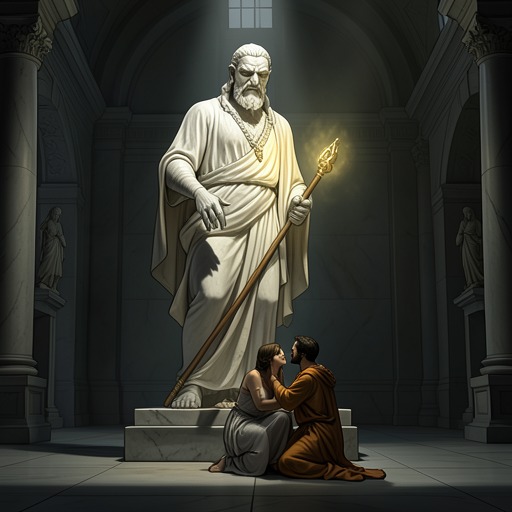
Metamorphoses (Ovid Edition)Juno stands in the poem as the Queen of Heaven, a divine power whose jealousy is both personal emotion and political force. She surveys the world from above, detects rivals and violations, and acts against them with an anger that can descend from the celestial realm into mortal and infernal scenes. Her interventions make her a recurring agent of conflict: she protects her status by opposing competing women, illicit desire, and claims that challenge the order of gods and families.
Identity and Divine Authority
Juno’s authority is presented through rank and genealogy. She is identified as the Queen of Heaven, yet her grandeur does not place her beyond passion; the narrative explicitly shows her acting to gratify hatred and soothe immortal wrath. Her divinity is therefore double-edged. She possesses cosmic standing, but that standing is repeatedly expressed through intensely personal responses to rivalry and insult.
Her sense of legitimacy also rests on lineage. In one speech, a figure invokes descent from Tantalus, described as the only mortal ever admitted to the feast of the gods, showing how divine and aristocratic status are argued through ancestry and proximity to the Olympian order. Juno’s own importance similarly depends on a hierarchy in which birth, marriage, and divine privilege authorize judgment over lesser beings. The poem uses her presence to connect private resentment with the larger mechanisms of celestial power.
Surveillance and Rivalry
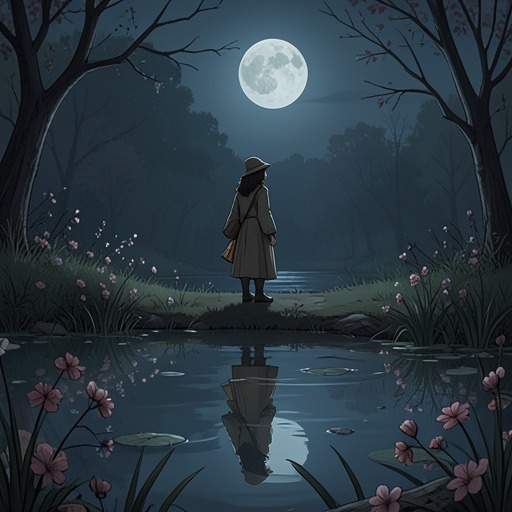
Juno’s first decisive action in the supplied episodes is an act of watchfulness. From above, she surveys the fruitful fields of Arcadia and notices that mist has spread across them. The landscape becomes legible to her as evidence: concealment itself arouses suspicion. Her gaze is not passive observation but the beginning of intervention, turning weather, fertility, and obscurity into signs of a rival’s presence.
That rivalry becomes even more visible when she sees a competing woman elevated among the stars. The rival appears in celestial form, spangled with stars and circled with light; instead of accepting the transformation as a completed escape from mortal danger, Juno seeks out old Ocean in the deep waters. The scene places the goddess’s jealousy against the scale of the heavens. A change of body and a new constellation do not end the conflict, because Juno’s gaze follows the rival beyond the earth and into the night sky.
The episode establishes a characteristic pattern in Juno’s characterization: metamorphosis changes the object of persecution without necessarily extinguishing the grievance. The rival’s elevation gives her a new radiance, but that radiance also makes her easier to recognize. Transformation thus becomes both protection and renewed exposure, while Juno’s surveillance gives the heavens the atmosphere of a contested political space.
Hatred, Punishment, and Descent
Juno’s wrath can drive her downward from the realm of daylight into the realm of night. The poem describes the Queen of Heaven descending to the lower regions in order to satisfy her hatred, emphasizing the extremity of an immortal anger that overcomes even the distance between divine heights and the underworld. Her movement is not merely geographical. It dramatizes the way resentment crosses boundaries that should separate celestial order from darkness, public sovereignty from private vengeance.
The descent also gives Juno a distinctly dramatic function. She does not simply represent an abstract prohibition; she becomes the force that carries punishment into hidden or forbidden spaces. Her anger supplies the pressure under which secrecy, desire, and family order are exposed. In this sense, she belongs to a recurring pattern of pursuit and revenge: an offended power identifies a transgressor, refuses concealment as a final refuge, and transforms the offender’s private act into a public catastrophe.
Desire, Kinship, and the Limits of Choice
The supplied stories repeatedly place Juno’s world beside conflicts over marriage, bloodline, and forbidden love. A young woman is told that neighboring monarchs, led by her beauty, compete in crowds for her marriage, and that the world is open to her choice except for one man. The prohibition is framed through social and dynastic pressure: many acceptable suitors are available, while one relationship is excluded because it violates the structure of kinship.
Against that prohibition, the woman declares that her beloved Caunus wishes her to grant the health only she can give him. Her language turns desire into a plea for life, but the emotional urgency does not erase the incestuous boundary surrounding the request. Juno’s broader narrative role is illuminated by this contrast. Divine jealousy and human forbidden love both arise where possession, kinship, and sexual choice collide; the difference is that Juno enforces hierarchy from above, while mortal characters experience its prohibitions as intimate confinement.
The same tension appears in the story of Myrrha and Cinyras. After the fatal secret has been brought to completion, Myrrha presents herself to Cinyras with the words, “Receive thy own,” and the two bodies join in a union that the poem marks as accursed. The phrase makes kinship itself the instrument of horror: what is returned to the father is not an ordinary gift but the daughter’s concealed identity. Juno is not the direct agent in this scene, but it belongs to the same moral and dramatic field in which hidden desire violates family order and produces irreversible transformation.
Narrative Role and Significance
Juno functions less as a single-episode protagonist than as a recurring architecture of opposition. She watches from above, interprets concealment as threat, pursues rivals across changes of form and place, and descends into darkness when hatred demands action. Her motives are not presented as detached justice. The poem foregrounds jealousy, hatred, and immortal wrath, making divine authority inseparable from affect.
Her presence also sharpens the poem’s central interest in metamorphosis. Bodies may become mist, stars, or other forms; lovers may attempt to evade social law through secrecy; yet transformation does not guarantee freedom. Under Juno’s gaze, alteration can preserve the memory of rivalry while giving it a new surface. The goddess represents the persistence of grievance through changing appearances, and her repeated interventions show that the world of the poem is governed not only by physical change but by emotions powerful enough to pursue their objects across earth, sky, and the realm of night.