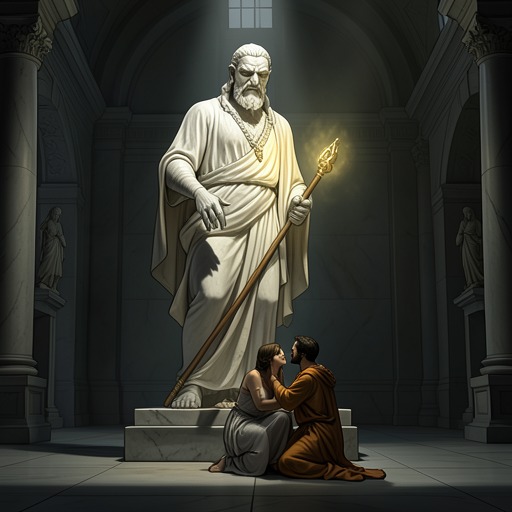
Jupiter
Metamorphoses (Ovid Edition)Jupiter is the poem’s supreme god and governing intelligence: a ruler who oversees the ordering of the cosmos, judges violence among mortals, binds himself through divine oaths, and stands behind the succession from mythic metamorphosis to Roman power. His authority is not presented as abstract omnipotence alone. It operates through decisions about bodies, punishments, promises, rescue, kingship, and divine remembrance, making Jupiter the central figure through whom disorder is repeatedly converted into a new arrangement.
Cosmic Sovereign and Judge
When the universe has been formed and its parts made to agree, Jupiter appears as the god who surveys the finished order and measures the conduct of the world against it. His rule therefore has a double character: he is both guarantor of cosmic proportion and an active judge of earthly behavior. Looking down from above, he recalls what he has recently discovered on Earth while observing an impious, arrogant, and cruel brood. The memory of human violence becomes the basis for divine deliberation, showing that Jupiter’s sovereignty depends not only on creation but also on continued scrutiny and correction.
This judicial role places Jupiter at the intersection of nature and politics. The world’s parts may be harmonized, yet human communities repeatedly generate arrogance, cruelty, and disorder. Jupiter responds by treating moral corruption as a threat to the larger structure he governs. The contrast between the ordered cosmos and the violent human brood gives his authority an ideological foundation: divine power appears necessary because earthly power has failed to restrain itself.
Oaths, Promises, and the Management of Bodies
Jupiter’s authority is also exercised through speech that becomes binding law. In the episode involving his son, he acknowledges the relationship and declares the son worthy of that name. As proof, he offers to grant whatever request is made and swears by the Styx, whose waters are hidden in darkness. The oath is more than ceremonial emphasis. By invoking the Styx, Jupiter turns paternal recognition into an irrevocable commitment, and the promise later becomes inseparable from the tragic consequences of granting what has been asked.
Across the poem’s stories, Jupiter’s sphere of influence is repeatedly marked by bodily transformation. The transformation of Daphne into a laurel, the transformation of Io into a heifer, and the story of Calisto all belong to a narrative world in which divine power changes identity by changing form. The episodes do not establish a single mechanical pattern: transformation may protect, conceal, punish, expose, or preserve. Yet Jupiter’s presence in this network makes visible the political dimension of metamorphosis. Bodies become the medium through which divine desire, jealousy, concealment, and judgment are written into the natural world.
The story of Calisto is particularly revealing because the huntress’s body becomes the site of public exposure and forced exclusion. Her companions undress her despite her reluctance, revealing the pregnant womb she has tried to conceal. Jupiter’s wider mythic authority thus exists beside a recurring vulnerability in the bodies subject to divine and social power. The poem’s transformations can offer escape from one condition, but they can also make private circumstances permanently visible as animal, plant, constellation, or other altered form.
Desire, Conflict, and Divine Consequence
Jupiter belongs to the poem’s recurring structure of desire followed by concealment, pursuit, and transformation. The stories surrounding Daphne and Io show how divine relations disturb the boundary between personal desire and cosmic authority. In one, a beloved becomes a laurel; in another, Io becomes a heifer. These changes preserve life or identity in altered form, but they also reveal that divine intervention rarely leaves the original human situation intact. Jupiter’s power can prevent one immediate danger while creating a lasting condition that reshapes the subject’s place in the world.
The same instability governs the story of Salmacis and Hermaphroditus, where the body is softened and its limbs unnerved before identities are fused. Jupiter is not the direct agent of every metamorphosis, but his position as chief god makes him the clearest emblem of the poem’s larger divine economy: gods act upon mortal and semi-divine bodies, and the results are neither simple deaths nor simple survivals. What remains is altered continuity, a life carried forward in a form that records the violence or desire that produced it.
The story of Venus and Adonis adds another register to this divine order. Cupid’s arrow wounds Venus, while Venus’s desires and pains become linked to revenge against her mother’s fires. The episode demonstrates how divine actions circulate through a family and cosmic network rather than remaining private. Jupiter’s world is governed by transmitted consequences: an arrow, an oath, a judgment, or a desire can travel beyond its first target and produce transformations, grief, or retribution elsewhere.
From Mythic Rule to Roman History
Jupiter’s authority remains active as the poem approaches Rome. After Tatius is slain by Lavinian fury and Romulus continues to reign, the warrior Mars puts on his burnished helmet and addresses Heaven’s imperial throne. This scene places Jupiter at the summit of a political universe in which martial force, kingship, and divine government are formally connected. The heavenly throne is not detached from history; it is the point toward which Roman power directs its appeal and from which its significance is measured.
The fifteenth book then turns explicitly toward Numa, the foundation of Crotone, the doctrines of Pythagoras, the death of Numa, Hippolytus, Cipus, Asclepius, and the apotheosis of Julius Caesar. Jupiter’s presence in this transition helps maintain continuity between mythic metamorphosis and Roman state formation. The poem does not abandon divine causation when it begins to narrate institutions and historical rulers. Instead, Rome’s political development is placed within the same field of elevated authority that has governed the earlier transformations.
The arrival of Asclepius at Rome demonstrates the practical side of this sacred politics. The drooping city ceases to mourn; joy is restored and health returns. Yet Asclepius is described as a foreign power, while Caesar is adored in his own city. The contrast separates imported divine aid from native political reverence. Jupiter’s order can accommodate both, but it also ranks them: healing saves the city, whereas Roman identity seeks its own object of worship within its civic and dynastic history.
Divine Descent and Imperial Apotheosis
The poem’s final political movement requires that a great ruler not appear to rise from an ordinary mortal stem. The speaker therefore invokes a beautiful goddess who bore Aeneas, connecting Roman greatness to divine ancestry. In this framework, Jupiter’s sovereignty authorizes the transformation of political lineage into sacred genealogy. Rule becomes more than inheritance or conquest: it is presented as the visible continuation of a heavenly order.
The culminating image is the elevation of Julius Caesar’s spirit. Fresh from his wounds, the spirit is to be carried upward and changed into a star, so that Julius may assume divine rites. This apotheosis repeats the poem’s basic logic on an imperial scale. A mortal body suffers violence; the spirit is separated from it; alteration prevents disappearance; and the new celestial form becomes an object of public ritual. Metamorphosis here is no longer merely a response to desire or punishment. It becomes the mechanism by which political memory is made permanent.
Jupiter’s importance lies in this capacity to join incompatible realms without erasing their tension. He presides over the agreement of cosmic parts, yet his stories contain coercion, exposure, grief, and irreversible bodily change. He is a judge of cruel humanity, a father bound by the Styx, and the sovereign of a divine order that eventually legitimizes Roman kingship and Caesar’s star-like immortality. Through him, the poem’s transformations become a continuous history of power: bodies change, identities persist in altered forms, and earthly rule seeks confirmation in the heavens.