Lapiths
Metamorphoses (Ovid Edition)The Lapiths are a Thessalian people most prominently associated with the wedding of Perithous, the son of Ixion, and Hippodame. Their decisive narrative significance lies in the transformation of a communal marriage feast into a battlefield: the Lapiths embody ordered human society, while the Centaurs bring a destabilizing mixture of human form and bestial impulse into the celebration. Their collective response converts outrage into organized resistance and makes the feast a founding scene of conflict between social law and violent appetite.
Identity and Setting
The Lapiths appear as a named community gathered at a wedding feast. The celebration takes place in a cool cave whose entrance is shaded by spreading trees, a setting that initially suggests enclosure, shelter, and fellowship rather than warfare. Perithous summons the Lapiths to join the wedding company, and their presence establishes the feast as a public occasion binding kin, allies, and guests together.
Their identity is therefore introduced through participation in a social ritual. They are not presented first as solitary heroes or as an abstract army, but as a people entering a shared celebration under the obligations of hospitality. The wedding joins Perithous and Hippodame in marriage, while the assembled community gives the union its social audience and legitimacy.
The Wedding Feast and Its Breakdown
The Centaurs, described as a cloud-born race half human and half beast, attend the feast alongside the Lapiths. Their physical hybridity is matched by their behavior. Instead of remaining within the limits of ceremonial guesthood, they seize women during the celebration, and the feast becomes an image of a captured town. The comparison is crucial: a space intended to confirm alliance is suddenly treated as territory to be raided.
The Lapiths experience the collapse of hospitality through the women’s cries. The narrative marks the turning point collectively: the cave resounds with female shrieks, and the assembled men rise, driven by the desire for swift revenge. The Lapiths’ transition from guests at a marriage to combatants is thus caused by a direct violation of the feast’s social order, not by an already declared military dispute.
Collective Resistance and Conflict
The Lapiths’ response is organized through confrontation rather than passive grief. Theseus speaks first, demanding an explanation for the madness that has seized the attackers. His intervention gives verbal form to the crisis before violence fully unfolds, but the question also reveals that the Centaurs’ conduct has crossed from ordinary rivalry into incomprehensible brutality.
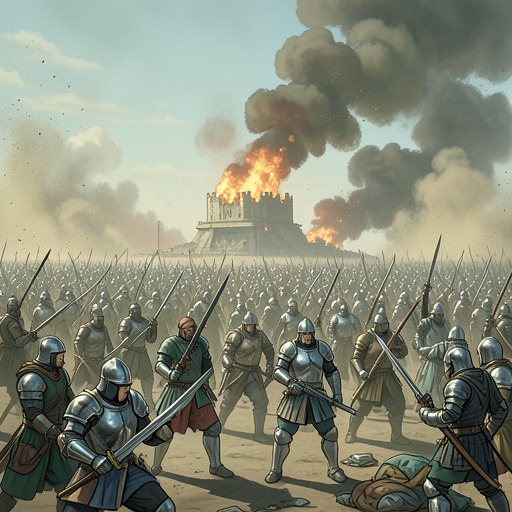
The ensuing conflict is a skirmish between the Centaurs and the Lapiths. The Lapiths function as the defending side: their immediate objective is to protect the women, restore the violated boundaries of the feast, and answer the seizure with force. The scene’s dramatic structure follows a rapid reversal from invitation to assault, from music and communal joy to cries, pursuit, and revenge. In that reversal, the Lapiths become the collective agents of restored order.
The conflict also establishes a sharp opposition between human and bestial conduct without making the boundary entirely secure. The Centaurs possess human bodies in part, speak and move within human society, and are admitted as guests; nevertheless, their behavior converts bodily mixture into social danger. The Lapiths’ resistance seeks to reassert the distinction between a protected human community and violence that treats persons as spoils.
Narrative and Thematic Significance
The Lapiths’ story is one of the book’s clearest examples of a recurring metamorphic logic in which an established order is disrupted and then redefined through crisis. Unlike stories centered on a single transformation of body or form, the Lapith episode transforms the meaning of a place and ceremony. The cave changes from a sheltered wedding hall into a warlike space, and the wedding party becomes an armed community.
Their episode also gives communal form to the theme of violated limits. The Centaurs’ offense is simultaneously sexual, social, and political: women are taken, hospitality is betrayed, and a marriage feast is made to resemble the sack of a city. The Lapiths’ collective action answers all three injuries at once. Their importance lies less in individually described deeds than in the way they make a community visible at the moment it must defend its laws.
The Lapiths therefore stand in structural contrast to the Centaurs. The latter represent appetite released from restraint; the Lapiths represent solidarity summoned by an attack on shared norms. Their wedding feast shows that civilization is not guaranteed by ritual alone. Its ceremonies can be overturned in an instant, but the community can also gather itself through recognition of the violation, appeal to justice, and collective resistance.