Latium
Metamorphoses (Ovid Edition)Latium is presented as the Italian ground where wandering heroes, local kings, divine intervention, and Roman expansion converge. The region is not merely a setting but a historical and sacred territory: the Tiber flows through it, plague threatens its people, foreign divinity is welcomed into its shrines, and the succession of Aeneas, Romulus, and Julius Caesar turns its landscape into the stage of Rome’s destined greatness.
Geography and Imperial Setting
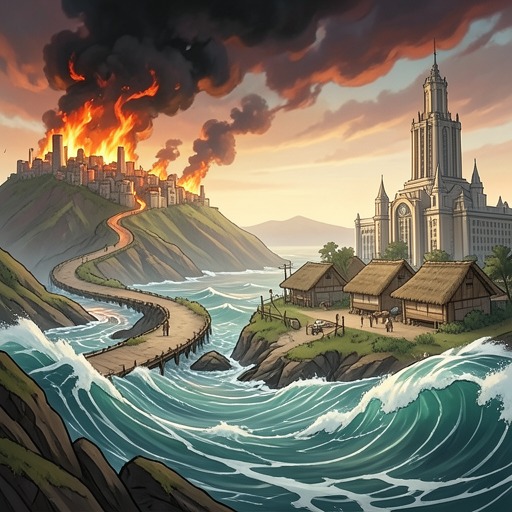
Latium is associated directly with the Tiber, whose waters run majestically toward the sea and enrich the surrounding countryside. This riverine landscape gives the region both physical fertility and political promise. The Tiber is not described as an isolated natural feature; it marks the territory in which heroic migration becomes settlement and in which the future Roman state takes shape.
The region’s importance is therefore geographic and dynastic at once. After Aeneas’s wanderings, his divine patrons grant him Lavinia and the throne of Latinus, but the inheritance is won only through war. Latium becomes the place where marriage, kingship, and armed conflict are fused: Aeneas’s arrival does not end struggle but establishes the lineage from which Roman sovereignty will proceed.
Aeneas and the Founding Line
Aeneas’s connection with Latium is presented as the beginning of a sanctioned succession. His wishes are crowned with Lavinia and Latinus’s throne, yet the prize is explicitly inseparable from warfare. The region thus receives its future ruler through a process that combines divine favor with military achievement, making conquest part of the sacred logic of Roman foundation.
The later narrative places Ascanius in command of the Latin scepter after Aeneas’s deification. Latium consequently functions as a bridge between the heroic past and the organized state: Aeneas establishes the line, Ascanius carries forward its authority, and the territory becomes the hereditary ground from which Rome’s power can grow.
Divine Presence and Public Crisis
Latium also appears as a vulnerable community requiring supernatural aid. A wasting plague infects its skies, and the region’s people suffer until Asclepius arrives as a foreign power. His presence transforms the political geography of Latium: the healer is brought into its sacred and civic center, his godhood is recognized in Roman shrines, and the city’s mourning gives way to restored health and joy.
This episode makes Latium a place where foreign divine power is absorbed into Roman religious identity. Asclepius is initially marked as an outsider, but his arrival is justified by the practical salvation he brings. The region’s recovery depends on accepting a heavenly stranger, while the restoration of public health converts religious incorporation into a visible political benefit.
Kingship, Rome, and Cosmic Legitimacy
The Fifteenth Book opens with the search for a ruler to guide the growing state, placing Latium within a larger narrative of political formation. The problem is not simply who should govern a city; it is how an expanding society can receive legitimate direction. The region’s earlier heroic inheritance now develops into an explicitly civic and constitutional concern.
Romulus’s reign and martial authority further connect Latium with the divine foundations of Roman rule. Mars appears in burnished armor and addresses the imperial throne of Heaven, framing the lower world’s political transformation within a celestial order. Latium’s history is consequently narrated as more than local succession: its rulers and institutions participate in a hierarchy that joins warfare, sovereignty, and the gods.
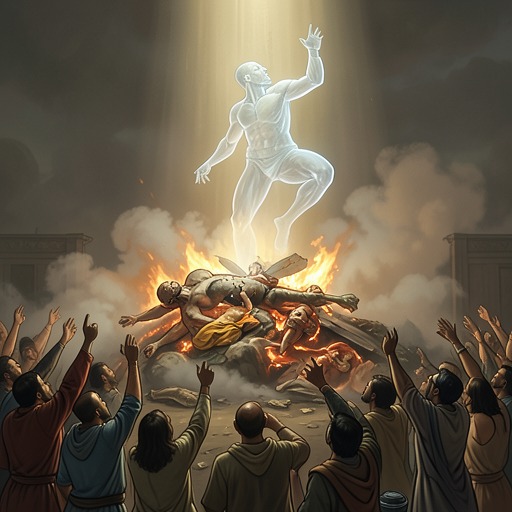
The same logic reaches its most direct expression in Julius Caesar. The beautiful goddess who bore Aeneas is invoked as Caesar’s divine ancestry, preventing the ruler from appearing to arise from merely mortal stock. Caesar’s spirit, fresh from his wounds, is to be carried upward and changed into a star, so that Julius assumes divine rites. Through this apotheosis, Latium’s foundational lineage extends from Aeneas through Rome’s rulers to imperial deification.
Narrative Significance
Latium concentrates the poem’s movement from transformation in nature to transformation in history. The work begins by singing of bodies changed into various forms, but its Roman conclusion turns change toward political permanence: wandering becomes settlement, succession becomes empire, a foreign god becomes a Roman object of worship, and a wounded ruler becomes a star.
The region also exposes the cost beneath imperial continuity. Aeneas receives his throne only after war; political order is born from conflict rather than replacing it. Yet the poem’s final movement presents Rome’s historical destiny as protected by divine ancestry and celestial recognition. Latium is therefore both a material landscape beside the Tiber and a narrative threshold where myth is reorganized into Roman memory, authority, and future greatness.
The poem closes by declaring that its work is finished and fears neither tempest, fire, war, nor wasting age. In that ending, Latium’s importance expands beyond its local geography. The region belongs to the chain of places through which Rome’s power is imagined, while the poem itself claims a durability parallel to the transformations it records: earthly kingdoms may change, but the story that gives Latium its imperial meaning is intended to endure.